Ground Picture – Shutterstock.com
At the beginning of 2025, IT trade press, search engines and manufacturer content were still the three central channels through which German IT decision-makers obtained information before purchasing decisions.
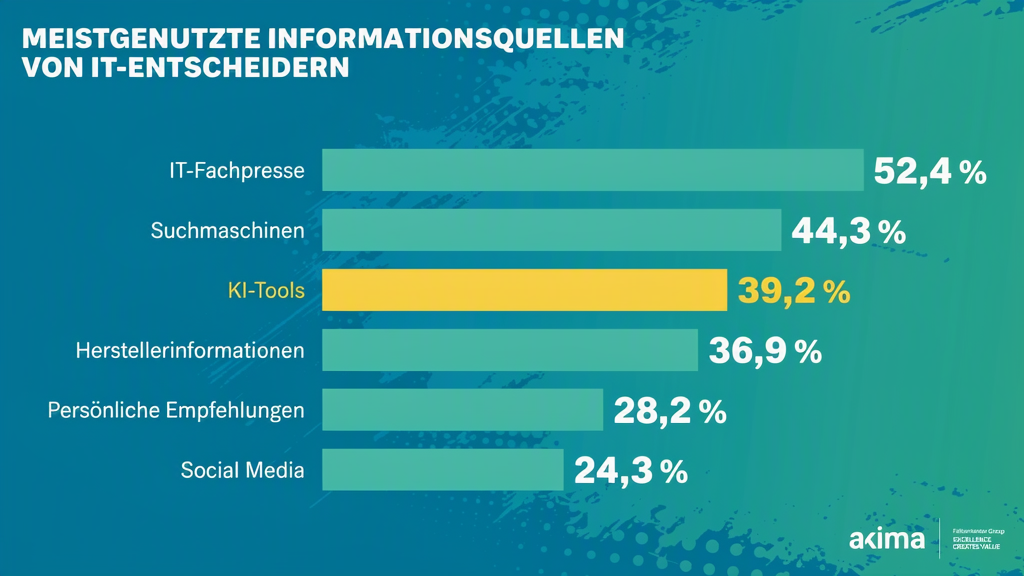
Just a year later, the situation has changed drastically: In a new survey by Akima Media among 309 IT decision-makers in German companies, AI tools moved from 9th place (2025) to 3rd place among the most used sources, thereby establishing themselves as new gatekeepers.
AI research is standard
90 percent of those surveyed by YouGov said they use at least one AI tool for professional research. At the same time, according to the study, more than a third now use ChatGPT, Gemini and Co. when it comes to specific investment decisions – in the previous year it was around 19 percent.
Overall, AI tools are in fifth place in the purchasing context – behind the IT trade press (45 percent), manufacturer information (44 percent), search engines (42 percent) and personal recommendations (35 percent). 37 percent of IT decision-makers said they had already contacted a provider because a language model recommended them.
What is particularly revealing is how far AI has already penetrated the evaluation process. According to the study, IT decision-makers use them for:
- the first orientation to a new topic (64 percent),
- the direct comparison of providers (47 percent),
- the preparation of shortlists (36 percent) and
- to identify exclusion criteria (35 percent).
“AI is already at the table when budgets are allocated – earlier than any sales representative ever could,” says Michaela Gross, co-CEO of Akima, commenting on the results.
The role of AI summaries is also interesting: for the slim majority (56 percent), these are often enough for an initial assessment – as a guide that guides further research. With a share of 27 percent, they rank ahead of content formats such as studies (26 percent), provider overviews (23 percent) or guides (20 percent) in terms of usefulness for IT decision-makers. Only technical articles (37 percent) and user reports (28 percent) are preferred.
Akima
Trust cannot be instantaneous
However, IT decision-makers do not trust AI blindly; the results are only used with reservations. For 70 percent of the IT decision-makers surveyed, the credibility of AI answers increases significantly when sources are cited – according to Akima, the highest approval rate of all the findings in this study. Comprehensible reasoning (47 percent) and verifiable references to sources (43 percent) are also strong trust drivers.
Almost half of the study participants (48 percent) also stated that they then validated the AI results using traditional research in specialist media or search engines.
When choosing a provider, visible specialists in the company have the strongest trust effect (36 percent), followed by verifiable reference customers (32 percent), certifications and partnerships (30 percent) and independent analyst ratings (29 percent).
According to the study, the IT trade press continues to hold its top position across all three dimensions of information behavior: regular use (52 percent), purchase context (45 percent), trust (40 percent). It remains the only channel that has both credibility and reach – while also serving as source material for AI answers.
The bottom line is that there is less change than one might think: the channels that IT decision-makers directly trust – specialist press, structured manufacturer information, well-founded case studies – are the same ones from which language models get their sources. Or as Akima manager Gross puts it: “The tools change, the currency remains. Quality can always be verified – through features that cannot be imitated: demonstrable expertise, verifiable references, consistent presence across all channels.”