With experience I can say that all the AI usage in Test Automation relies mostly on the Machine Learning techniques and prediction based analytics to identify bugs or security risks, experience from the previous test runs to improve the problem detection and even generate test scenarios automatically. Here I will try to simplify it further so that maximum Testers can understand the enhancements AI can offer in Automation and implement it in real time scenarios.
AI implementation in Test Automation
The AI enabled testing solutions as mentioned above have the capacity to develop test scripts on their own, learn from test results, and modify their testing approaches in response to changing behaviour of the application while Traditionally the Test automation used to depend on the scripts that needed continuous upgrades else they would become incapable of adjusting to shifting application functionality. On the other hand, artificial intelligence (AI) makes it possible to automate tests intelligently using tools like machine learning and natural language processing.
Test Case Generation Using AI
The future of automated test case generation in software testing lies in autonomous agents, predictive prioritization, and real-time requirement-to-test pipelines. AI using the behaviour or the pattern of testing to automatically analyse code, application behaviour and historical test data to identify the Critical Test Scenarios and provide thorough test cases using machine learning methods. This procedure improves test coverage and identifies any errors that manual testing could have overlooked. Software testing becomes more effective, accurate, and adaptable with AI’s help, resulting in higher-quality products and quicker release cycles. Below are some of the AI test case generation tools and frameworks available, the benefits they provide, and the operational risks to account for before integrating them
- AI test case generation uses natural language processing (NLP) and machine learning (ML) to automatically design and maintain tests from requirements and production telemetry.
- It converts manual test authoring into a continuous, model-assisted process that adapts with every code change and CI/CD deployment.
- Test case generation using generative AI predicts user flows, formulates scenarios, and produces executable scripts for faster validation.
- Reinforcement learning and static/dynamic code analysis are applied to refine test accuracy and relevance over time.
- Automated test case generation boosts test coverage, cuts maintenance overhead, and aligns QA with Agile and DevOps workflows.
- Key challenges include model drift, false positives, limited explainability and data privacy concerns each of which requires proactive governance and monitoring.
Bug Detection using AI
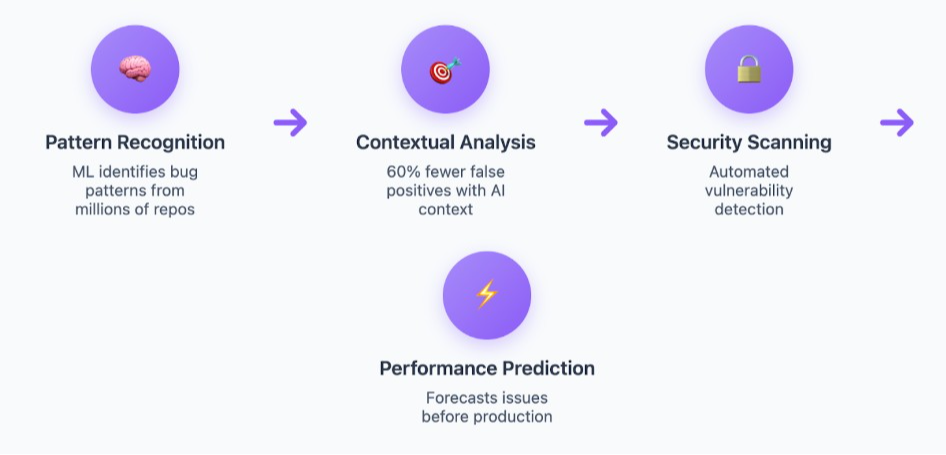
AI-powered testing tools can analyse enormous volumes of code and test data, making it possible for them to more quickly and correctly find errors, defects, and potential problems than traditional methods of testing The overall quality of the programme improves, and the development cycle can be sped up by AI’s ability to automate the issue discovery process and lessen the need for manual testing. AI has introduced multiple powerful approaches for Bug Detection
-
Predictive bug detection in software – AI predicts potential problem areas before errors occur. It uses historical bug data, code complexity analysis, and developer activity patterns. This reduces costly post-release issues.
-
AI-powered software testing tools – These tools scan codebases automatically. They learn from previous testing cycles and adapt detection strategies. They save testing time while improving accuracy.
-
Automated debugging with AI – AI-based debugging automates repetitive checks. It identifies faulty code segments with higher precision than manual methods. This leads to quicker defect discovery.
-
Machine learning for software bug fixing – Machine learning algorithms highlight unusual code behaviors. They classify errors and flag unseen defects. This ensures broader detection coverage.
-
Artificial intelligence for bug detection using NLP – AI interprets bug reports written in natural language. It converts these into actionable insights for developers. This reduces human error during report handling.
Bug Fixing Using AI
AI detects bugs by analyzing historical data, code structures, and developer activity. It uses predictive analytics to highlight high-risk areas. AI in software testingapplies machine learning and anomaly detection. This reduces missed defects. AI ensures accurate detection in large codebases. Now a question arises that can AI fix software bugs automatically? n The answer is Yes, I can speak with experience that AI supportsautomated debugging with AI. It suggests fixes, validates them, and ensures stability. Machine learning for software bug fixing helps by applying past repair knowledge. The automation reduces human effort, speeds up fixes, and ensures consistent performance across multiple software environments.
AI not only detects but also fixes bugs effectively.
-
Automated debugging with AI – AI generates potential fixes. It tests them within a sandbox environment before implementation. This minimizes risks of new errors.
-
Machine learning for software bug fixing – Algorithms learn from previously fixed bugs. They apply similar patterns to correct new ones. This improves repair speed.
-
AI-powered software testing tools for fixes – These tools suggest optimized patches. They even recommend refactoring methods to stabilize long-term performance.
-
Artificial intelligence for bug detection in fixing – AI integrates with IDEs. It warns developers instantly and offers corrective code snippets. This accelerates the fixing process.
Generative AI
By the end of 2026, Generative AI in software testing will no longer be viewed as an experimental capability. It has become a practical necessity due to AI-generated code, frequent UI changes, microservices architectures, and accelerated release cycles. Modern QA teams now expect AI not only to assist but to autonomously create, adapt, and maintain tests in production environments. This innovative approach goes beyond the confines of traditional automation. Unlike systems that merely execute predefined steps, generative AI can autonomously produce novel and valuable outputs. The breadth and depth of AI’s applicability within QA are vast, making it imperative for professionals to grasp this paradigm shift.
- Generative AI shifts software testing from static automation to autonomous, adaptive, and continuously evolving test creation.
- Generative AI improves test coverage, consistency, and feedback speed while reducing manual effort and maintenance.
- Modern QA teams rely on AI to handle rapid UI changes, microservices complexity, and accelerated release cycles.
- Reliability, governance, and human oversight are essential to prevent hallucinated or irrelevant AI-generated tests.
- QA roles are evolving toward strategic quality intelligence, AI supervision, and decision-making rather than manual execution.
Autonomous Testing
Autonomous testing makes use of machine learning to learn from test outcomes, spot trends, and fine-tune testing approaches, resulting in increased effectiveness, shorter test cycles, and more test coverage. This innovative method enables QA teams to concentrate on more important activities while assuring better software quality .
Autonomous testing is a self-directed, AI-powered approach to quality assurance where software tests are:
- Created using natural language
- Executed autonomously in real-time
- Maintained through self-healing logic
- Aligned with actual user journeys, not just code
Unlike traditional automation that still relies heavily on engineering, autonomous testing empowers QA analysts, product teams, and non-technical users to contribute directly to test coverage and velocity. It’s the shift from scripts to stories. From testers to collaborators. From bottlenecks to breakthroughs. Whether you’re leading a financial services team in Japan, managing ERP systems in London or optimizing CI/CD pipelines in New York, the autonomous testing speaks your QA language.
- Self-healing tests that adapt to changes in the UI or DOM
- AI-driven assertions based on context, not static selectors
- Test orchestration agents that prioritize, schedule, and run tests intelligently
- Pre-code test creation, enabling tests from wireframes or requirements
To Conclude, the value of AI in software testing must be seen in its capacity to raise effectiveness, accuracy, and coverage while decreasing expenses. To get the best testing outcomes, organisations ought to carefully evaluate the advantages and disadvantages of AI testing and find a balance between AI Driven Automation and human expertise.