According to the 2025 AI Marketing Industry Report by Social Media Examiner, 79% of marketers want to actively build AI-powered workflows into their operations. And only 36% are worried about AI displacing their roles.
Teams that hesitate in using AI are competing against organizations that can ideate, draft, test, and optimize content much faster and at scale.
AI is restructuring how content is created, reviewed, distributed, analyzed, and refined across modern marketing departments.
AI-powered ideation and content planning
Content planning once relied on brainstorming sessions and instinct. AI content idea generators now analyze keyword intent, audience questions, and performance data within seconds. Planning is increasingly data-assisted rather than reactive.
AI reshapes ideation workflows in several practical ways:
- Generating topic clusters from one core keyword
- Creating structured SEO-aligned outlines
- Identifying competitor content gaps
So, a B2B SaaS team targeting AI content marketing can, for example, receive a full pillar-page strategy plus supporting articles instantly. Strategists can then refine messaging and align it with quarterly revenue goals.
Turning analytics into editorial direction
AI planning tools connect directly to CRM and analytics dashboards. Instead of manually reviewing engagement reports, marketers receive prioritized suggestions tied to real conversion metrics.
It is a good idea to build a repeatable AI briefing template that includes the target persona, funnel stage, a primary keyword, and internal links. Consistency at the input stage improves consistency in output quality.
On Narrato, for instance, you can generate a complete content brief, with keywords, references, and more, before you generate a blog post.
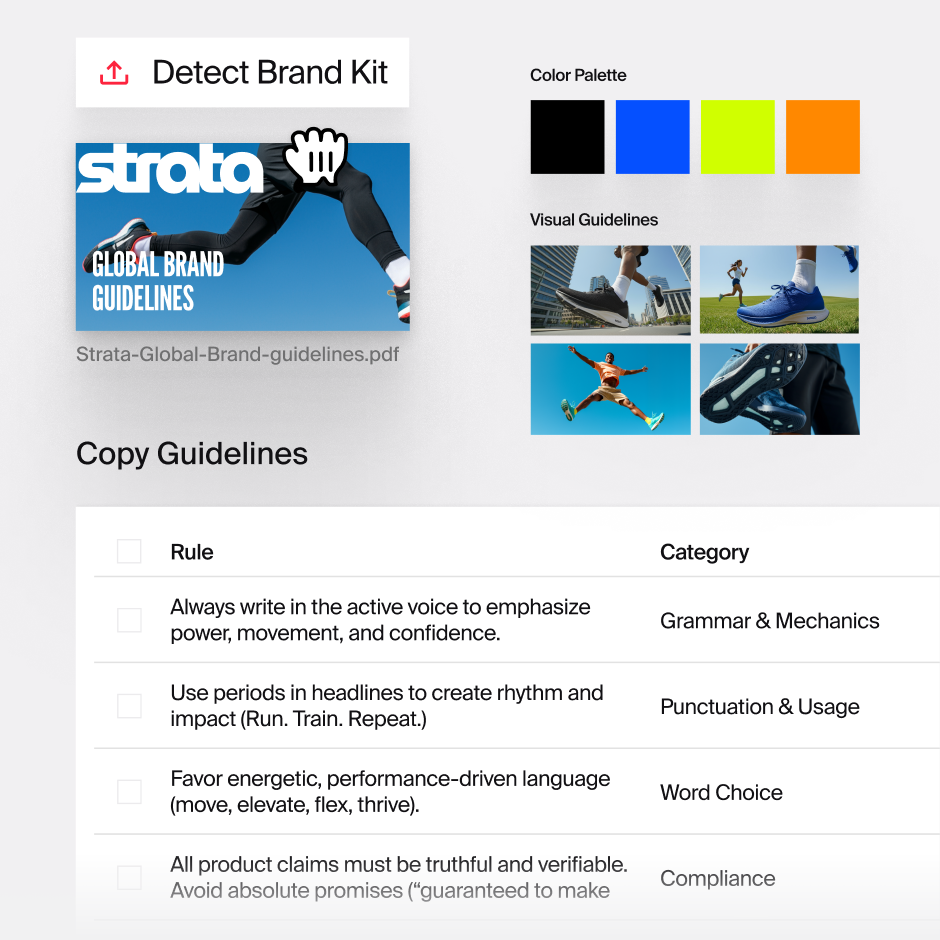
Typeface, on the other hand, lets you create your own brand kits that save your audience segments, brand guidelines and visual style. Every time you generate content, the AI pulls this information from your brand kit to ensure the output is audience personalized, on-brand and consistent.
AI blog writers and draft acceleration
Drafting is often the slowest stage of content production. AI blog writers compress that stage dramatically by transforming structured briefs into first drafts within minutes.
Marketing teams experience similar gains when drafting time drops and strategic refinement increases. AI blog writers are commonly used to:
- Draft long-form articles from approved outlines
- Repurpose webinars and podcasts into written content
- Refresh legacy blog posts with updated angles
So, a mid-sized ecommerce company that once published four articles per month could scale to eight without hiring additional writers. Editors dedicate time to strengthening storytelling, internal linking, and SEO optimization.
Building a human-in-the-loop system
AI-generated drafts still require human oversight. Accuracy, tone alignment, and compliance reviews in most cases remain human responsibilities.
High-performing teams can create a structured review system by:
- Verifying all statistics against original sources
- Aligning messaging with documented voice guidelines
- Running originality and plagiarism scans
Incidentally, as marketing stacks expand with AI tools, credential security becomes critical. So, many teams centralize logins using a secure password manager to protect access to platforms, dashboards, and systems.
However, platforms like Typeface have built-in brand governance and compliance capabilities, thus shortening and simplifying review cycles. The Brand Agent can automatically check AI generated content against your brand rules and audience personas.
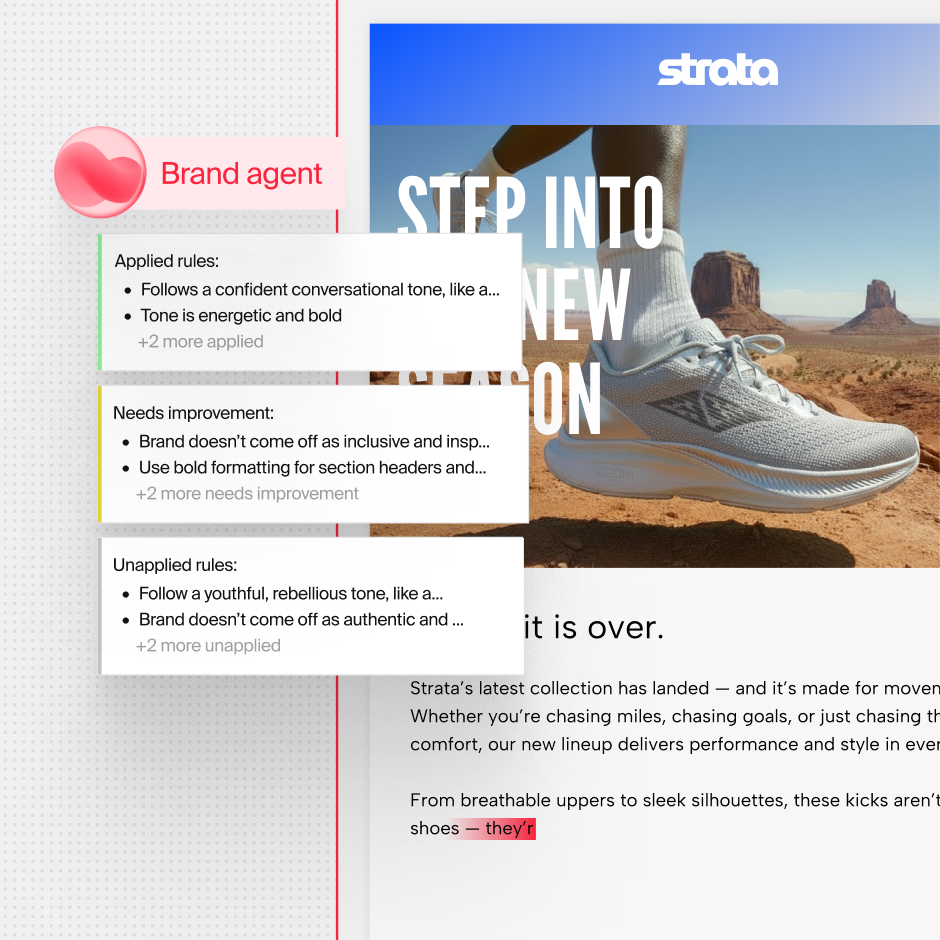
Responsible AI features ensure that AI does not generate any harmful or inappropriate content and adheres to compliance guidelines.
AI content optimization and search performance
Publishing faster means little without performance optimization. AI is now transforming how teams refine content after it goes live.
SEO-focused AI tools analyze ranking signals, semantic gaps, and competitor structure in real time. Instead of manually comparing top-ranking pages, marketers receive prioritized optimization suggestions.
Optimization workflows now include:
- Identifying missing related keywords
- Recommending internal linking opportunities
- Analyzing readability and structure
A SaaS company may discover that high-ranking competitors include detailed FAQs and comparison sections, for instance. AI tools can flag those gaps instantly, allowing teams to update content within hours rather than weeks.
Continuous post-publish improvement
Traditional workflows treated publishing as the finish line. AI shifts that mindset toward ongoing optimization.
Marketers increasingly:
- Monitor ranking changes using AI dashboards
- Receive automated content update alerts
- Generate revised sections based on new keyword trends
Continuous improvement keeps evergreen content competitive. It also aligns the content with evolving search behavior.
AI social media post generators and real-time optimization
Social media requires relentless output. AI social media post generators allow teams to convert one long-form asset into multiple channel-specific posts within minutes.
A study published by TechRadar found that 86% of creators use generative AI in their workflows, and 81% say it enables them to create content they could not otherwise make. Marketing teams can test more formats without expanding headcount.
AI enhances social workflows through:
- Generating LinkedIn, Instagram, and X captions
- Suggesting trend-informed hashtags
- Producing multiple hook variations for A B testing
So, a fintech startup launching a product update, for example, could transform a single blog announcement into platform-specific posts tailored to audience expectations. Social managers refine tone and compliance language before publishing.
Scaling A B testing without burnout
Manually creating content variations limits experimentation. AI tools generate dozens of headline and caption combinations instantly.
Teams often test:
- Question-based versus statement-based hooks
- Short-form versus extended captions
- Emotional versus analytical messaging
Higher testing volume produces clearer engagement insights. And it produces faster optimization cycles.
AI-powered paid advertising and creative optimization
Paid advertising demands constant creative refresh. AI ad generators enable rapid concept development and testing across segmented audiences.
A December 2025 study published on arXiv found that AI-created ads achieved a 59.1% preference rate over human-created ads in controlled experiments. Early-stage ideation benefits significantly from AI-assisted iteration.
Modern paid media workflows now include:
- Drafting segmented copy for cold, warm, and retargeting audiences
- Generating headline and description combinations at scale
- Predicting performance patterns using AI insights
A direct-to-consumer brand running seasonal promotions can generate dozens of ad variations in one session. Marketers then shortlist high-potential options and refine them for compliance and brand voice.
Accelerating creative refresh cycles
Creative fatigue reduces click-through rates. AI shortens refresh cycles dramatically.
Performance teams typically:
- Analyze engagement metrics using AI dashboards
- Identify high-performing language trends
- Generate updated variations within hours
AI personalization and audience segmentation
Modern audiences expect personalized experiences. AI now enables marketing teams to tailor content at scale without manually rewriting assets for every segment.
AI analyzes behavioral data, purchase history, and engagement signals to adjust messaging dynamically. Personalization no longer requires dozens of separate campaigns.
Personalization workflows now include:
- Generating email variations by lifecycle stage
- Adjusting landing page copy by traffic source
- Customizing ad messaging by audience segment
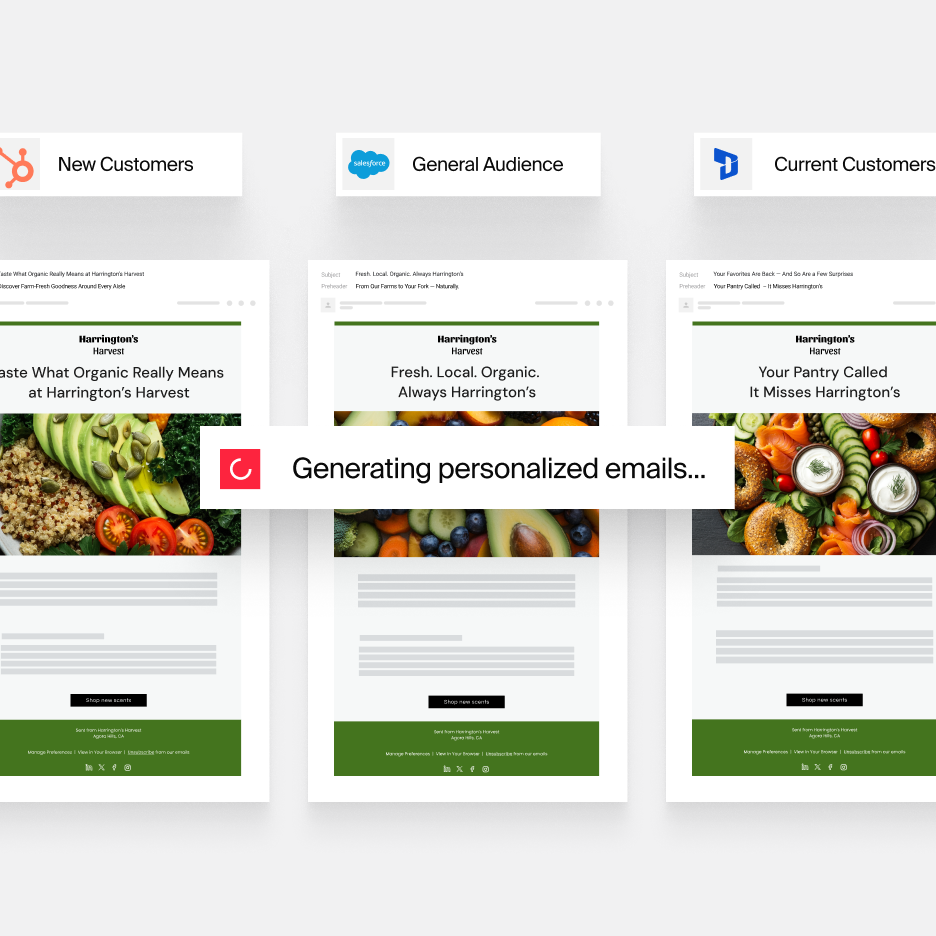
A subscription-based software company, for example, can deliver different homepage messaging to new visitors and returning users. AI systems detect behavior patterns and adapt content accordingly.
Balancing automation with authenticity
Over-automation can feel robotic. Human oversight ensures personalized content remains authentic and aligned with brand values.
Marketing leaders often:
- Define guardrails for tone and messaging
- Review AI-driven personalization outputs
- Test audience reactions before full deployment
Balanced implementation enhances engagement. And that is without sacrificing trust.
AI-driven content repurposing and multi-channel distribution
Creating one strong piece of content is no longer enough. Modern marketing teams are expected to stretch every asset across blogs, email, social media, video, and paid campaigns without doubling production time.
AI is transforming how teams repurpose content across channels. Instead of manually rewriting a blog post into multiple formats, marketers use AI tools to deconstruct long-form assets and rebuild them into platform-specific variations.
AI-powered repurposing workflows often include:
- Turning blog posts into LinkedIn carousel copy
- Converting webinars into email nurture sequences
- Extracting key insights into short-form video scripts
A B2B cybersecurity company, for example, can publish one in-depth report and use AI to generate executive summary emails, social media snippets, sales enablement one-pagers, and podcast talking points. Human editors can refine tone and remove redundancy.
Building a repurposing system instead of one-off assets
AI makes content repurposing systematic rather than reactive. Teams create structured prompts that instruct AI to extract statistics, key quotes, frameworks, and action steps from cornerstone content.
Practical implementation usually follows three steps:
- Create a master asset with clear sections and subheadings
- Feed the structured asset into AI with channel-specific instructions
- Review outputs for clarity, voice, and compliance
Distribution also becomes more coordinated. AI tools can recommend optimal posting times, suggest cross-linking opportunities, and identify which assets should be promoted through paid channels.
Repurposing with AI extends content lifespan and increases ROI per asset. Instead of constantly chasing new ideas, marketing teams extract more value from what they have already created while maintaining consistency across every touchpoint.
AI writing assistants and workflow automation
Content creation involves internal communication, documentation, and reporting. AI writing assistants now streamline those operational layers.
Teams use AI tools to:
- Summarize meetings into clear action items
- Draft campaign briefs automatically
- Generate performance summaries for stakeholders
Integrating AI across the marketing stack
Disconnected AI tools create friction. Integration creates leverage.
High-performing teams connect AI systems to:
- CRM databases for personalized messaging
- SEO platforms for keyword alignment
- CMS environments for streamlined publishing
Platforms like Typeface Arc Forge make this easier by seamlessly integrating AI with your existing infrastructure via MCP and APIs so you can pull in any data the system needs to create meaningful content.
AI-powered content performance forecasting and predictive analytics
Publishing content used to involve educated guesses about performance. AI is now helping marketing teams forecast which pieces are likely to rank, convert, or drive engagement before they go live.
Predictive analytics tools analyze historical performance, search trends, competitor data, and audience behavior to estimate outcomes. Instead of waiting weeks to see if a blog post performs, marketers receive probability-based projections during the planning stage.
AI-driven forecasting workflows often include:
- Estimating potential traffic based on keyword competitiveness
- Predicting conversion likelihood by funnel stage
- Scoring headlines for engagement probability
A SaaS company planning a new feature launch can test multiple blog angles through AI models before writing the full article, as just one example. The system would highlight which version aligns best with past high-converting assets, helping the team prioritize effort.
Making data-led decisions before publishing
AI forecasting shifts decision-making earlier in the workflow. Teams no longer rely solely on intuition or isolated metrics.
Implementation usually involves:
- Feeding historical campaign data into predictive tools
- Comparing multiple content concepts side-by-side
- Prioritizing production based on forecasted ROI
Predictive analytics also reduces resource waste. Instead of producing ten speculative articles, a team may focus on five high-probability topics with stronger ranking potential.
Forecasting does not eliminate uncertainty, but it increases strategic confidence. Marketing leaders gain clearer visibility into how AI, content, and marketing investments connect to measurable outcomes before campaigns even launch.
Where AI, content, and marketing converge
AI is fundamentally reshaping content marketing workflows. From ideation and drafting to optimization, personalization, and automation, AI compresses timelines and expands creative capacity.
Organizations that integrate AI thoughtfully gain speed, scalability, and sharper strategic focus while retaining human oversight. So, evaluate your current workflow and identify repetitive bottlenecks. And if this article was helpful, be sure to check out our other informative content!