Lagos traffic rarely stops, and neither does attention. Levvy Box, a Lagos-based mobility advertising platform, is betting that time spent on the road is time brands can capture. Originally conceived as a GovTech solution to digitise transport levies, the company has pivoted toward monetising movement across the city.
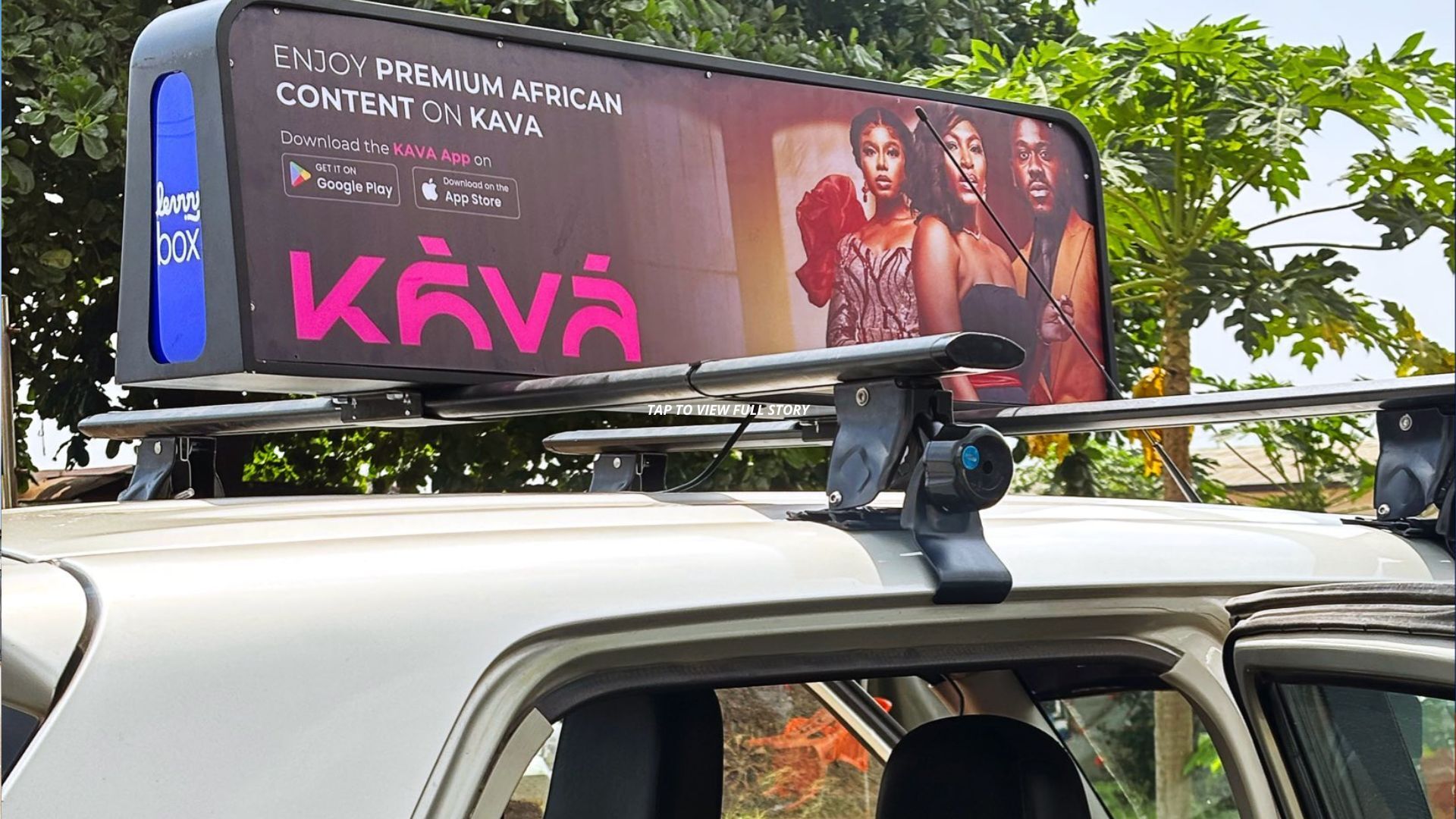
Using glossy, illuminated boxes mounted on vehicle roofs, Levvy Box transforms ride‑hailing cars and other fleets into moving billboards, ensuring brands stay constantly visible to Lagosians as they commute through traffic, estates, markets and nightlife hotspots across the city.
The numbers show it may be on to something. The company, which began full operations in August 2025, claims that within five months, it spent more than 1.42 million minutes on Lagos roads, reaching 43,780 riders, generating 2.35 million minutes of brand view time, and covering over 1.16 kilometres across the city.
Levvy Box, founded by Olamigoke Kumuyi, Ayomide Ishola and Goodness Chinemelum, did not set out to build an advertising company. The original product, initially launched as Levvy in March 2023, was conceived as a GovTech platform designed to enhance transparency and curb revenue leakages. In its early pilot phase, it operated mainly as a portal for tracking government revenues and an activity tracking portal for commercial buses in Lagos, often referred to locally as Korope and Danfos.
The idea made sense on paper. In practice, it ran into problems in early 2023 when it began talks with the Lagos branch of the National Union of Road Transport Workers (NURTW), which controlled the commercial buses. As product development progressed, the co-founders met resistance.
“We were meant to liaise with them, but there was pushback from some government stakeholders at the time, which prevented the solution from coming to fruition, primarily because it threatened to eliminate the roles of various middlemen,” Levy Box CEO, Olamigoke Kumuyi, said. “They chose to maintain and improve upon their manual, cash-based system rather than adopting a digital one.”
Eventually, the NURTW’s support waned in September 2023. Without institutional backing, Levvy’s original GovTech vision collapsed.
Holding on to the mobile layer
Rather than shut down, Kumuyi took inspiration from New York-based digital taxi-top advertising companies Halo Group and Adobe Firefly in December with the belief that mobility itself was still valuable. If government reform was blocked, perhaps the private sector offered a more realistic path forward.
“I entered the Advertisement world from there, signed up to Advertising Regulatory Council of Nigeria (ARCON) in April 2024, wrote exams towards becoming a member and then started meeting people in the industry and speaking to them, learning from them, heard about the companies that tried It before us and how they failed, and these were part of data points that helped us through 2024 as we we’re also running test along side,” Kumuyi said.
While pitching to companies, one question kept surfacing in meetings: How do we reach more people? Despite the dominance of Google, Meta, YouTube and influencer marketing, many Nigerian brands struggled with saturation.
Digital advertising became increasingly expensive, crowded, and noisy. The average cost per click on Google Ads rose to $4.66 in 2024, up from $4.22 in 2023, a 10% year-on-year increase. What’s more striking is that 86% of industries saw costs rise in 2024, meaning this wasn’t limited to a few highly competitive sectors; it was a broad, across-the-board trend.
Attention was fragmenting, but people were still moving through the city, creating a clear opportunity for out-of-home advertising.
Kumuyi pivoted to creating a mobile advertising platform, Levvy Box, starting in 2024.
“I then registered it in May 2024, while we started testing, research and development until we fully launched with a fleet of 10 cars in August 2025,” he said. The company went commercial in August 2025 with its first campaign for Fedan Investment Limited (FIL), a mobile accessories brand in Nigeria.
Out-of-home (OOH) advertising, which reaches people outside their homes, was seeing renewed interest. The overall OOH market grew by roughly 4% to 5.6% globally in 2024. While other traditional media (like print and broadcast TV) saw declines, OOH hit record highs due to increased urbanisation and a return to pre-pandemic travel levels, according to a Statista report.
In Nigeria, the OOH market was valued at $154.40 million in 2025 and is projected to reach $309.60 million by 2030. Demand for billboards, street furniture, and transit advertising has been growing, even as the broader advertising sector remains crowded and bureaucratic.
“The demand kept getting louder,” Kumuyi said. “Brands wanted more reach, more visibility everywhere.”
Early experiments and quick failures
In early 2024, Levvy began experimenting with mobile advertising using ride-hailing vehicles such as Uber and inDrive. Inspired by coordinated taxi advertising in cities like New York, the team initially tested digital rooftop screens.
The experiment failed fast. Devices broke. Heat-warped components. Poor roads, erratic driving and power issues exposed a harsh reality.
“Nigeria humbled us,” Kumuyi said. “You can’t copy and paste what you see abroad.”
Those failures forced a shift in thinking. Levvy stopped viewing itself as an advertising company and began operating as an operations and distribution business.
The core challenge was no longer creativity or sales, but uptime, reliability and logistics in one of the world’s toughest urban environments, Lagos.
“Environment, human behaviours, vehicle conditions, pricing and purchasing power, insurance, openness to new things, regulations and safety management, accidents and damage caused by poor road structures and reckless driving,” Kumuyi said. “All these we found out during our test.”
Digital displays were abandoned in favour of static rooftop ads, redesigned specifically for Nigerian road conditions. The team tested different materials, including aluminium, plastics and metals, refined box shapes for aerodynamics and weight balance, and optimised viewing angles. Sun exposure, road damage and ease of installation all shaped the final product.
After multiple prototypes, Levvy manufactured the boxes to its own specifications and imported them from China.
Distribution was cracked through partnerships. Levy Box currently operates through independent drivers and structured mobility arrangements.
“For legal reasons, we can’t disclose partner names at this stage,” Kumuyi said. “To date, we’ve onboarded over 1,000 drivers, with an actively deployed subset that continues to grow.”
Mobility operators, which formed the foundation of Levvy Box’s distribution. Brand partnerships followed afterward and more are still coming.
The first official partnership with mobility operators, which formed the foundation of Levvy Box’s distribution, was launched in August 2025 with just 10 vehicles. In the following months, Levvy refined its understanding of driver behaviour, regulatory requirements and route dynamics.
Gradually, the operational model stabilised. Kumuyi points to distribution, operations, product reliability and uptime, and driver adoption as the four pointers that this model has been stabilised, resulting in a repeatable model that the company is now scaling through Project M3.
The stress test
The real stress test came with Moonshot by , one of Africa’s biggesttechnology conferences, Levvy’s largest campaign at the time. The activation required 60 vehicles—10 rooftop placements and 50 in-car placements—and reached 15,840 riders across 9,600 trips.
Midway through the campaign, driver unrest across ride-hailing platforms threatened execution. In response, Levvy tapped into informal driver communities that Kumuyi had engaged during earlier testing. Within weeks, the company expanded its active driver pool to over 400.
That expansion proved pivotal. It stabilised the Moonshot campaign and laid the foundation for a broader operational network, which the company says has since grown to more than 1,000 deployable vehicles across Lagos.
The Moonshot deal also clarified Levvy’s growth trajectory. It validated the concept, accelerated visibility and market presence, and set the stage for a third phase focused on capacity and scale, culminating in Project M3, the plan to deploy 1,000 boxes by the end of 2026.
Inside the car: intimacy over impressions
In-car advertising became Levvy’s second product line, but early experiments with digital screens proved too fragile and expensive. The company instead developed low-maintenance, damage-resistant placements positioned directly within passengers’ line of sight.
That design shift produced longer, more intimate engagement. “It’s just you and the brand for the entire journey,” Kumuyi said. “You can’t skip it.”
Levvy also tackled one of out-of-home advertising’s persistent challenges: measurement. Through data partnerships, the company tracks trips, distance travelled, and estimated time on the road, using mobility data to calculate exposure and view time. These metrics underpin its 2025 performance, 1.16 million kilometres travelled and 2.35 million minutes of brand exposure.
Despite this traction, Levvy remains bootstrapped. Kumuyi has deliberately avoided venture funding, choosing instead to finance expansion through revenue, client deposits, and reinvestment. With another 1,000 Levvy Box–branded vehicles planned for 2026, the company is positioning itself for its next phase of growth.
Regulation remains uneven. Nigeria’s OOH ecosystem is fragmented, with agencies such as the Advertising Regulatory Council of Nigeria (ARCON) often criticised for slow advert approvals and limited creative flexibility. Kumuyi believes the system is improving, but gradually.
“There’s still a long way to go,” he said. Levvy Box plans to roll out what it calls the Big Beautiful Box in February 2026, larger than its current units and designed to give brands greater freedom to customise the designs displayed on its vehicles.