
Key Takeaways
- Social media ROI compares the cost you put into social media with the value you get out.
- Proving social media ROI helps you protect budgets and make smarter strategy decisions.
- To calculate social media ROI, add up your total costs, measure the value created, and apply the ROI formula.
- Tools like Hootsuite help teams pull data across multiple platforms, track performance over time, and map social activity to real business results.
You know that social media makes an impact. But calculating its ROI? That can feel like throwing darts in the dark.
In this post, we’ll walk you through how to calculate, measure, and improve your social media ROI, plus the tools that make it easier.
Free downloadable guide: Discover 6 simple steps to calculating your social media ad campaign ROI.
Social media ROI is the value your business gets back from social media marketing and advertising. It compares what you put into social (costs, time, effort) versus what you get out.
Social ROI can be both monetary and non-monetary:
- Monetary value: Anything that directly affects revenue or pipeline (e.g., sales and conversions)
- Non-monetary value: Anything that helps your business, even if it doesn’t lead to revenue right away (e.g., follower growth or customer satisfaction)
Measuring social ROI can help teams make smarter decisions and defend their budgets. Still, it’s easier said than done.
In Hootsuite’s 2024 Social Media Trends report, we found that social media ROI remains a big concern for marketers, with 68% reporting they worry about proving ROI from their social efforts.
The good news? Social is delivering results.
According to recent research, social commerce is expected to generate $908 billion in 2026, up 10% YOY. By 2028, purchases made through social media are expected to surpass the $1 trillion mark.
Social media ROI matters because it shows how your social efforts actually support revenue, growth, and real business outcomes.
Tracking social ROI helps you:
- Determine where your time and money is best spent.
- Know what works and what doesn’t, based on the metrics that really matter to your business.
- Adapt to trends, audience shifts, and market conditions quicker.
- Make a stronger case for investment when it’s time to ask for more budget or headcount
If you want to scale your social strategy or protect your budget, you need proof. Learn how to effectively communicate your social media strategy to executives with this guide on social media strategy for executives.
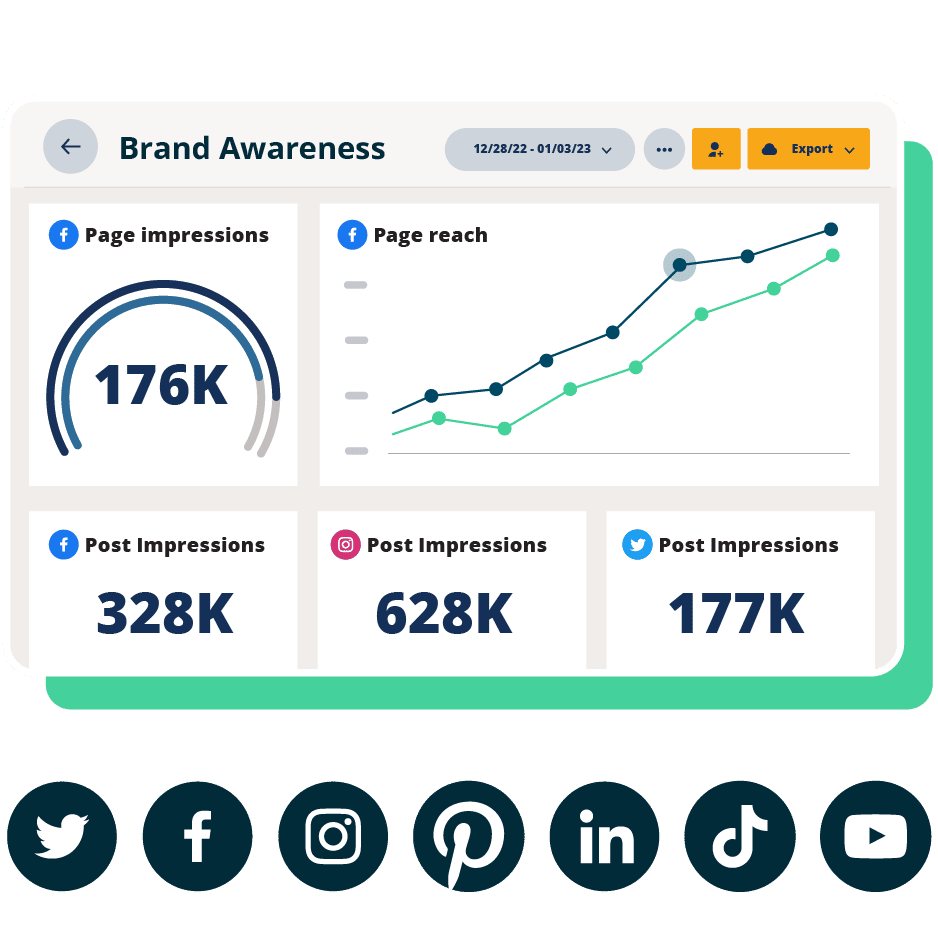
#1 Analytics Tool for Growth
Beautiful reports. Clear data. Actionable insights to help you grow faster.
Start free 30-day trial
Social media ROI is calculated by comparing the value generated from social media to the total cost of your social media investment.
Here’s a simple formula to calculate social media ROI:
Social media ROI = ((Value generated from social media – Costs of social media investment) / Costs) * 100
To use this formula, you need two things:
- The value generated from your social media efforts
- The cost of your social media investment (both monetary and non-monetary)
Below, we’ll walk you through how to find your social media value, total your costs, and calculate social ROI with confidence.
1. Define your social media goals
Start by getting crystal clear on what social media should do for your business. ROI looks very different depending on whether you’re focused on sales, leads, awareness, or customer experience.
Big-picture goals matter, but they’re often too broad to measure on their own. That’s why it’s helpful to set campaign-specific goals alongside higher-level objectives.
For example, campaign-specific goals might include:
- Content downloads
- Email sign-ups
- Trials
Evaluating your performance at the campaign level makes it easier to see what’s working (and what needs a rethink) over a set period of time.
2. Connect those goals to the right metrics
Once your goals are locked in, choose the social media metrics that help you show progress toward them.
Different goals require different metrics. For example:
- Lead generation goals = form fills, sign-ups, or downloads
- Brand awareness goals = reach, impressions, brand mentions, or sentiment
- Engagement goals = comments, shares, saves, or click-through rates
The takeaway: not every metric matters for every goal, so focus on the ones that show meaningful movement.
3. Determine your social media costs
Next, add up the full cost of your social media investment over a set period of time. This includes all the time, money, and resources that go into your social media activities (or a specific campaign).
Common social media costs include:
- Ad spend
- Influencer fees
- Software and tool subscriptions
- Employee salaries
- Time spent planning, publishing, and reporting
You’ll want to get really granular here. If it takes time or money, it belongs in your total.
4. Determine your social media value
At this step, calculate the total value generated by your social media efforts. This value can be monetary or non-monetary.
Monetary value includes:
- Sales or revenue attributed to social media
- Leads or conversions
- Improvements in conversion rate, cost per lead (CPL), or cost per acquisition (CPA)
Non-monetary value includes:
- Brand awareness and reach
- Engagement
- Follower growth
- Customer sentiment or satisfaction
Pro tip 💡: To assign value to non-sales-y outcomes, use indicators such as customer lifetime value (CLV) or estimated values per lead, click, or engagement.
5. Calculate social media ROI
Now it’s time to crunch the numbers using the social media ROI formula above.
The result of the formula (a.k.a. your ROI) is usually expressed as a percentage.
If your ROI is above zero, your social media marketing efforts are paying off. If it’s below zero, you’re spending more than you’re getting back, which is your cue to adjust the strategy.
Here are a few examples of how this social media ROI calculation might work IRL.
Example 1: E-commerce
An e-commerce business wants to measure the ROI of its latest social media marketing campaign aimed at increasing sales. Here’s how they could do it:
- Value Generated: $50,000 in sales from social media referrals
- Costs: $10,000 on TikTok and Facebook ads, $5,000 on content creation, $3,000 on software subscriptions
- ROI Calculation: ((50,000 – 18,000) / 18,000) * 100 = 178%
This means the campaign generated 178% more value than the resources invested.
Example 2: B2B
A B2B company focuses on lead generation through LinkedIn. They want to calculate the ROI of their efforts:
- Value Generated: 100 qualified leads, each valued at $200, totaling $20,000
- Costs: $2,000 ad spend on LinkedIn, $1,500 on content creation, $500 on analytics tools
- ROI Calculation: ((20,000 – 4,000) / 4,000) * 100 = 400%
This indicates a 400% return on their social media investment.
The best way to track your social media ROI today is to take advantage of powerful social media analytics tools. Oh, by the way, have you heard of Hootsuite Analytics?
Here’s how Hootsuite’s tools can help you measure ROI in social media.
Use analytics to improve strategies
If you want to prove your social media ROI, you’ll need to know how your content is performing. And, if you want to know how your content is performing, you’ll need a robust social media analytics platform.
For example, tracking engagement metrics over time makes it easier to identify what content topics or formats connect with your audience – which helps you adapt your content marketing strategy.
With Hootsuite’s powerful analytics tools, you can fine-tune your campaigns by examining how your content performs month after month and across different social media platforms.
Then, get practical tips on how to expand your content’s reach and social media performance so you can keep refining your social marketing strategy for even greater success.


With Hootsuite’s Advanced Analytics, you can easily highlight what’s working (and what’s not) so you can zero in on your best-performing activities. Track sales, sign-ups, and conversions from specific posts and use this info to craft content that really hits the mark.

See what works for the competition
Want to stay ahead of the competition? Hootsuite lets you keep an eye on up to 20 competitors per social network.
It shows you what’s clicking for them — like their top posts, trending hashtags, and favored content styles. This way, you can adjust your strategy based on what’s already proving successful for customers like yours. It’s like having a playbook of winning moves right at your fingertips.

Plus, use Hootsuite’s social media benchmarking to see how you measure up against the industry at large. By checking metrics such as profile impressions, reach, followers, and engagement rates, you can spot areas for improvement and growth.

Pro tip💡: Want to see generalized results across industries? Check out Hootsuite’s Industry Benchmarking tool.
Tell a compelling story with reports
One of the best ways to sell your social media efforts to your stakeholders is through regular, in-depth reporting.
Hootsuite’s reporting tool helps you create visually appealing reports that clearly show the performance of your paid and organic social media channels. Start from scratch or use templates to produce professional reports that effectively communicate the impact of your social campaigns on your business.

Track results beyond social
Social media ROI can come from anywhere, even outside of social media.
Luckily, Hootsuite doesn’t just limit you to social metrics. By integrating with platforms like Google Analytics or Adobe Analytics you can see how your social media efforts contribute to broader business goals.
These integrations help you track essential actions like sign-ups and purchases, providing a clear view of how each social media post impacts your bottom line.

Link tracking and web attribution tools can also be helpful when tying social efforts directly to business outcomes. By associating unique post IDs with each social post, you can connect web conversion data — like completed goals or purchases — back to specific social activities.
With real-time analytics, marketers can spot trends as they emerge instead of waiting for end-of-month reports.
Measuring social media ROI means measuring what you get back from the time and money you put into social media marketing. It helps you see which strategies are paying off and which ones might need adjusting.
Use this FREE social media ROI calculator to see where you land.
Using our ROI Calculator is simple:
- Enter your social media costs and results.
- Get instant insights into your ROI and what’s driving your success.
- Compare different social media campaigns to see which ones are delivering the best results for your business.
With the social media ROI calculator, you can:
- Prove the impact of your social media efforts in dollars and cents.
- Make smarter decisions based on clear data.
- Impress your team and stakeholders with tangible results.
Disclaimer: This tool provides estimates and is meant for informational purposes only. Results may vary based on your specific circumstances and goals.

Improving your social media ROI comes down to testing what works, tracking results, and refining your strategy over time.
Here’s how to get started:
1. Test and optimize
Social media is a constantly changing landscape where testing and tweaking is key to getting the most out of your efforts. And experimentation is a must.
As Eileen Kwok, Social & Influencer Marketing Strategist at Hootsuite, shares, “Social is a place where we are continuously testing new content, features, and learning what’s working/not working,” And she’s right.
One way to do this is by running A/B tests on social media content. Experiment with different topics, formats, and posting times to optimize your content. You can also run experiments through organic social accounts and paid social media ads.
For example, we ran an experiment to test whether Instagram carousels perform better than Reels. After three weeks, we found carousels earned better engagement and reach!
Check out all our social media experiments here.
There are many factors you can test, including:
Testing — and reviewing your social media analytics — helps you learn what types of content actually resonate with your followers. Based on those insights, you can scale up that content or ad and increase your social media advertising ROI.
2. Get inspired by competitors
It’s one of the most tried and true rules in social media: check out what your competitors are doing.
Lucky for you, social posts are public. You can literally see who liked what and how much on any public facing profile.
But you can take it a step further with tools like Hootsuite Analytics. It lets you track competitor results across channels and see industry benchmarking data that shows how you stack up in your niche.

3. Use UTM parameters
One of the easiest ways to track social media ROI is with Urchin Tracking Module (UTM) parameters.
UTM parameters are tags you can add to the ends of your URLs that let you track exactly how much traffic a specific URL (like a landing page) gets.

So, if you have a URL on your LinkedIn post that directs users to your online store, you’ll be able to see exactly how many people went to your store from that post, and who actually bought from you.
Now that’s what we call measuring social media ROI.

4. Don’t discount your followers
Everyone says followers are a vanity metric — and that vanity metrics don’t count.
But, the truth is, followers matter. At least in the way that without them, you don’t get engagement, and without engagement, you won’t get sales.
Take it from TIME’s Social Media Strategist Tameka Bazile, who says that:
- Follower count does determine trust and loyalty.
- 75% of people who follow brands on social media have plans to purchase from them.
- 64% of consumers will buy or boycott a brand based on its position on a social issue.
Now tell us followers don’t affect your ROI.

5. Keep refining your goals
Goals in social media marketing strategy should be flexible, not set in stone.
As Kwok points out, “The goals you have set for at the start of the year, could have already changed. Depending on the shifts your organization is making, or the changing social landscape, make sure you are revisiting your goals every quarter to see if any updates need to be made.”
Adjusting your goals as new information comes available helps you weed out the tactics that aren’t working, and pay more attention to the ones that are. The stronger your social media strategy, the stronger your results.
Social media marketers often have mixed feelings about tracking ROI. On one hand, it’s the best way to show the value of our efforts, and prove to higher-ups that all these memes, reports, and influencer partnerships are actually worth it.

On the other hand, it can be hard to accurately attribute sales to specific posts or campaigns. Not to mention, single posts might not always move the needle, but your wider social media presence could. How do you track that?
Still, data shows that 55% of marketers believe that using social media improves sales. Not to mention, all those increased traffic, exposure, and lead gen benefits that can indirectly boost the bottom line. Clearly, the proof is in the pudding. So, why do we still feel so unsure?
Kwok points out that there are some common misconceptions about social media ROI. One big myth is that social media is only good for building brand awareness, not for driving actual sales.
“While awareness is important, social media can also drive leads and sales,” she explains. “Secondly, there’s the belief that going viral equals social ROI. However, virality doesn’t always translate to meaningful engagement with your target audience. It’s essential to focus on addressing audience pain points rather than chasing viral content.”
Kwok also notes that staying the course in an ever-shifting social landscape can be stressful. “Trends come and go, algorithms change… It can be a challenge to continuously prove how social is bringing in ROI as not every post is going to land with your audience.”
Setting clear goals is key. Whether aiming for brand awareness, customer engagement, or direct sales, defining your KPIs upfront gives you a roadmap to measure success.
Kwok advises, “You don’t know what your ROI is until you’ve laid out the goals you are tracking towards.” In short, you can’t measure what you haven’t set.
FAQ: Social media ROI
How do enterprise organizations measure social media ROI?
Enterprise organizations measure social media ROI by tying social activity directly to business goals like revenue, leads, and cost savings.
This typically involves tracking performance across teams, platforms, and regions using centralized reporting tools like Hootsuite.
Which social media ROI metrics show real business impact?
The most useful social media ROI metrics are the ones tied to business outcomes. These might include revenue influenced by social, leads generated, cost per lead, or customer retention. The right social media metrics depend on your goals, but they should always show how social supports the bigger picture.
How do leading brands connect social media ROI to revenue?
Leading brands connect social media ROI to revenue by using tracking tools, clear attribution models, and shared data across teams. This helps them see how social supports the customer journey, from first touch to final conversion.
What tools help prove social media ROI across channels?
Tools that bring all your social data together make it much easier to prove ROI across channels. Platforms like Hootsuite help teams track performance across social networks, connect social results to business goals, and share clear reports with stakeholders.
When your data lives in one place, it’s easier to see what’s working and show how social supports the bigger picture.
How should you report social media ROI to executive stakeholders?
When reporting social media ROI to executives, focus on what matters most to the business. Keep reports clear and concise, highlight trends over time, and connect social results to revenue, growth, or cost savings whenever possible.
Use Hootsuite Analytics to get plain-language reports of your social data to see exactly what’s driving results for your business—and where you can boost your social media marketing ROI.