Hyundai has been building a very specific story for months about the future of its factories, one in which humanoid robots go from being a distant promise to a real industrial tool. The image is powerful and connects with a global race to automate increasingly complex processes, but in South Korea that discourse has already found its first limit. Even before robots enter production lines, the union has come forward to make its position clear and warn that any changes that impact employment will have to be negotiated.
A clear warning. Hyundai Motor Union has made it clear that “without an agreement between the company and workers, not a single robot can enter South Korean plants,” stressing that any decision with an impact on employment must go through the negotiation table. The message connects directly with the current collective agreement, which requires all measures that affect work to be subject to debate and joint approval. With this positioning, the introduction of humanoids is emerging as one of the possible reasons for friction between worker representatives and the Asian corporation.
Fear that South Korea will lose prominence. The union links automation to a broader movement of industrial reorganization, marked by the growth of manufacturing in the United States. As they explain, the planned increase in capacity at the US plant could end up subtracting volume from factories in South Korea, and they maintain that two centers would already be suffering from a lack of workload. In this context, humanoids are interpreted not only as a technological tool, but as an element that can accelerate job adjustments if it is not accompanied by clear guarantees regarding the maintenance of employment.
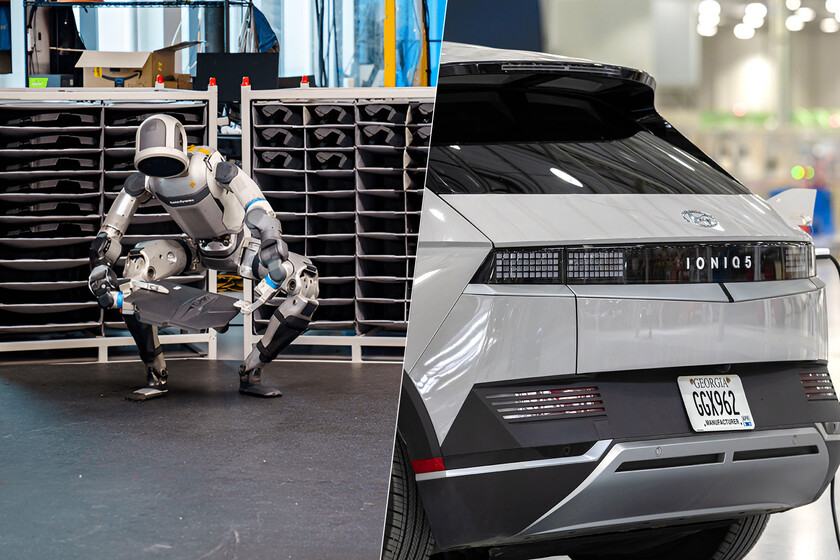
The starting point of the discussion. This comes after Hyundai presented Atlas, the humanoid robot developed by Boston Dynamics, as a key piece of its medium-term industrial strategy. The firm assured that it plans to progressively integrate it into its global network of factories starting in 2028. It also explained that these robots are designed to take on general industrial tasks and work alongside people, with the aim of reducing physical effort and taking on potentially dangerous jobs. Of course, he avoided specifying how many units he will deploy in the first phase or how much the project will cost.
First in the United States. The manufacturer has already begun to draw how it wants to industrialize this bet. The group has explained that it will build a specific plant in the United States for the production of robots, a factory dedicated to producing Atlas on a large scale in the coming years. The first operational destination would be at the Georgia plant, known as HMGMA, where the humanoids would initially be used in very specific tasks, such as sorting and sequencing parts for the assembly line.
The small labor print. Hyundai’s commitment is part of a much broader race to bring humanoid robots to the industry. Companies such as Tesla, Amazon or the Chinese manufacturer BYD have announced similar plans, although with different degrees of maturity. Some projects have already moved from demonstration to real work, such as the Figure 01 robot at a BMW plant, where it performs support tasks autonomously. These are still limited and highly supervised experiences, but sufficient to show that the leap from the laboratory to the factory has already begun.
Images | hyundai
In WorldOfSoftware | 100% autonomous factories where it is not necessary to turn on the light: China is already considering manufacturing cars only with robots in 2030