The talks held in Berlin have reactivated the idea of an agreement to end the war in Ukraine like never before, to the point that Donald Trump has assured that peace is “closer than ever” after prolonged contacts with both European leaders and Vladimir Putin.
If this horizon occurs, Finland has just sounded the alarm.
The peace that appears. The United States has put on the table a plan that, according to its own negotiators, would resolve around 90% of the points of friction and that includes a ceasefire supervised by Washington, far-reaching security guarantees and a central role for Europe in the stabilization of the country.
kyiv admits real progress, although it emphasizes that the territorial issue remains the most painful core of the negotiation, with Russia demanding concessions in the Donbas that Ukraine is reluctant to accept. Even so, the general tone is one of contained optimism, with the feeling that, for the first time since 2022, there is a minimally viable political architecture to stop the fighting.
Security guarantees. The key element of the plan is a package of security guarantees described by US officials as the most robust ever offered to Ukraine, with explicit parallels to NATO’s Article 5. Europe is willing to lead a multinational force on the ground, a “coalition of the willing” that would help regenerate the Ukrainian armed forces, protect its airspace and guarantee maritime security, always with political and operational support from the United States, although without US troops deployed in Ukraine.
In addition, Washington would assume supervision of the ceasefire and an early warning system for possible violations, while European countries would legally commit to act in the event of new aggression. For kyiv, these guarantees are the essential condition for accepting any freezing of the conflict, even leaving aspirations such as joining NATO on hold, something that Zelenskiy has come to openly raise.
The hidden Price of peace. However, beneath this apparent diplomatic advance lies growing unrest on Europe’s eastern flank. Finland has issued a warning as clear as it is uncomfortable: peace in Ukraine will not mean the end of the Russian threat, but very likely its geographical displacement.
According to the Finnish Prime Minister, Petteri Orpo, Moscow would take advantage of the end of hostilities to redeploy forces to NATO’s borders, especially in the Baltic and northern Europe, strengthening its position vis-à-vis the Alliance in a period of just three to five years. From Helsinki, it is insisted that Russia would continue to be a revisionist power and that interpreting peace as a general de-escalation would be a strategic error of the first order.
The eastern flank prepares. The most exposed countries are already acting accordingly. Estonia, Latvia, Lithuania and Poland are on track to spend more than 5% of their GDP on defense, well above traditional NATO targets, as they coordinate common capabilities in air defense, drones and ground forces, and work to accelerate the movement of troops and weapons across the continent.
Finland, with its historic culture of preparedness against Russia, maintains bunkers, strategic reserves and civilian training programs, despite going through a serious economic crisis. These countries fear that a peace agreement will lead some European partners, further away from the front, to relax their attention and their military spending just when, in their opinion, the threat would be reconfiguring and not disappearing.

Europe and a decision. The debate comes in a critical week for the European Union, forced to decide whether to financially support Ukraine in the long term, unlock the use of frozen Russian assets and assume that its future security depends less on Washington and more on its own deterrence capacity. Orpo has been explicit in warning that Europe cannot afford to just talk about peace, but must act quickly and resourcefully, because there is no credible alternative plan if support for kyiv fails.
Thus, the paradox is strongly imposed: progress towards peace in Ukraine, far from closing the chapter of European security, could open another equally delicate chapter, in which Russia, freed from the Ukrainian front, once again strains the continental chessboard and forces Europe to finally face the strategic consequences of a conflict that was never just about Ukraine.
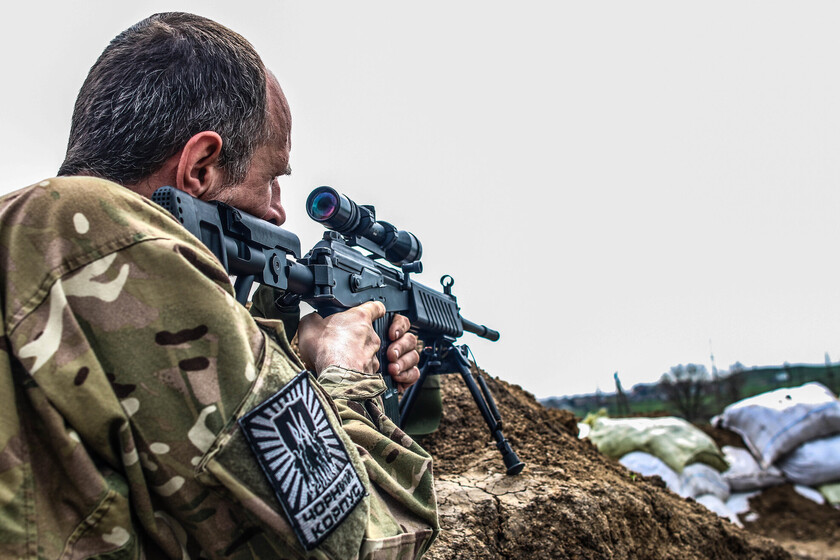
Imagen | Ministry of Defense of Ukraine
In WorldOfSoftware | Something unprecedented has happened in North Korea: a video has revealed that they are sending their soldiers in Ukraine to the “slaughterhouse”
In WorldOfSoftware | The drone war in Ukraine is complete nonsense: the manuals that were useful two weeks ago are a death trap today