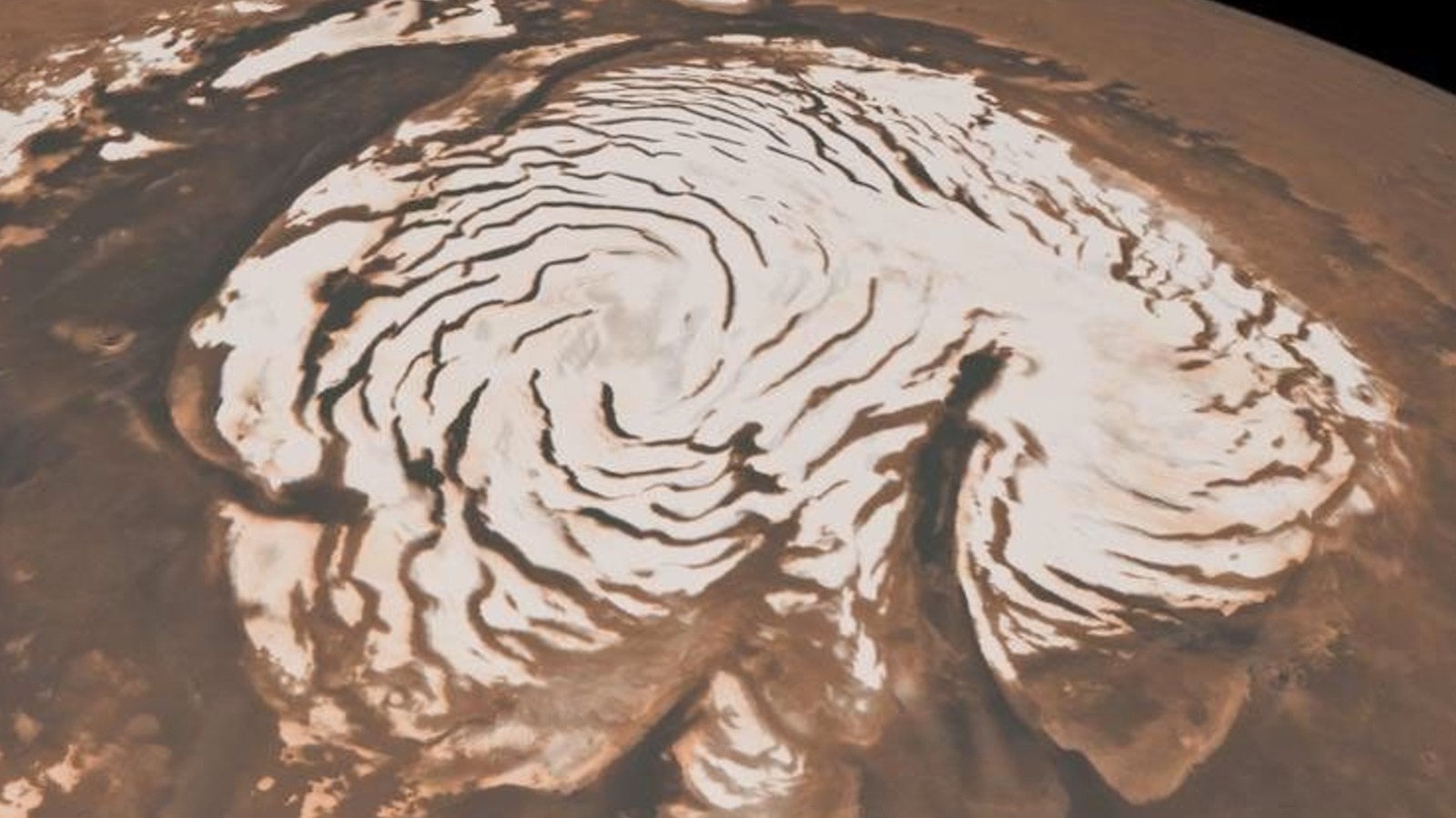
Humanity has dreamed about discovering life on alien planets for as long as we have dreamed about visiting other worlds. Since Mars is the closest planet to Earth we can feasibly visit (hopefully by the 2030s), it will be the first place we start the search. NASA even has a plan of attack and thinks the best place to look will be … anywhere there is ice.
In 2025, a team of NASA scientists published a study in Astrobiology investigating how organic biosignatures would degrade on the surface of Mars. The researchers used dead Escherichia coli microbes as a stand in for any life that may have once been on Mars, then bombarded it with gamma radiation to simulate exposure to cosmic radiation. It turns out that amino acids in the E. coli could survive in ice deposits for an estimated 50 million years. Therefore, any regions of Mars covered in ice or permafrost (frozen soil, rock, and sediment) are prime locations to locate traces of life on the planet.
Admittedly, the prospect of finding not even microscopic life on Mars but instead the organic building blocks might sound a tad disappointing — and a far cry from the bug-eyed, green-skinned creatures we once envisioned — but some people at NASA believe alien life is already extinct. It really doesn’t matter what we find, because it would still be the discovery of the century.
NASA might have already found signs of life on Mars
Even though ice might be the key to finding biosignatures on Mars, future rovers might not necessarily need to scour the planet for frozen water, just areas where there used to be water. In 2025, NASA reported that the Perseverance rover picked up samples, specifically mudstone (a type of compacted clay), from a location known as Jezero Crater. This area is believed to have once been either an ancient riverbed or a prehistoric lake.
The organization published its findings in Nature, and according to the article, the rover found what NASA believes to be “potential biosignatures.” While the collected samples need to be examined further, the rover appears to have discovered organic carbons that are the remains of chemical reactions common to microbial life in low temperatures. Of course, we won’t know for sure unless NASA scientists get their hands on the mudstone.
If tests confirm researchers’ suspicions, then future Mars missions set on discovering alien life might be split between two sets of priority targets. Here’s hoping that the AI program that might pilot the rover in the future is up for the task.