

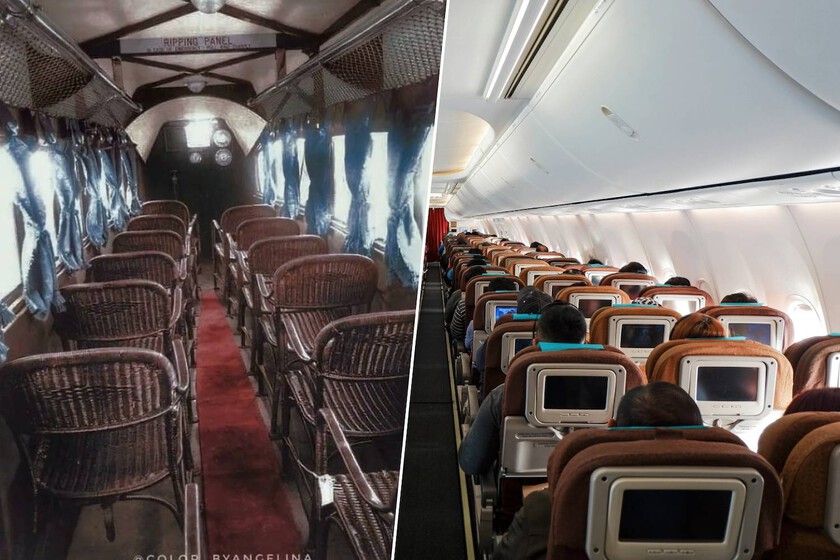
As an eternal user of economy class when traveling by plane, my small pleasures are limited to trying to get rid of the damn middle seat in favor of being able to stretch my foot in the aisle or see the sky from the window, in addition to having at least one armrest unit of my own. As for the seats, what can I tell you: bearable for a flight of a couple of hours, but it becomes uphill if the flight is longer. And hey, not that bad, it could be worse: I could have to travel standing or sit in a wicker chair.
Standing is a future thing, but as incredible as the wicker chairs in the cabin of an airplane may seem, it is a reality. A few years ago someone posted a photo on Twitter that claimed to be of an Imperial Airways plane in 1936 that, more than an aircraft, looked like the living room of your great-aunt Paqui’s house: red carpet on the floor, wicker seats and, of course, no sign of a seat belt. Scopes verified the photo, but not the date (the same cockpit appears in British Airways archives dating back to the 1920s), making the image a faithful representation of what it was like to take a flight in commercial aviation at the time.
Soaring through the skies in a wicker chair. In 1919 the first airline companies were born and among the list there are some mythical ones that continue to fly today such as the Dutch KLM or Avianca in America. That year the Lawson Airliner took to the skies as the first passenger plane and the seat chosen for passengers to travel seated were wicker chairs, according to Air Charter Service USA, more specifically 26 units. PJ Wilcynski, a Boeing historical researcher who reviewed the company’s archives, confirmed to Travel+Leisure magazine that wicker chairs bolted to the floor were the beginnings of passenger seats.
But the wicker chairs were something ephemeral. As commercial aviation took off, the aeronautical industry sought more efficient and safer materials. First, in the late 1920s, with padded and leather-covered wicker chairs. As PJ Wilcynski explains, “Leather was very popular because it made the seats easy to clean, due to all the soot from airports and the dusty runways where planes landed in those early days.”
Why wicker. At that time, the main design criterion for an airplane seat was that they had the lowest possible weight to maximize the payload, something decisive given the limited thrust of those engines. Functionality and lightness above all, we will talk about resistance to potential impacts another day. The choice was as innovative as that original Lawson: they were light seats and surprisingly comfortable by the standards of the time.
The wicker seat was short-lived. In the 1930s, the Aluminum Company of America created a passenger seat made of a light metal: aluminum. And until now: most airplane seats have an aluminum frame. By the end of that decade, aluminum tube structures were widespread on airline aircraft of the time. With the change, comfort elements such as cushions and covers gained weight and velvet covers and thick seat belts arrived. In 1936, rubber-covered foam seats became the standard, with the legendary Douglas DC-3 airliner.
In 1952 the first commercial reclining seats arrived. However, according to PJ Wilcynski, the real paradigm shift in seats to convert them into the experience we live today came with the Boeing 747, back in 1970: “the multiplex system was introduced, with the function of calling the operator and activating the reading light. It was also the system that provided the audio for the movies being watched, through pneumatic tubes connected to the armrest.”
A before and after in security. Traveling on a plane on a structure as flimsy as wicker and without a seat belt does not seem like the safest thing in the world. However, safety criteria have (fortunately) evolved tremendously: in the early years the seats had to withstand a force of 6g, but in the 1950s that requirement rose to 9g. Currently the list of criteria is long: airplane seats must meet a 12-second fire resistance test and withstand a force of 16g, in addition to being light, incorporating foam suitable as a float and offering sufficient resistance for all types of passengers.
In | In the 1960s planes were going so fast that someone promised trips to the Moon. And people bought them
In | Rise and fall of the Havilland Comet, the first commercial airliner with jet engines that went from innovation to tragedy
Cover | Twitter and Mohammad Arrahmanur


