By using this site, you agree to the Privacy Policy and Terms of Use.
Accept
World of SoftwareWorld of SoftwareWorld of Software
  • News
  • Software
  • Mobile
  • Computing
  • Gaming
  • Videos
  • More
    • Gadget
    • Web Stories
    • Trending
    • Press Release
Search
  • Privacy
  • Terms
  • Advertise
  • Contact
Copyright © All Rights Reserved. World of Software.
Reading: Inside Netflix’s Graph Abstraction: Handling 650TB of Graph Data in Milliseconds Globally
Share
Sign In
Notification Show More
Font ResizerAa
World of SoftwareWorld of Software
Font ResizerAa
  • Software
  • Mobile
  • Computing
  • Gadget
  • Gaming
  • Videos
Search
  • News
  • Software
  • Mobile
  • Computing
  • Gaming
  • Videos
  • More
    • Gadget
    • Web Stories
    • Trending
    • Press Release
Have an existing account? Sign In
Follow US
  • Privacy
  • Terms
  • Advertise
  • Contact
Copyright © All Rights Reserved. World of Software.
World of Software > News > Inside Netflix’s Graph Abstraction: Handling 650TB of Graph Data in Milliseconds Globally
News

Inside Netflix’s Graph Abstraction: Handling 650TB of Graph Data in Milliseconds Globally

News Room
Last updated: 2026/03/23 at 10:34 AM
News Room Published 23 March 2026
Share
Inside Netflix’s Graph Abstraction: Handling 650TB of Graph Data in Milliseconds Globally
SHARE

Netflix engineers have built Graph Abstraction, a high throughput system designed to manage large scale graph data in real time. The platform powers several internal services, including social graphs for Netflix Gaming and service topology graphs used for operational monitoring and incident analysis. By separating edge connections from edge properties and replicating data globally, the system enables millisecond level queries across roughly 650 TB of graph data, allowing engineers to analyze complex relationships quickly and reliably.

Graph processing systems often face a trade off between expressive queries and predictable performance. Traditional graph databases tend to prioritize flexible traversal and complex query capabilities, but many operational workloads require extremely fast responses at high throughput. To meet these requirements, Netflix’s system restricts traversal depth and often requires a defined starting node, trading some query flexibility for consistent low latency at scale.

Graph Abstraction supports several internal use cases. These include a real time distributed graph that captures interactions across services in the Netflix ecosystem, a social graph used by Netflix Gaming to model user relationships, and a service topology graph that helps engineers analyze dependencies during incidents and root cause investigations. The platform also maintains historical graph state through a TimeSeries abstraction, enabling analytics, auditing, and temporal queries over graph evolution.

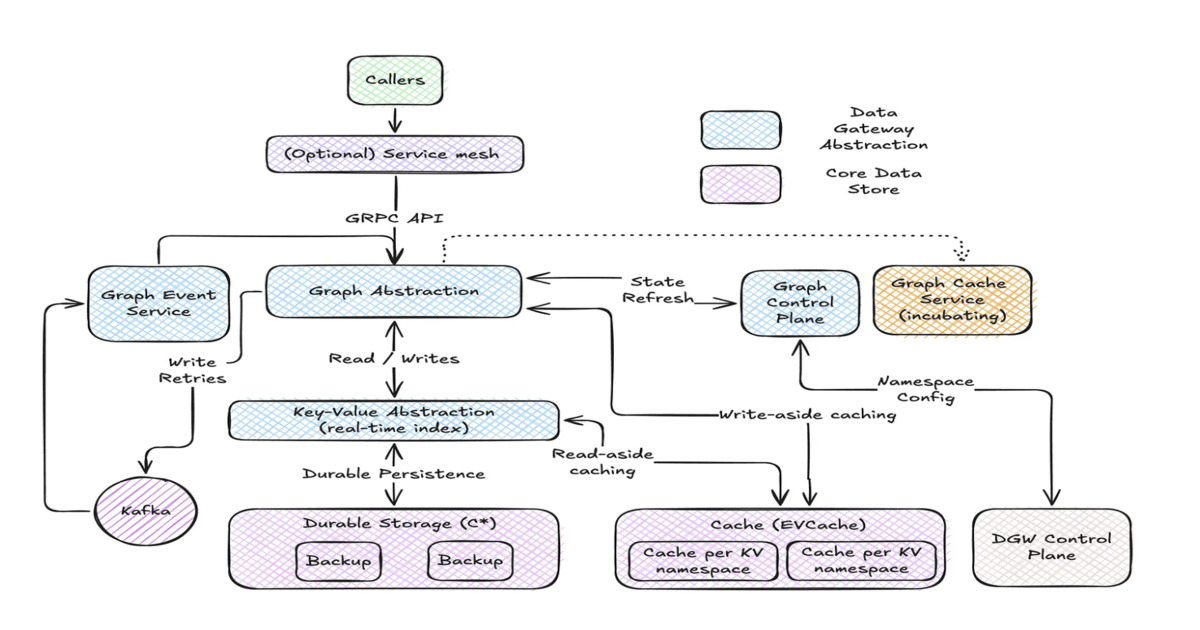
Rather than building a standalone graph database, Graph Abstraction is implemented as a layer on top of Netflix’s existing data infrastructure. The latest graph state is stored in a Key Value abstraction, while historical changes are recorded through the TimeSeries abstraction. To reduce latency, the system integrates with EVCache, Netflix’s distributed caching layer. Graph schemas are loaded into memory and strictly enforced, enabling validation, optimized traversal planning, and elimination of invalid query paths.

Graph Abstraction architecture built on Netflix’s data infrastructure (Source: Netflix Tech Blog)

The platform also uses caching strategies: write-aside caching prevents duplicate edge writes, while read-aside caching accelerates access to node and edge properties. These techniques reduce read and write amplification and maintain performance under heavy workloads. Graph Abstraction exposes a gRPC traversal API inspired by Gremlin, enabling services to chain traversal steps, apply filters, and limit results.

Netflix engineers describe that global availability was achieved through asynchronous replication across regions, ensuring eventual consistency while supporting high throughput. Both caching layers and durable storage replicate graph data across regions, balancing latency, availability, and consistency trade-offs.

Global replication across caching (Source : Netflix Tech Blog)

Netflix engineers emphasize that in production the system delivers single digit millisecond latency for single hop traversals and under 50 milliseconds for two hop queries at the 90th percentile, providing predictable performance at scale. The design carefully balances traversal planning and execution to enable efficient exploration of large graph datasets.

As Netflix expands into new verticals such as live content, gaming, and advertising, Graph Abstraction is expected to play an increasingly important role in modeling relationships between users, services, and content while maintaining high throughput, global availability, and low latency access across the platform.


Sign Up For Daily Newsletter

Be keep up! Get the latest breaking news delivered straight to your inbox.
By signing up, you agree to our Terms of Use and acknowledge the data practices in our Privacy Policy. You may unsubscribe at any time.
Share This Article
Facebook Twitter Email Print
Share
What do you think?
Love0
Sad0
Happy0
Sleepy0
Angry0
Dead0
Wink0
Previous Article 7 Steps to Turn One Amazon Video into Two Streams of Affiliate Income – Digital Marketing
Next Article CcHUB launches GATEWAY to train 340,000 Nigerians for global gig work  CcHUB launches GATEWAY to train 340,000 Nigerians for global gig work 
Leave a comment

Leave a Reply Cancel reply

Your email address will not be published. Required fields are marked *

Stay Connected

248.1k Like
69.1k Follow
134k Pin
54.3k Follow

Latest News

BYD launches new Denza N9 flagship SUV in China · TechNode
Computing
Take Nearly 50% Off the Anker Solix C800 Solar Bundle Ahead of Amazon's Big Spring Sale
News
Apple’s WWDC 2026 event starts June 8th
News
Report: Helion is working on a massive fusion power deal with OpenAI
Computing

You Might also Like

Take Nearly 50% Off the Anker Solix C800 Solar Bundle Ahead of Amazon's Big Spring Sale
News

Take Nearly 50% Off the Anker Solix C800 Solar Bundle Ahead of Amazon's Big Spring Sale

3 Min Read
Apple’s WWDC 2026 event starts June 8th
News

Apple’s WWDC 2026 event starts June 8th

0 Min Read
Ecovacs Deebot X11 OmniCyclone Review: Rapid Recharging for Longer Cleaning Runs
News

Ecovacs Deebot X11 OmniCyclone Review: Rapid Recharging for Longer Cleaning Runs

6 Min Read
Dash0 raises 0M at B valuation to change cloud observability with AI agents –  News
News

Dash0 raises $110M at $1B valuation to change cloud observability with AI agents – News

5 Min Read
//

World of Software is your one-stop website for the latest tech news and updates, follow us now to get the news that matters to you.

Quick Link

  • Privacy Policy
  • Terms of use
  • Advertise
  • Contact

Topics

  • Computing
  • Software
  • Press Release
  • Trending

Sign Up for Our Newsletter

Subscribe to our newsletter to get our newest articles instantly!

World of SoftwareWorld of Software
Follow US
Copyright © All Rights Reserved. World of Software.
Welcome Back!

Sign in to your account

Lost your password?