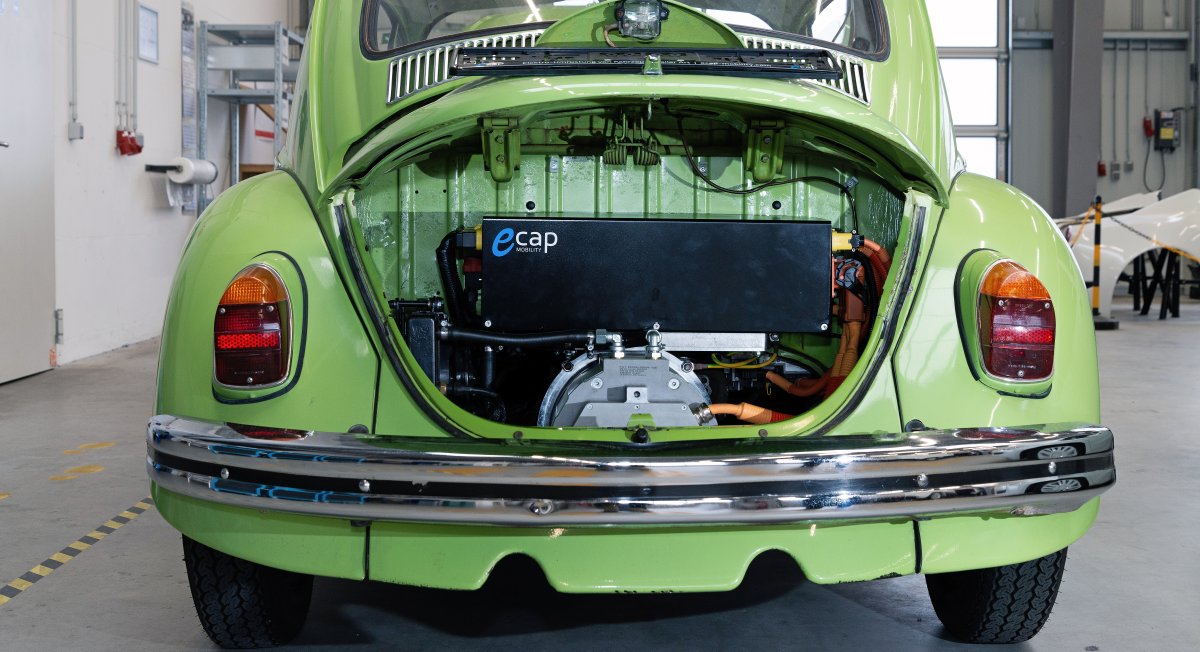
The UNECE, the United Nations Economic Commission for Europe, is working on a globally valid set of rules for converting combustion engines to electric drives. A working group under the World Forum on Vehicle Regulations will develop harmonized regulations by 2027 that will establish minimum requirements for conversion kits, define performance requirements for converted vehicles and enable the use of standardized kits that will be recognized in all participating countries.
Read more after the ad
It is still unclear whether inventors and self-converters will also benefit from a future set of rules. The current draft stipulates that only authorized installers are allowed to carry out conversions. Anyone who works in their own garage would remain dependent on national individual approval for the time being. The group’s next meeting will take place on June 11th.
Patchwork of national regulations
So far, anyone who wants to convert their combustion engine to electric drive in Germany is faced with an expensive individual purchase – and in most other countries there is no regulatory framework at all. Only France introduced its own standardized approval process for conversion kits in 2020, but in practice there has been no breakthrough so far.
In Germany, too, companies that have attempted mass-produced conversion have failed. But there is a lively tinkering scene and a handful of smaller workshops that convert combustion engines to electric drives. Make sheds light on the hurdles and challenges that hobbyists face who want to convert their combustion engine to electric drive on their own and get it through the TÜV.

When converting to an electric vehicle, the original gearbox is usually retained and connected to an electric motor via an adapter plate.
The UNECE is not a paper tiger when it comes to vehicle regulations: its regulations are recognized by 64 contracting states, including the entire EU, Great Britain, Japan and South Korea. The type approvals and test standards according to which vehicles and their components are approved in Europe largely come from there. If the working group adopts a UN regulation for retrofitting, EU member states could adopt it directly into national law and replace the previous expensive individual acceptance with standardized approval. The working group covers all vehicle categories, from two-wheelers to trucks. It is led by France and Spain, supported by Sweden, Germany, Great Britain, Japan and the European Commission.
Huge inventory, big impact
Read more after the ad
The need is great. There are around 1.4 billion cars on the road worldwide, the vast majority of them with combustion engines. Even if only electric cars were sold from tomorrow, the existing fleet would remain on the road for decades. Retrofitting could help to decarbonize this stock more quickly – with a better carbon footprint than buying a new car. The French environmental agency ADEME calculated in 2021 that a converted small car causes 66 percent less CO₂ over its remaining service life than a diesel engine that continues to operate and even 47 percent less than a brand-new electric car because there is no need to produce a new body.
A cost-benefit analysis by the Fraunhofer Institute for Systems and Innovation Research on behalf of SWR also shows that a conversion can also be economically worthwhile: with costs of 12,000 to 15,000 euros and an annual mileage of 14,000 km, the investment pays for itself after around seven years.
(mch)