It has long been a stressful rite of passage for many young people but, in recent years, passing the actual driving test is the easy part. Now, many people seeking a test need to wake up early to snag a date before the bots do and, even then, they are looking at a long and arduous wait.
Despite moves from the government to address the issue, an audit report released this week found plans to cut the wait for a driving test to seven weeks by the end of the year would not be achieved until November 2027.
One of the main barriers is an exodus of driving examiners. Only a net 83 more driving test examiners have been hired despite 19 recruitment campaigns since 2021, with the average wait for a practical test now at 22 weeks across Great Britain, according to the National Audit Office.
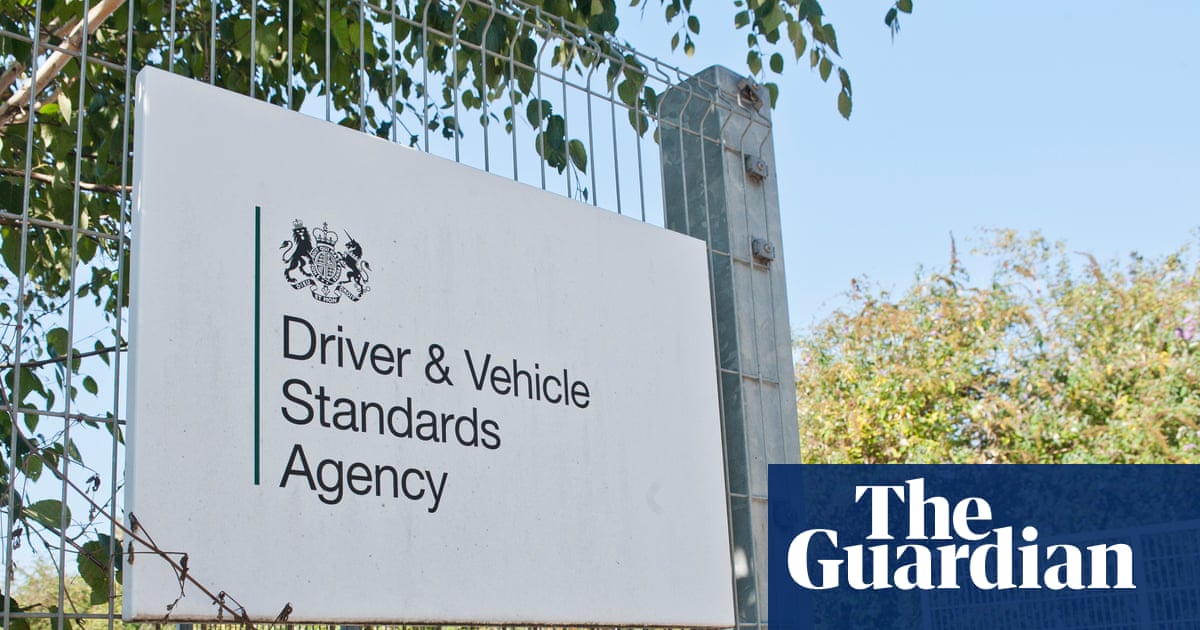
So, why is it so hard to recruit Driver and Vehicle Standards Agency (DVSA) driving examiners, and are instructors – who used to flock to test centres for a more stable career – tempted by the current offer?
Leon Woodman, 35, Devon, former driving examiner
In his previous job, kitted out with a bright hi-vis and Battenberg-marked car, Woodman was often mistaken for a police officer. “I was working as a traffic officer for Highways England. I was dealing with everything from hard-shoulder breakdowns to fatal incidents,” he said.
After a friend suggested he become an DVSA examiner, Woodman took on the advice and joined a local test centre.
He said he wanted to bring a “positive attitude” to his new role. “I really enjoyed the job. I remember it took me two goes to pass my driving test. I remember my first one having this really miserable driving examiner and I thought: ‘This is pure torture’. Then my second driving examiner was fantastic. He came out with a smile on his face and I said: ‘That’s the way I want to be,’” said Woodman.
But the job did come with challenges. “You quite often get those times where you’ve stopped a crash from happening because you’ve taken control of a vehicle and then you’ve got to do another test within the next five minutes. That’s what people don’t realise about the job,” he said.
On the other hand, Woodman said it was “nice to make an impact on people’s lives every day” by telling them they had passed. “Some people break down in tears and other try to give you a hug.”
Despite enjoying the job, Woodman left the DVSA in June 2023. “I moved on because of the money. I was growing a family and I was jealous of a few mates of mine who were hybrid working,” he said.
As government workers, DVSA driving examiners are paid on a civil service pay scale. They are designated executive officers, maxing out at just over £30,000.
“Prices for lessons went up quite a bit after Covid and instructors were earning a lot more than they were previously,” said Woodman . He thinks that has “slimmed down” the DVSA’s pool of people.
Jason Sykes, 54, Dewsbury, former driving examiner and current instructor
When Sykes first switched from being a freelance driving instructor to a DVSA examiner in 2016, he was happy. “At the time, I was taking home a similar amount of money without having to put in nearly as many hours. I was getting holiday pay, sick pay and a reasonable pension. I got my weekends back and I finished at the same time every night. I loved the job,” he said.
But, after Covid, things changed. He was vocal to senior DVSA figures about the issues he was experiencing with the job, including, he said, the recently departed chief executive, Loveday Rider.
He said he had met her on four occasions and brought up examiner’s poor wages and the “dodgy” booking system which allows bots and less reputable instructors to buy up tests and sell them at a hugely inflated price. “It’s not fair on the learner,” he said.
Sykes switched back to being a driving instructor but he still has fond memories of being an examiner. “I had one lady, her name was Jean. She was 82 years old. She had been here five times and she was desperate to pass.
“She’d started to learn to drive when she was about 20 and then she met her husband. After this, she had no reason to need to drive any more because her husband drove,” said Sykes.
After her husband died, she still wanted to get around so she started learning to drive again. “She passed her test when she was 82. It was amazing and lovely giving somebody that age a pass certificate,” said Sykes.
On the other hand, there are some close calls, including one instance that left him “drip white”. He recalls one young woman who wanted to do her test in her own car, which she had hardly driven, because “that’s the car that she’s going to be driving when she passes”, he said.
“The instructor was sat in the back. As we emerged out at the end of a road, the candidate on test had missed the fact that there was a car transporter with about 12 cars on it hurtling up the road at 30 miles an hour towards us,” said Sykes.
“She tries to pull out but she fumbles at the controls. She reached for a manual handbrake in the car but there wasn’t one, only an electric one she was unfamiliar with. I said: ‘Drive, drive, drive.’ I went drip white, so did the instructor. We just pulled up to the side of the road and I went: ‘I think we’ve seen enough.’”
Joshua Ramwell, Stafford, 39, driving instructor
Ramwell, who runs the YouTube channel Josh the Driving Instructor, has been an instructor since 2019. Before this, he was a teacher. Does being a DVSA driving examiner tempt him? “If I’m completely honest, no,” he said.
While Ramwell takes his “hat off to examiners” who have his “complete and full respect”, he thinks it can be quite a thankless job. He said: “When you pass someone, they generally thank the instructor. And if you end up failing someone, examiners end up being blamed for it.”
He was a relative late bloomer to driving, getting his licence at 22. He said the most rewarding part of being an instructor was when students get a “lightbulb moment”, whether struggling with a clutch or taking on a daunting roundabout.
“You can see it in their eyes, the cogs working, and next thing you know, they’re absolutely perfect at roundabouts,” he said.
Ramwell has had many success stories but, like most instructors, some near-misses as well.
“I had this really lovely girl but she suffered a lot from anxiety. We were driving down the road and unfortunately, there was another driver behind us who might have been late for work or something because she was tailgating us a bit closer than you would like.
“I told the girl: ‘Don’t look behind you. Just focus ahead, the roundabout’s coming up. In a minute you’re gonna have to press the brake.’
“The second I said the word ’brake’, in the middle of the road at 30 miles an hour, she just full-on emergency stopped and I had enough time to shout ‘Noo’ before the person behind hit straight into the back of us. That was a very sad day.”