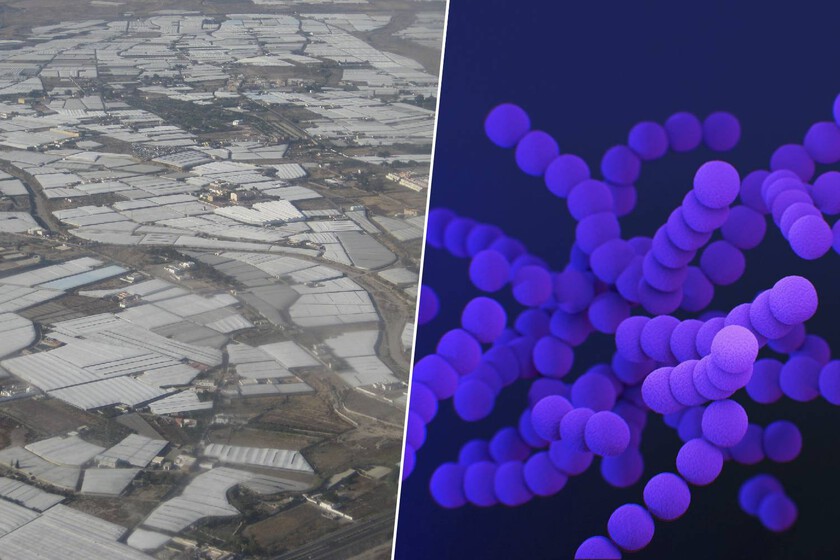
The west of Almería is world famous for a colossal structure that can be seen from the space itself, such as the ‘sea of plastic’. Thousands of hectares of greenhouses that act as a true agricultural engine for all of Europe, which has a microenvironmental B side that science has just seen when analyzing everything that is on top of this amount of plastics. And the problem is not only visual pollution or the amount of microplastics that can end up in the sea, but also the microscopic stowaways that travel in them.
The microbiological world. As two recent investigations led by scientists from the Autonomous University of Madrid have pointed out, it has been seen that abandoned plastics are not simple inert garbage; They are perfect vehicles for the development and spread of pathogens.
And we are not talking about just any pathogens, but about bacteria that have very powerful resistance genes against antibiotics inside. A topic that we have talked about on numerous occasions due to the problem it poses for public health and the challenge of searching for new medications to eliminate the bacteria that threaten our health.
The first study. Published in 2025 and with a very clear objective ahead: to analyze the plastic samples that were collected at three key points in El Ejido. These points specifically were the interior of a greenhouse, a waste dumping area and the Punta Entinas-Sabinar nature reserve.
When investigating the collected plastics, what they could see was a complex biological community, what science calls the “plastisphere“By analyzing biofilms, which are the layers of microorganisms attached to plastic, the researchers identified no less than 295 resistance genes to commonly used antibiotics, such as tetracyclines, macrolides and beta-lactams.
The most alarming fact. Having a bacteria resistant to our main pharmacological weapons is honestly worrying, but the real fear comes when the team detects 52 mobile genetic elements. This means that bacteria use plastic as a meeting point where resistance mechanisms are shared among them, making a bacteria that can be destroyed with amoxicillin become resistant when in this contact. It’s literally like trading cards are being exchanged.
How they arrive. These bacteria end up on top of the plastics, forming a biofilm precisely due to hazardous water and fertilizers that sometimes contain traces of antibiotics and microorganisms that end up colonizing these canvases. And the reality is that when a microorganism does not stop being in contact with an antibiotic, it eventually develops the mechanisms to block its effect.
The second study. If these plastics were left locked in a room, the truth is that they would not cause any problems, but science has put figures on the worrying mobility of this waste.
Here science documents how agricultural polymers escape from intensive exploitation and disperse through the soil, water, air and even the fauna of the area. On the nearby coast, the team collected 1,397 plastic fragments, analytically confirming that their composition exactly matches the materials used in local agriculture. And the worst of all is that in all these fragments that ended up elsewhere, associated pathogenic microorganisms were detected.

Global health. The WHO itself points out that antibiotic resistance is one of the greatest threats to global public health. Until now, the focus was on hospitals and drug abuse in intensive livestock farming, but now these Spanish researchers have detected a new front on which action should be taken.
And it is no wonder, since plastics are acting as reservoirs of resistant bacteria, which not only incubate superbacteria, but can also be transported by wind and water, which are responsible for spreading them throughout protected natural areas, aquatic ecosystems and food chains.
Images | Roger Casas-Alatriste CDC
In WorldOfSoftware | Faced with the need to look for weapons against superbacteria, science has opted to send viruses into space