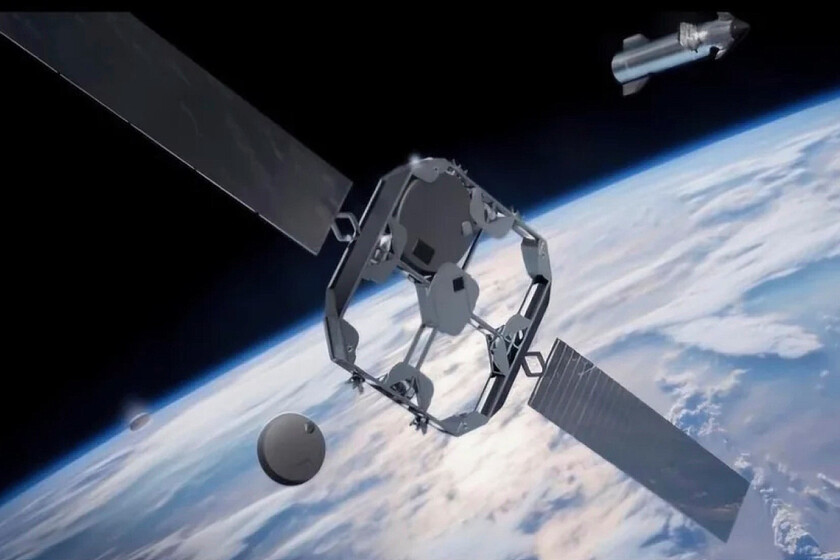
At 6:53 AM EDT (12:53 in Madrid) today, Tuesday, a Falcon 9 rocket took off from Cape Canaveral in Florida (USA). He did so with a very special mission: a technical demonstration of his new and mysterious re-entry capsule, called Starfall. This is not about missions to the Moon or Mars.
What’s up? It goes from manufacturing products in space to then taking them to Earth.
Musk Space Transport, SA. As pointed out in Ars Technica, documents published by the Federal Aviation Administration (FAA) provide more information. This document indicates that the purpose of Starfall is the “transport and delivery of goods through space.” We are therefore faced with a new and interesting business avenue for SpaceX, which once again – as is the case with Starlink – moves away from pure space exploration to propose alternative solutions to “terrestrial” operational problems.
SpaceX does not release any pledge. The company has detailed some of the phases of the mission on its official website, but has not given much information about the payload of said mission, and its message is confusing. According to those responsible: “today’s mission includes a demo of a new vehicle that will allow affordable and routine access to the microgravity environment for scientific research and for manufacturing in the same space.” The vehicle will make its re-entry to end up in the Pacific Ocean about 1,300 km west of California.
Space pharmacies. The FAA report reveals that Starfall will allow “point-to-point delivery of critical payloads through space in rapid times,” in addition to ushering in an era in which products can be manufactured in space thanks to the absence of gravity or in microgravity environments. There are companies already involved in this objective, and the purpose at the moment seems to be to manufacture pharmaceutical products. Once manufactured, vehicles like Starfall could be used to deliver these products to Earth.
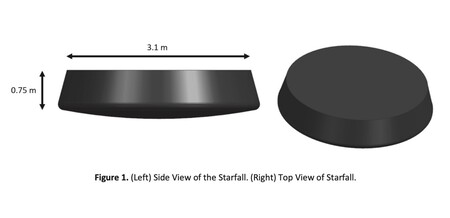
One ton of cargo. Existing documentation shows how Starfall is shaped like a cylindrical disk. Its diameter is 3.1 m, its height is 0.75 m and its weight is 2.1 tons. The current design contemplates that the load capacity of this capsule is about one metric ton.
SpaceX wants to eat the competition. Companies such as Varda Space Industries or Atmos Space Cargo had already launched reentry vehicles on missions with Falcon 9 rockets. With Starfall, SpaceX precisely enters this market to provide not only the rocket in which the cargo is launched, but also the reentry capsule that will bring the manufactured product to Earth. It will be very difficult to compete with its costs and vertical integration.
Space mining in sight. The short-term focus seems to be the production of drugs in microgravity conditions, but SpaceX could have another objective in the medium and long term. Specifically, asteroid mining, which could end up being commercially viable and will require a cheap and massive way to bring metals and rare earths mined in space to Earth.
Destination Mars. Starfall may also be part of Elon Musk’s ambitious plan to colonize Mars. While the Starship will be tasked with moving massive 100-ton loads, Starfall can be very useful for precise delivery of smaller supplies and delicate equipment.
A Starlink-like pattern. SpaceX’s plan seems to propose a strategy similar to that followed with Starlink. The satellite constellation has become an increasingly important alternative to traditional communications systems, and with Starfall the idea is not to explore space, but to control the supply routes to exploit it.
In | SpaceX wants to reach a capitalization of 1.75 trillion dollars. Analysts are clear that it is worth less than half