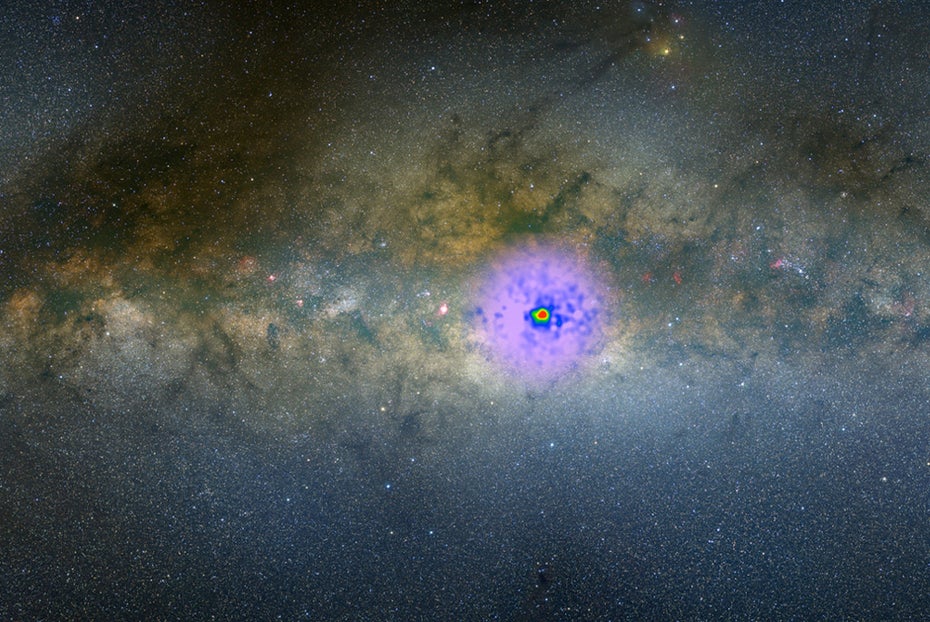
A team of researchers from the Austrian University of Vienna and the Lawrence Berkeley National Laboratory in the US state of California has re-examined the so-called gamma ray glow in the center of the Milky Way. The scientists used artificial intelligence methods to take a completely new look at the existing data recordings. As described in detail in a study published in the journal Physical Review Letters, dark matter is once again becoming the focus of astrophysical investigations as a very likely cause of the mysterious glow.
This phenomenon, known as the Galactic Center Excess, has puzzled astrophysics for more than a decade. Specifically, this is an approximately spherical gamma ray glow that extends over thousands of light years and whose physical origin is still completely unclear. Previous explanatory models generally favored a large population of particularly rapidly rotating neutron stars, known in the scientific community as millisecond pulsars.
Machine learning involves photon energy
Previous statistical studies primarily supported this theory of pulsars because they identified so-called spatial point sources in the data. However, these studies completely ignored a crucial physical aspect: the specific energy of each photon detected. The research team therefore developed a new machine learning method that was trained with more than a million simulated sky maps to evaluate spatial and spectral information simultaneously for the first time.
The consistent inclusion of this energy information fundamentally changes the interpretation of the telescopic data, as Space.com reports. If stars or pulsars were actually responsible for the massive gamma glow, these point light sources would have to be extremely faint, according to the new calculations. The University of Vienna writes in an official press release that these stars must be so weak that they would ultimately be almost indistinguishable from the diffuse radiation that would arise from the presumed dissolution of dark matter.
Huge amounts of pulsars would be required
Dark matter is currently a physical construct. Astrophysical calculations assume that this postulated, invisible form of matter makes up around 85 percent of all matter in the universe and in principle does not interact with the ordinary matter we know. However, if such suspected dark matter particles collide in the extremely dense center of a galaxy, the theory suggests they could annihilate each other, releasing massive energy in the form of gamma rays. The trained algorithms now showed that for the alternative pulsar hypothesis, at least 35,000 such point sources would have to exist in the center of the Milky Way in order to produce the measured values.
This is a significantly higher number than the few hundred to a maximum of a thousand sources that were considered realistic in some previous academic works. With this new finding, the current study undermines one of the strongest counterarguments to date for the already popular theory of self-annihilating dark matter. However, in practice, properly interpreting the signals remains a gigantic challenge because the galactic center is an extremely dense and exceptionally bright area of the gamma-ray sky, making spurious signals unavoidable.
Not definitive proof, but an important signal
“The question of the origin of the Galactic Center Excess is one of the longest-running debates in astrophysics,” is how astrophysicist Florian List from the University of Vienna classifies the situation. According to his own statement, his detailed work does not necessarily show that dark matter is solely responsible for the signal received. However, based on the massive data analysis, it suggests that it is still far too early to finally banish this fascinating astrophysical possibility from the files.
Editorial recommendations
${content}
${custom_anzeige-badge}
${custom_tr-badge}
${section}
${title}
Even if the presented study still lacks direct scientific evidence for dark matter, it inevitably forces the astrophysical community to rethink old models. Future evaluations must now show whether even finer measurement methods or much larger data sets can perhaps still technologically isolate the extremely weak pulsars. Until such instruments become available, the colliding dark matter hypothesis remains a completely plausible explanation for the measurements.
Despite all the technological euphoria, it should not be ignored that the machine results depend heavily on the background models used in the simulations. A systematic change in the underlying parameters for modeling the structure of our Milky Way could theoretically significantly reduce the required number of pulsars again. The search for the true physical nature of galactic gamma rays still requires a great deal of technological and, not least, classical analytical development work.
Top Article
${content}
${custom_anzeige-badge}
${custom_tr-badge}
${section}
${title}