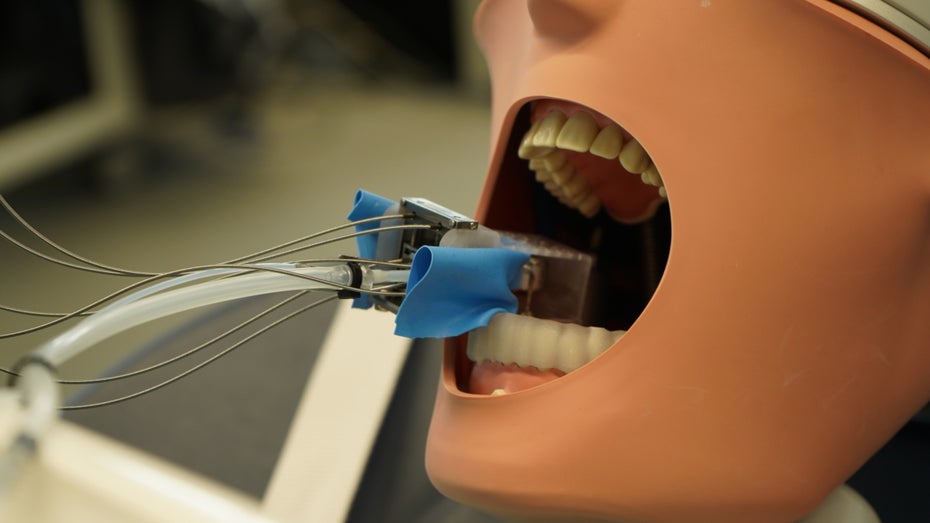
A team led by Professor Georg Rauter and researcher Yukiko Tomooka at the Swiss University of Basel has developed a novel miniature intraoral robot that fully automatically prepares human teeth for crowns. As can be read in a study published in the specialist journal IEEE Transactions on Medical Robotics and Bionics, the compact system is intended to significantly speed up future dental treatments and make them significantly more pleasant for patients.
Until now, crown treatments inevitably required several separate sessions because dentists first had to grind down the tooth, make impressions and insert error-prone temporary restorations. The new robot, which the Swiss company is presenting in a recent press release, enables direct computer-aided planning and subsequent execution of the entire milling work in a single session after an initial digital scan.
During traditional manual procedures, dentists rely primarily on their visual judgment, which, according to scientific evaluations, can lead to over 75 percent of healthy tooth structure being removed unnecessarily. A robot-assisted approach promises a much gentler treatment in which only the precisely calculated minimum amount of material is removed.
Mechanical coupling solves the delay problem
Previous robotic systems in dentistry, such as those currently being developed by competing companies from the United States or France, often work with voluminous robot arms that stand next to the patient. These massive constructions absolutely require external optical tracking systems to record head movements, which always leads to dangerous time delays in the electronic control.
The new prototype from Basel circumvents this fundamental problem of spatial distance through direct mechanical fixation on an individually manufactured dental splint directly in the oral cavity. When a person being treated turns or tilts their head, the small robot, measuring just 43 by 26 by 28 millimeters, moves absolutely synchronously with the teeth due to this rigid connection.
In order to reduce the weight and space required in the oral cavity to the strict minimum, the developers relocated the heavy drive motors completely next to the treatment chair. Instead, the precise power transmission to the milling head takes place via millimeter-thin, flexible shafts, which ensures direct, delay-free operation and allows clinical use even with a small mouth opening of just 18 millimeters.
The actual milling process is intelligently divided into two successive work steps in order to make optimal use of the very limited anatomical space. First, the system effectively reduces the tooth height with a short, wide drill, before a second, much longer and thinner attachment takes over the delicate processing of the side tooth walls.
Impressive laboratory values with a need for technological improvement
In initial laboratory tests on plastic models and on a special dental ceramic whose extreme hardness is similar to natural tooth enamel, the device has already milled extremely precise geometric paths. The mechanical forces that occur during grinding always remained below five Newtons, which roughly corresponds to the gentle weight of a small half-liter bottle of water.
However, with a deviation of an average of 0.18 millimeters, the absolute positioning of the rotating drill still just misses the target of a maximum of 0.12 millimeters defined for strict clinical use. This still measurable inaccuracy results primarily from the control technology currently used, which currently operates completely “blindly” exclusively on the basis of the computational data from the external motors.
In the next development phase, the research team plans to install tiny cameras and position sensors directly into the delicate joints of the robot in order to increase the work precision through internal data comparison. Such a closed loop would tell the system in real time exactly where the drill is located and guarantee seamless, error-free continuation of treatment even after a sudden power failure.
Editorial recommendations
${content}
${custom_anzeige-badge}
${custom_tr-badge}
${section}
${title}
The ambitious project is funded by the innovation agency Innosuisse from Bern and is being driven forward in close collaboration with the Center for Dentistry at the Swiss University of Zurich and the medical technology company Camlog Biotechnologies GmbH from Basel. Such profound industrial collaborations indicate a clear economic marketing interest, but extensive clinical tests on human patients must first prove absolute medical safety before it can be used across the board in regular practices.
The dental market will decide in the coming years whether this highly miniaturized system can prevail in the long term against the technological developments of massive robot arms. However, the innovative approach of consistent reduction in size and direct mechanical coupling to the patient offers an undeniably elegant solution to a previously unsolved problem in surgical robotics.
Top Article
${content}
${custom_anzeige-badge}
${custom_tr-badge}
${section}
${title}