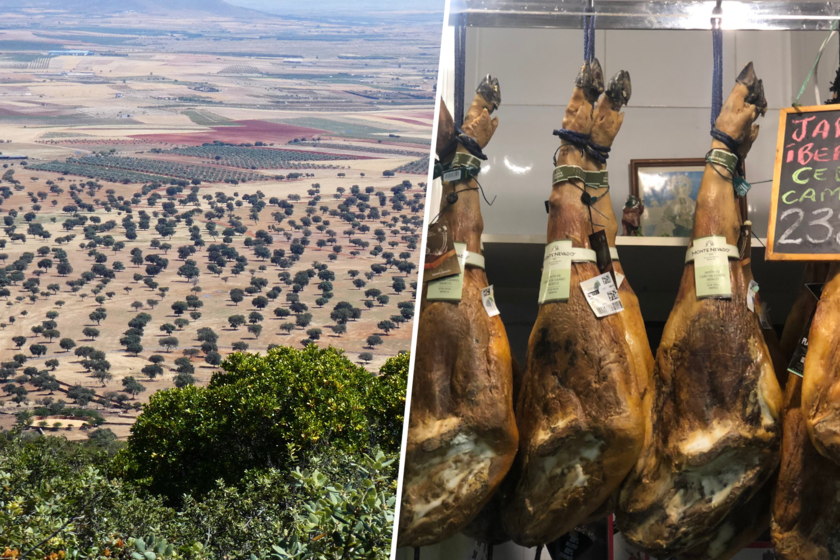
The ‘dry’ advances through the pastures of western Spain. And it is normal, not only is it a serious disease that causes the death of holm oaks and cork oaks; It is the consequence of decades of bad forestry practices that have undermined the ecosystem from within.
But that is not new. We have known for many years that the Iberian pasture has an expiration date. The news now is that Iberian ham producers have begun to realize the consequences of the problem and some of them have decided to take action on the matter.
This is how acorn-fed ham wants to save one of the most characteristic forests of the Iberian Peninsula.
What do we talk about when we talk about the pasture? Let’s start with the latter: despite what many may think from the top of the Vía de la Plata, the pasture is not “virgin nature”, or anything similar. It is a very complex agro-silvo-pastoral system, the result of centuries of forest clearing, extensive grazing and human uses of all kinds.
We are used to ecosystems that are maintained despite economic activity, but in this case the example is the opposite: we are talking about a very unique productive structure of four million hectares on which pastures, cork, game, honey and, of course, ham depend. If the pasture falls, the acorn falls and, with it, the ham falls.
A nightmare called ‘Seca’. That is, at least, its popular name. It is a pathogen (Phytophthora cinnamomi), directly linked to the decline and death of these forests. CICYTEX describes it as a major threat to the Iberian pasture. And, anyway, he is right.
It is true that the fungus is, to a certain extent, opportunistic: it needs water stress and alternating dry and wet periods to spread and infect trees. However, once it appears, it activates a whole series of functional changes (from defoliation and dieback of shoots and branches to necrosis of the root system) that lead to the death of the tree.
That is why, little by little, the nightmare of the drought has become more terrible and distant.
Intervention. To the point where the ham companies have taken action on the matter. The Joselito group, for example, has invested more than 6 million euros in R&D. Their bet is to change the focus, stop focusing on getting better fungicides and bet on the regeneration of ecosystems that can confront diseases.
According to company data, more than 2,700 hectares have been intervened (Badajoz, Cáceres, Seville and Portugal) and, for the moment, an improvement of 7.5% has been achieved in vegetation indices in treated areas. It is not the only project and the truth is that, a priori, it is good news. It’s a drop in the ocean; but it is the beginning of what may be a new paradigm. And that, at least, allows us to face the situation with a little more hope.
Whose pasture is it? Beyond marketing, the need for companies to maintain the pasture and the change in concept compared to Seca, the initiative generates many uncertainties. The main one has to do with the privatization of countryside conservation.
It is good news that agricultural industries are beginning to show solidarity with the environment in which they carry out their activity. As we have learned in recent years, the trend is just the opposite.
The risk. However, supporting the maintenance and management of four million hectares on the shoulders of the ham industry (or on the rest of those who “take advantage” of the productive infrastructure of the dehesa) is a risky decision. We have already seen how depopulation has destroyed the ecosystems of half the country: do we really want to leave our natural heritage in the hands of an industry as fragile as agriculture?
Image | Miguel Angel Masegosa | Jose Antonio Rivero Forne
In WorldOfSoftware | In California, the funds discovered that there is no investment more profitable than farmland. Now it’s Spain’s turn