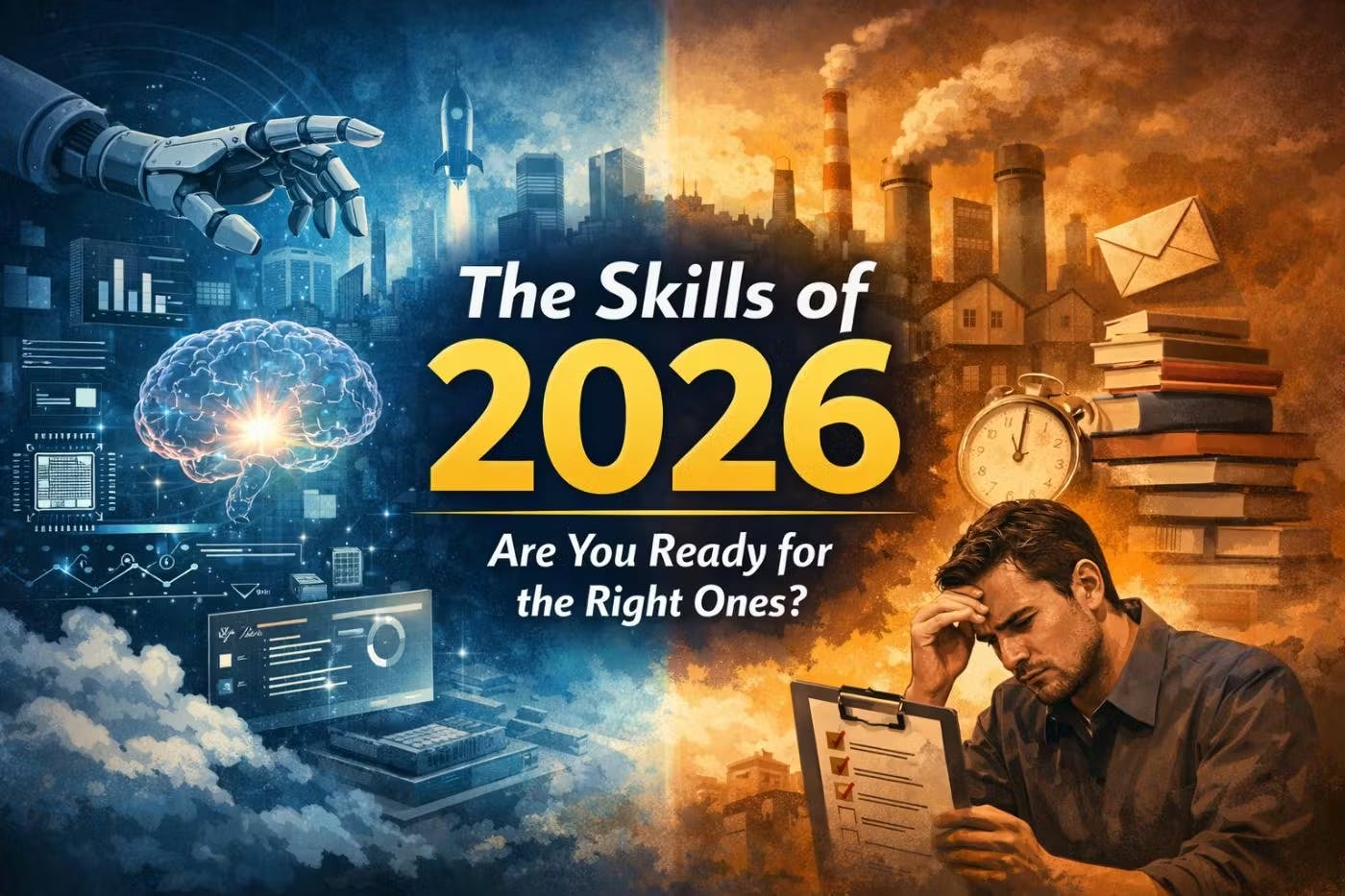
Every few years, the same question resurfaces:
“What skills will be in demand in the future?”
The recurring question of future in-demand skills has gained new urgency in 2026 due to rapid labour market transformation. The real issue isn’t a lack of information, but that most people are preparing for the wrong future by learning skills in isolation. They treat competencies as siloed resume points (e.g., a single programming language or tool), believing this offers security.
However, the modern labour market rewards capability in systems, not just simple technical proficiency. Value is created by understanding how disparate tools, data, and human teams interact to achieve an outcome, the ability to connect and optimise the whole mechanism.
The acceleration of AI dramatically widens this gap. As AI handles discrete, repeatable tasks (like basic code or data analysis), the demand for human expertise shifts upward. The future belongs to individuals who can manage, orchestrate, and optimise the entire system that utilises these AI components, the architects of systems, not just the operators of individual tools.
The Old Model of “In-Demand Skills” Is Broken
So the market has shifted from what you know to how you apply, adapt, and integrate knowledge. The traditional model for career skills is becoming obsolete.
The Old Model (Skills as Static Assets): In the past, the path was straightforward:
- Learn specific, defined skills (e.g., Python, data analysis, cloud computing).
- Obtain certifications.
- Get hired.
This system thrived when:
- Job roles were clearly defined.
- A large volume of entry-level jobs was available.
- Gaining experience was a gradual process.
The New Reality (The Shift in 2026):
That world is rapidly disappearing. Today, the market requires more than just knowledge.
- Artificial Intelligence now excels at many task-level skills that humans once performed.
- Companies prioritise hiring for impact and demonstrable results over mere knowledge.
- The financial and operational risks associated with poor hiring decisions are escalating.
- Corporate training budgets are shrinking.
Consequently, the focus has shifted from what an individual knows to their ability to apply, adapt, and integrate knowledge effectively.
The Real In-Demand Skills for 2026 (That Most Lists Miss)
Let’s be clear: technical skills still matter. However, technical skills alone are no longer enough. The most in-demand skills for 2026 fall into five categories.
1. Systems Thinking (The Skill Behind All High-Value Roles)
Systems Thinking is the fundamental cognitive framework for high-leverage roles. It is the ability to move beyond isolated components to understand the holistic, dynamic architecture of any system (business, software, organisation, etc.).
This skill involves:
- Understanding Part Interaction: Recognising connections, dependencies, and feedback loops (e.g., how sales commission affects product development and burn rate).
- Seeing Cause and Effect: Tracing consequences through complex networks to anticipate secondary and tertiary effects (e.g., finding a marketing system change caused the drop in sales).
- Identifying Leverage Points: Locating the specific, non-obvious points where a small effort yields disproportionately large, positive results for maximum impact.
The Irreplaceable Human Factor
While AI excels at pattern recognition and execution on codified inputs, it cannot reliably design, evaluate, or optimise systems in context. System design requires deep contextual understanding, novel problem synthesis, and the judgment to anticipate human behaviour, skills uniquely human.
Systems Thinking as the Professional Multiplier
This cognitive superiority explains why systems thinkers consistently occupy strategic, high-value roles:
- Product thinkers outperform pure coders by understanding code within the larger product ecosystem, business goals, and user experience.
- Systems-thinking analysts outperform pure data query experts by interpreting numbers within an operational context, transforming data into high-leverage strategic insight.
- Founders/Executives outperform feature builders by constantly designing and balancing the entire system (capital, talent, culture, product, market).
Systems thinking is the multiplier skill that converts technical proficiency into strategic leadership, moving individuals from task execution to scaled value creation.
2. Problem Framing (Not Problem Solving)
AI is excellent at solving problems once they are clearly defined. However, the critical steps of identifying, framing, and scoping the problem remain a uniquely human domain.
Humans retain a significant advantage in:
- Identifying the Right Problem: Leveraging intuition, context, ethics, and non-quantifiable factors to diagnose root causes and challenge flawed objectives.
- Asking the Right Questions: Formulating incisive inquiries (“What if…?” “Why are we doing this?”) that drive innovation and meaningful value.
- Defining Constraints and Trade-offs: Establishing boundaries (budgetary, ethical, etc.) and making difficult judgments that transcend algorithmic optimisation.
The Future Premium: Problem-Finding
In the age of AI, the highest strategic value will accrue to individuals with the meta-skill of problem-finding. The ability to declare, “We are solving the wrong problem here is the real opportunity,” will define leadership.
This strategic problem-framing capability is foundational for success in roles like Strategy, Senior Technical Positions, Consulting, Product Leadership, and Policy. This essential human complement to AI, defining reality before optimising within it, is highly rewarded in the marketplace.
3. AI Collaboration (Not Prompting)
The rapid obsolescence of “prompt engineering” as a standalone skill means professional success now hinges on strategic AI application, not mechanics.
Critical competencies for modern professionals are:
- Knowing When to Use AI: Discerning which tasks are best for AI augmentation (e.g., drafts, data analysis) versus those requiring human judgment or strategic thought.
- Knowing What to Trust and What to Validate: Developing a sceptical eye to verify AI outputs, check for “hallucinations” and bias, and cross-reference against reliable sources.
- Knowing How to Integrate AI Outputs: Translating raw AI insights into actionable steps, considering organisational, ethical, and market context.
The in-demand role is the AI supervisor, who demands higher-order management skills:
- Combine Domain Knowledge with AI Output: Interpreting and refining AI suggestions through the lens of deep subject matter expertise.
- Spot Hallucinations, Bias, and Weak Assumptions: Performing critical quality control to correct errors and challenge flawed AI assumptions.
Ultimately, AI must be a force multiplier, amplifying human productivity and critical thinking, not a substitute or crutch. The future belongs to those who master and manage AI.
4. Domain Depth + Transferable Thinking
The professional landscape of 2026 demands the T-shaped professional, where context beats credentials. In a volatile, uncertain, complex, and ambiguous (VUCA) world, success requires an adaptable model over rigid specialism.
The T-shape combines two essential capabilities:
- Deep Expertise (The Vertical ‘I’): Mastery in one core discipline, providing technical authority and specialised problem-solving capacity.
- Transferable Thinking (The Horizontal ‘ — ‘): Cognitive flexibility to connect disparate ideas, bridge silos, apply frameworks across units, and communicate complex concepts for holistic, strategic contribution.
This blend drives intersectional careers (e.g., Finance + Data, Compliance + AI), creating unique value propositions that automation cannot replicate.
Why Context Trumps Credentials: Credentials only prove knowledge, but context proves wisdom and the ability to apply a diverse skillset to achieve measurable business impact. Automation targets narrow specialists. The T-shaped professional’s value lies in the dynamic interplay, the creative application and connection of ideas, which is inherently human and irreplaceable.
The lesson is clear: Credentials are a start, but mastering situational awareness and deploying versatile, deep, and transferable skills is the true path to sustainable career success.
5. Learning Velocity (The Meta-Skill)
The most valuable skill is no longer what you know because your learning velocity is your real employability. The modern professional landscape has shifted from valuing static knowledge to prioritising a dynamic trifecta for success:
- Learning Velocity: Rapidly assimilating new concepts and technologies.
- Unlearning: Strategically abandoning outdated knowledge to adopt superior approaches.
- Application: Pragmatically applying new knowledge to solve real-world problems.
This shift means careers are non-linear, roles are fluid, and job titles are unreliable. In this VUCA world, your qualifications are defined by future potential, not past achievements. Your learning velocity is your real employability, guaranteeing relevance and value in the modern economy.
Why Most People Are Preparing for the Wrong Future
Traditional career guidance, based on an increasingly obsolete professional landscape, relies on failing assumptions:
- Stable Roles,
- Predictable Progression, and
- Clear Entry Points via specific credentials.
However, the modern labour market, driven by technology and globalisation, now values different competencies:
- Adaptability over Preparation,
- Application over Accumulation of knowledge, and
- Evidence (portfolios, results) over Credentials.
This structural mismatch explains why many professionals feel stuck and frustrated. They diligently followed the outdated map (earned degrees, took entry-level jobs) and prepared successfully for a predictable system that no longer exists. Their strategy was sound, but the game has changed.
What This Means for Professionals in 2026
Career planning based on superficial metrics is setting you up for obsolescence. The job market demands skills over credentials.
Obsolete Career Foundations:
- Job Titles: Titles are mere labels; focus on the function and impact you deliver.
- Certificates Without Application: Collecting diplomas without hands-on application offers diminished value. The market demands demonstrable mastery through results, not just proof of learning.
- Tools Without Understanding: Proficiency in a specific tool is transient. True expertise lies in grasping the ‘why’, the foundational, tool-agnostic principles.
The Future Mandate: Impact-Based Competencies
Modern hiring systems, human or AI, reward demonstrated capability and impact, not credentials. Future-proof your career by focusing on these questions:
- Can you explain why? Move beyond ‘how’ to ‘why’ to demonstrate critical thinking and adaptability, separating the expert from the technician.
- Can you link output to business impact? Technical skill is a commodity; the ability to translate it into measurable value (e.g., revenue increase, cost reduction) is the differentiator. Employers want outcomes, not outputs.
- Can you demonstrate a real-world application? Proof, like project portfolios and documented case studies, is the future’s currency. Real-world success is exponentially more valuable than high exam scores.
The market filters for effectiveness. Future-proofing your career means becoming a creator of measurable impact, not just a collector of documents.
The Quiet Shift Already Happening
Professional evaluation and hiring are fundamentally changing, shifting the basis for identifying and recruiting talent. The Paradigm Shift
The move is decisive:
- From Signals to Capability: Hiring is moving from relying on proxies like university prestige or past employer status (signals) to assessing direct, observable capability, the actual skills and problem-solving ability required for the job. The focus is now on what a person can do, not where they learned.
- From CVs to Evidence: The static CV is being replaced by the demand for concrete evidence, portfolios, case studies, code repositories, and metrics that prove expertise and impact. This values verifiable outcomes over self-reported history.
- From Credentials to Outcomes: Formal qualifications are being superseded by a focus on outcomes. Organizations prioritize the demonstrable impact an individual has made. The key question is “Did you achieve a measurable, valuable result?” not “Did you get the certificate?”
This necessary shift is uncomfortable, forcing hiring managers to develop objective assessment methods for true meritocracy.
This institutional change explains why talented, credentialed people feel overlooked: the system changed before the advice did. Traditional career advice focusing on pedigree and standard qualifications is now mismatched with a system that demands evidence and outcomes.
In Conclusion
Professional competence is rapidly shifting. In-demand skills for 2026 are not just new tools, but new ways of thinking, learning, and applying knowledge. True value lies in cognitive agility, the capacity to learn, unlearn, and relearn (meta-skills) over static expertise. This demands critical thinking, systems thinking, and emotional intelligence to solve complex problems and collaborate. In an age of accelerating technology, human judgment, creativity, and synthesis are the ultimate competitive edge. Individuals and organisations who master these intellectual and adaptive capabilities will not just survive disruption; they will become the architects of the future economy.