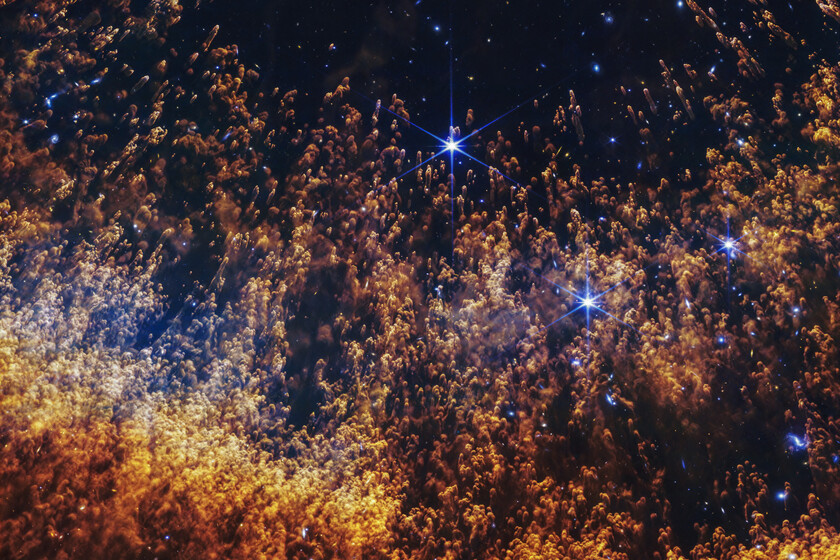
If there were a nebula popularity contest, the Helix nebula would be at the top: it is one of the brightest and closest to Earth, located about 650 light years from the Solar System, in the constellation of Aquarius. However, the fact that it was discovered more than two centuries ago and its resemblance to the “Eye of Sauron” have made it one of the most photographed in history.
Over the years the Hubble Space Telescope has captured some of the most iconic images of the Helix Nebula, like the one you can see just below these lines, but the new images that NASA has just published of the James Webb They are simply on another level. If you like astronomy and want to renew your desktop background, here are some great candidates.
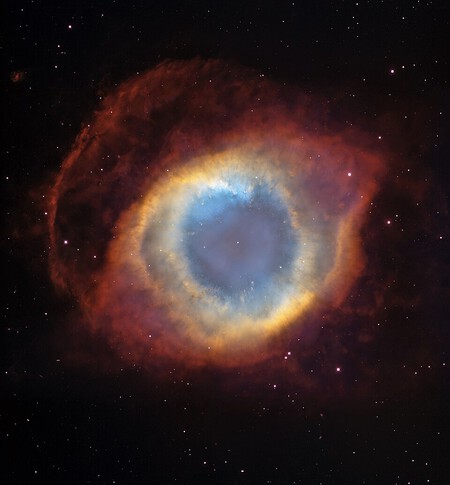
One of the most iconic images of the Helix Nebula, made by Hubble. POT
The reason is not so much because of the nebula itself, it is that the difference in sensitivity and sharpness is abysmal compared to the veteran Hubble and the retired Spitzer, as you can see in this video. The key is the size of their “eye” (the mirror) and the type of light they detect.
Thus, while Hubble observes mainly in the visible and ultraviolet, with a 2.4-meter mirror, Spitzer was a pioneer of the infrared with a much smaller mirror, 0.85 meters, which limited its resolution. The James Webb combines the best of both approaches: with a 6.5-meter mirror and extraordinary infrared sensitivity, it achieves unprecedented resolution in that range of the spectrum and is capable of passing through interstellar dust. In image quality it plays in another league.
The Webb Space Telescope photographs the Helix Nebula in spectacular detail
The correct term to refer to this nebula is “planetary nebula”, which does not clarify very well what we have in front of us: they are not formed from planets, but from stars like the Sun. When their life is running out, these stars emit large amounts of gas in an envelope that expands in a grandiose but “brief” phenomenon (in cosmo, not terrestrial units). It is, in a nutshell, like glimpse the possible final destiny of the Sun and our planetary system.
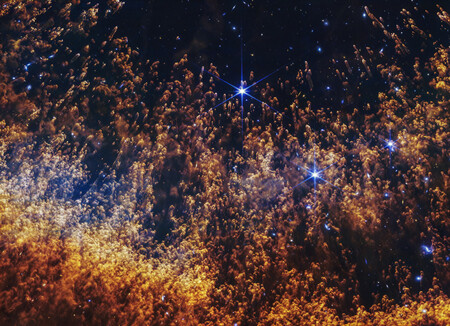
This new image highlights comet-like knots, strong stellar winds, and layers of gas released by a dying star as it interacts with its environment. Image: NASA, ESA, CSA, STScI; Image processing: Alyssa Pagan (STScI)
The image obtained with Webb’s NIRCam (Near Infrared Camera) that you see just above shows a type of pillars that look like comets with elongated tails, tracing the circumference of the internal region of an expanding gas envelope, explains NASA. The image shows “scorching winds of hot, fast-moving gas from the dying star colliding with slower, cooler layers of dust and gas ejected earlier in its life, sculpting the nebula’s extraordinary structure.”
Webb’s near-infrared vision highlights these knots against the ethereal image from NASA’s Hubble Space Telescope, and thanks to the higher resolution, the focus is much sharper than ever. In addition, this infrared vision makes it possible to clearly visualize the transition between the hotter and colder gas as the envelope expands.
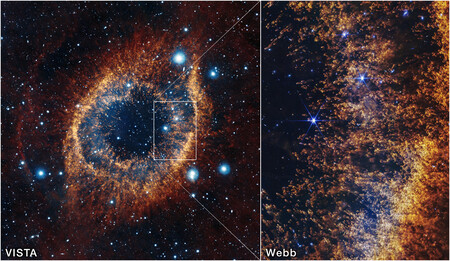
The Helix Nebula from the Visible and Infrared Telescope for Astronomy located on Earth (left) in front of Webb’s field of view (right). Image: ESO, VISTA, NASA, ESA, CSA, STScI, J. Emerson (ESO); Acknowledgment: CASU
Outside the Webb’s frame, you can see the white dwarf in the center of the nebula (its nucleus), which emits very strong radiation. This energy works like a kind of flashlight that illuminates the surrounding gas in different chromatic layers depending on the temperature: the blue area is the closest and hottest, the coldest is red at the edge, where the gas mixes with dust. In the middle, the intermediate area in yellow, where atoms begin to join together to form molecules.
The most striking thing on a technical level is that to date, Spitzer images only hinted at the formation of these molecules, but the resolution of the Webb allows us to see precisely those dark and protected “pockets” between the bright orange and red tones: it is where complex molecules are being manufactured. This interaction is essential insofar as it constitutes the raw material from which one day new planets could form in other star systems.
In WorldOfSoftware | NASA has published 96 fantastic posters of the universe that you can download for free in HD
In WorldOfSoftware | The first images from NASA’s new satellite offer us a completely different view of the oceans
Images | POT