Joe Maring / Android Authority
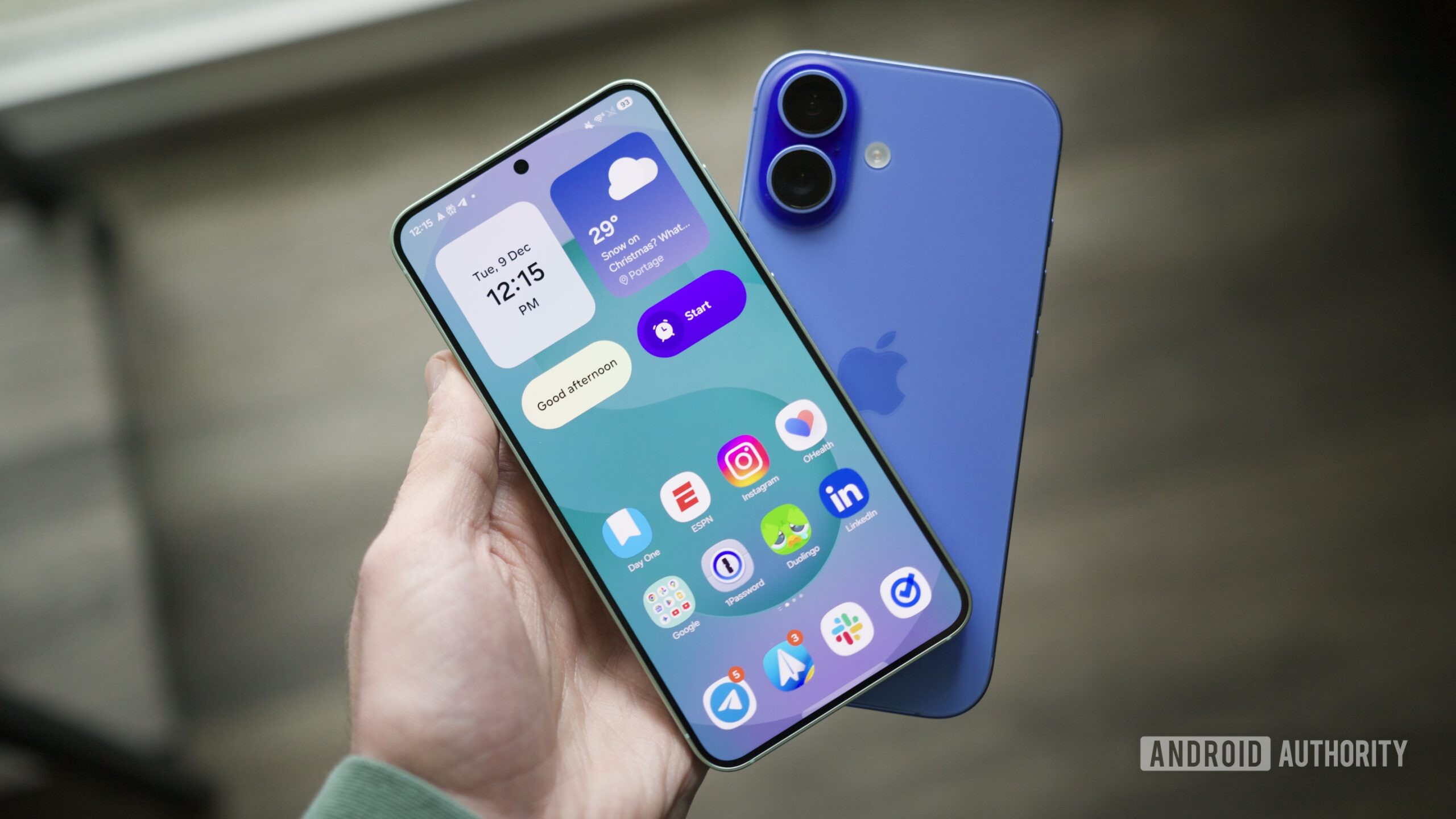
It’s no secret that over the last few years, we’ve seen much more incremental yearly updates from smartphone makers, with fewer major changes to the formula. This is especially true for Samsung, which has been doing less each generation to set its devices apart. It is rumored that the situation will get even worse, as the Galaxy S26 is expected to be virtually identical to its predecessor, beyond a minor processor upgrade and a few other small refinements.
I get the urge to feel like manufacturers are phoning it in (pun semi-intended), and that a change is needed. Still, I’m starting to realize it might be hardcore fans, and people like me, who need to change their perspective.
Are more incremental yearly phone updates inevitable as the market matures?
0 votes
The smartphone market has matured, and the result is admittedly boring

Ryan Haines / Android Authority
While the frustration is understandable from a tech enthusiast’s perspective, much of this appears to be a natural outcome of market maturity. In the early days, the leap from one generation to the next was immediately noticeable. Improvements spanned processors, RAM standards, storage, cameras, batteries, and nearly every other component. I remember my Nexus 5 feeling like a genuinely substantial upgrade from my Nexus 4. A great deal has changed since 2013, and with each successive release, the perceived impact of upgrading has diminished.
As smartphones grew larger and settled into more uniform designs, there was simply less room for dramatic generational change. Processor advancements continued, but real-world performance differences between a new phone and a two or three-year-old model became increasingly subtle. Over time, attention shifted toward battery life, camera performance, and charging speeds, while major hardware leaps became less frequent. Software, followed later by AI, gradually took on a more prominent role in driving upgrades.
Many of us miss the days when yearly smartphone upgrades were more likely to bring big changes, but the market is moving on.
This brings us to the current landscape. Innovation has not disappeared in 2026. A wide range of unconventional devices still reach the market, though many are not targeted at the United States.
Some of the most ambitious design experiments come from China-based manufacturers that do not sell domestically and have less brand power outside of certain spheres. For them, standing out through bold design and experimentation is often essential.
For example, we’ve seen OnePlus, Honor, and a few other brands experiment with massive silicon-carbonate batteries. Likewise, we’ve seen the Vivo X200 Ultra with its impressive 200MP periscope telephoto sensor.
In contrast, the iPhone, Galaxy, and Pixel lines dominate the US market. Not coincidentally, these brands are also the most conservative when it comes to visual changes and major innovations.
For established players, consistency carries significant value. Too much deviation can lead to consumer uncertainty or fatigue, and many new features fail to register with mainstream buyers anyway.
Comparatively less popular brands such as Motorola and OnePlus, which also operate in the US, tend to take more risks. They are more willing to revise designs or introduce unconventional features, largely because experimentation is a viable way to attract attention in a tightly controlled market.
Although I would welcome a more dramatic design shift from Samsung, or a clearly transformative upgrade beyond incremental improvements, the current approach appears effective. If it were not, manufacturers would likely feel greater pressure to rethink their strategies.
This behavior is typical of mature industries. As someone who has followed the PC market since the mid-1990s, I can attest that there was once far more diversity in system design, and even a short span of years could bring noticeable gains in capability compared to the modern era. Today, it has become common for PC designs to remain largely unchanged for extended periods, with only modest annual updates. When interest in a product line begins to decline, that is often when manufacturers introduce more substantial redesigns.
In many respects, smartphones now follow a similar pattern. Of course, it’s not a perfect comparison. The PC market has more alternatives like custom-built systems and heavier brand competition.
Even so, innovation still exists in smartphones aimed at power users. We’ve already mentioned a few innovations above, but there are also more global devices that still stand out, such as the Samsung Galaxy Z TriFold.
Upgrade expectations are still high for some users, but marketing could solve some of this

Joe Maring / Android Authority
In the early years, smartphone reveals tended to feel like major cultural events and were a big deal. It wasn’t always even just the geeks like me. I knew several Apple fans who were less tech-y, yet they followed announcement events closely. Between the rumor mill and hype train, people learned to expect big things at announcement conferences.
Over time, the crowd actively interested in major smartphone innovation shrank as phones looked and behaved more uniformly. People no longer wanted big changes, because what they had worked well.
This started as an iPhone mentality in a lot of ways, but it has drifted into the Android camp over time as well.
The problem is that many of the more ardent smartphone fans still seem to tie their expectations to that earlier era. Some of this is likely down to nostalgia. I certainly miss the days when smartphones still felt like an exciting frontier of possibilities. It’s part of why I tried so hard to love foldables, because I missed the novelty.
As smartphone technology matures, incremental updates become the norm. This doesn’t have to be a big deal.
I also feel like the companies themselves are part of the problem. They are still attempting to keep the old hype training running. Branding is still often focused on the latest models and not on the brand as a whole.
Samsung and Apple are both good examples here. Every year, they still put out teasers, big conferences, and other efforts that paint their devices as “the next big thing”. Yet the actual changes are increasingly small.
If companies want to continue leaning into a more incremental update cycle, clearer messaging is needed here. This doesn’t mean abandoning marketing, but it means less focusing on hyping launches and more on hyping the brand.
Right now, the focus still seems to be on the entire Galaxy, Pixel, or iPhone family. This needs to change. Personally, I’d love to see brands simplify and slow down their upgrade and release strategy across the base models, while still treating one of their high-end models as more of a separate product that is more aggressively upgraded and innovated on. We already see this to some degree with devices like the Galaxy S Ultra line, but doubling down on the innovations here would signal that the niche market isn’t being completely ignored.
Innovation has slowed, but it doesn’t mean it’s dead

Adamya Sharma / Android Authority
The truth is that a combination of market maturation and our current economic environment has led to a world where smartphone innovation is slower than ever, but that doesn’t mean it’s a problem. Constant innovation is no longer required for a quality smartphone experience. Most users care more about reliability, stability, and consistency. I don’t see this changing anytime soon.
With AI and software taking the main focus, there are fewer incentives to make big changes. As long as consumers are buying, manufacturers likely feel it doesn’t matter if a segment of their fanbase is unhappy. Heck, changing things suddenly could even end up pleasing a few while angering many.
Don’t want to miss the best from Android Authority?


This doesn’t have to be a bad thing. Phones might be more boring, but progress is still happening. There’s less reason to get excited in the same way, but it also means that the hype is easier to sell when they do make big changes. For example, if Samsung started being less aggressive with marketing on most new Galaxy models, more people would get super excited in years where something felt truly new and hyped.
The smartphone market isn’t done innovating; the pace is just now slower. And that’s okay.
Thank you for being part of our community. Read our Comment Policy before posting.