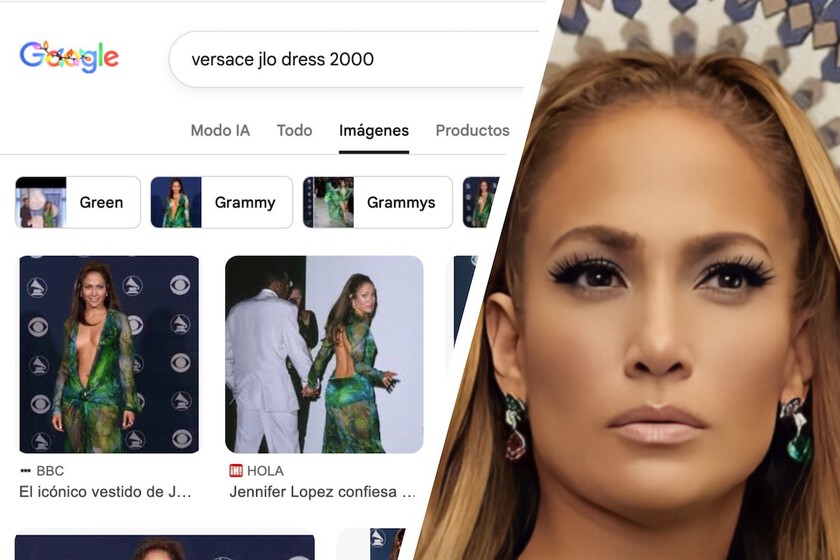
If you have a moment, go to Google and type something like “Jennifer Lopez 2000 Grammy dress.” Leave that new AI Mode section aside and tap on the ‘Images’ tab to find a green Versace dress with a jungle print that caused a real sensation in both the fashion media and the world of technology. In fact, that dress marked a before and after on the internet.
Because before February 23, 2000, when we wanted to see what clothes the current star had worn to an event (to give an example), we had to wait for the news to appear on TV, browse through magazines or go to the Internet to Google it. And there you didn’t find the photo, but instead you had to wade through a sea of blue text links to search through. There was no Google Images. We’re not even talking about videos.
Before JLo’s Grammys dress, this was all campo text
Why it is important. Google’s decision to organize information based on images and not only on text not only changed the world of fashion as the work of a European brand went from being seen on the catwalks and little else, to reaching the entire world. It also modified our way of accessing information, laying the foundations for an Internet (and later, social networks) focused more on audiovisuals than on pure and simple text. These were the dawn of the internet of content.
What started in July 2021 with an index of 250 million images, went to one billion images in 2005 and by 2010, exceeded 10 billion. Later, Google stopped offering that figure to focus on quality over quality. Paradoxically, in 2025 it is following the opposite path, massively deindexing images as they are considered low quality or generated by AI.
The context. In the year 2000, the Google search engine was not what it is now: the undisputed leader with almost 90% share. And the “almost” thing is something about the post-internet – ChatGPT had been overcoming that barrier for more than a decade. In fact, with just a couple of years of life, it was beginning its rise at a time when there was no hegemony as it managed to impose later, with others like Yahoo! and Altavista with greater weight.
And then she arrived on the red carpet at the 42nd Grammy Awards, nominated that year for Best Dance Recording for “Waiting for Tonight.” Jennifer Lopez wore a semi-transparent green dress with a dizzying V-neckline that fell to her navel. If you already existed at that time and were old enough to watch TV, you surely saw it because because her dress was viraleven before that concept was used for matters other than biology.
Seeing it once wasn’t enough, so people went online to search for it en masse. “People wanted more than text (…). At the time, it was the most popular search we had ever seen,” Eric Schmidt told Project Syndicate. The former Google CEO explained that at the time “we didn’t have a sure way to get users exactly what they wanted: J.Lo wearing that dress.”
Between the lines. That’s when Google Search Image started cooking. According to Cathy Edwards, director of engineering and product at Google Images, it wasn’t something that happened overnight, but JLo lit the fuse. There were few employees, but as Edwards explained in 2020, everyone was clear that they needed to build a photocentric search engine. The question was knowing what priority to give it.
That same summer, Google hired a newly graduated engineer, Huican Zhu, and put him to work with Huican Zhu, who was the executive director of YouTube and who at that time was responsible for product. The two went hand in hand and, according to Edwards, they practically developed it alone to launch Google Search Images in July 2021.
In WorldOfSoftware | People are so fed up with the current Internet that they are returning to MySpace. Not out of nostalgia, but out of rebellion
In WorldOfSoftware | All the times that throughout the 20th century we imagined ourselves on the Internet