Gaming does not have an attention problem.
It has a trust problem.
Players still want to play. They still buy consoles, upgrade PCs, watch trailers, share clips, join Discord servers, argue about patches, and wait years for major releases. The appetite is still there. The emotional connection is still there. The audience did not suddenly become lazy, impossible to impress, or too distracted to care.
What changed is the product.
A growing number of games no longer feel like entertainment first. They feel like systems designed to hold attention at any cost. They feel engineered to keep players busy, not necessarily happy. They offer progression before pleasure, chores before curiosity, and endless maintenance before actual joy.
That is why so many players sound frustrated now.
They do not hate games.
They hate what too many games have become.
The industry keeps calling it engagement.
That word has quietly taken over modern gaming.
Engagement.
It sounds harmless. Smart, even. But in practice, it often means something very specific: how often can we make the player come back, stay longer, click more, grind harder, and build their routine around our product?
That mindset changes design.
Once a game starts chasing engagement as a primary goal, everything begins to shift. Menus become crowded. Rewards become timed. Progress gets stretched. The experience becomes less about fun and more about habit formation. Suddenly, the player is not just there to play. The player is there to maintain momentum.
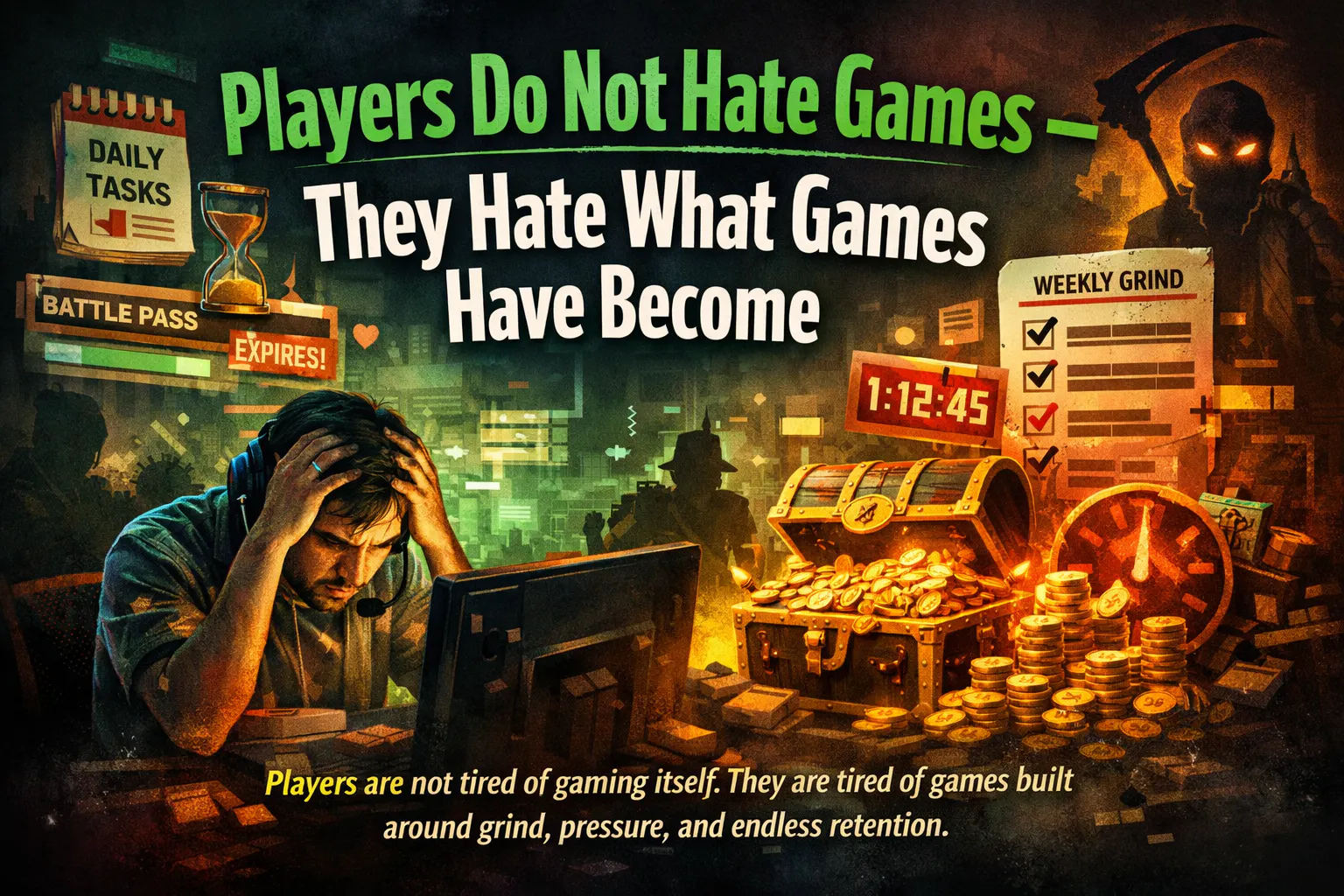
Login reward. Daily quest. Weekly reset. Limited event. Seasonal ladder. Battle pass expiry. Bonus weekend. New currency. New shop rotation. New thing to avoid missing.
None of these systems is terrible on its own.
Together, though, they can turn a game into an obligation machine.
And players can feel it.
Too many games now feel like jobs with better lighting.
That is the real problem.
Not difficulty. Not complexity. Not competition.
Exhaustion.
A lot of modern games ask for too much before they give enough back. They demand consistency, routine, and emotional investment before they have fully earned the player’s trust. The result is a weird kind of fatigue that is hard to explain to people outside gaming.
You open the game.
You look at the tasks.
You check the event timer.
You think about the grind.
And then you close it.
Not because you hate gaming.
Because the game already feels like work.
This is why so many players say they are “burned out,” even when they still love the medium itself. They are not tired of games in the broad sense. They are tired of being managed by them. Tired of feeling manipulated by systems that confuse time spent with satisfaction gained.
That is not burnout from fun.
That is burnout from design.
More content is not solving the problem.
The industry’s favorite response to player fatigue is usually the same: add more.
More modes. More rewards. More crossovers. More seasons. More map updates. More progression. More reasons to come back.
But more is often exactly what makes the experience worse.
A lot of games are already overloaded. They do not lack content. They lack clarity. They lack rhythm. They lack restraint. They lack the confidence to let the player enjoy the game without surrounding every moment with artificial urgency.
There is a difference between a game that feels alive and a game that feels demanding.
The first one pulls you in.
The second one leans on you.
That difference matters more than many studios seem willing to admit.
Because when players step away, it is easy to blame “changing habits,” or “market saturation,” or “aging audiences.” It is harder to admit that your game might simply feel emotionally expensive to play.
But that is exactly what many players are reacting to.
Not a lack of content.
A lack of breathing room.
The best games still understand one old rule.
Fun first.
That rule sounds obvious, but modern game design often treats it like a luxury instead of a foundation.
The best games still know better.
They do not make the player feel trapped inside a system. They create momentum. They create surprise. They create flow. They make curiosity stronger than obligation. They make players want one more match, one more mission, one more hour—not because a reward expires soon, but because the experience itself feels good.
That distinction is everything.
Players can forgive bugs, balance issues, and even occasional repetition when a game feels honest. What they struggle to forgive is the feeling that every part of the experience has been optimized to extract time, money, and routine before delivering delight.
Once that feeling shows up, the relationship changes.
The player becomes suspicious.
And suspicion kills joy faster than difficulty ever could.
Live service is not the villain, but bad live service is everywhere.
It is too easy to say live service ruined gaming.
That is not true.
Live-service design can work. Ongoing games can build incredible communities. Updates can deepen a world. Seasonal content can keep things fresh. Shared online spaces can create the kind of stories that static games never could.
The problem is not the format.
The problem is imitation.
Too many studios saw a few giant success stories and copied the surface logic without understanding what made those games stick in the first place. They copied the passes, the shops, the events, and the endless roadmaps. But they forgot that players only tolerate those things when the core experience already feels strong, generous, and worth returning to.
Without that foundation, live service becomes a treadmill.
And treadmills are great for metrics, but terrible for wonder.
Players miss games that let them leave.
This is one of the most overlooked reasons older games still feel refreshing.
They let you stop.
You could finish the mission. Save the game. Walk away. Come back a week later. Nothing punished you for having a life. Nothing made you feel late. Nothing treated absence like failure.
That freedom mattered.
A lot of modern games do not offer that feeling anymore. They are always in motion. Always updating. Always nudging. Always giving the player something else to chase before the last thing has even become enjoyable.
In trying to stay relevant every day, many games have become harder to love over time.
Because love needs space.
When every session feels like a reminder, a deadline, or a maintenance cycle, the emotional texture changes. The player is not exploring anymore. The player is keeping up.
That is not the same thing.
Gaming does not need more addiction mechanics
It needs more confidence.
Confidence to be memorable without being endless.
Confidence to be deep without being exhausting.
Confidence to trust that a great experience creates return behavior better than artificial pressure ever will.
Right now, too much of the industry seems afraid that if players are not constantly nudged, they will disappear. So games become louder, busier, and more demanding. Every week has to feel urgent. Every system has to loop. Every mechanic has to retain.
But that fear is making games worse.
A confident game does not beg for attention.
It earns it.
And players still respond when that happens. You can see it every time a sharp, focused, imaginative game cuts through the noise. Players instantly remember what they were missing. Not bigger maps. Not more currencies. No more grind.
Just joy.
Players are not asking for less gaming.
They are asking for better relationships with games.
That is the real conversation.
Players do not want every title to be smaller, easier, or old-fashioned. They are not rejecting ambition. They are rejecting a design that mistakes compulsion for meaning. They are rejecting systems that turn leisure into management. They are rejecting the idea that a game must consume their routine to deserve survival.
And honestly, they should reject it.
Because the medium deserves better than that.
Games are capable of wonder, tension, beauty, chaos, intimacy, challenge, and pure, unforgettable fun. They are one of the most flexible creative forms in modern culture. They should not be reduced to habit engines wearing expensive skins.
If players seem colder now, it is not because they stopped caring.
It is because they can feel the difference between being entertained and being harvested.
That is why this moment matters.
Not because gaming is dying.
But because too many games are drifting away from the thing that made people love them in the first place.
Players do not hate games.
They hate what games become when design stops respecting joy.
And the studios that understand that first will not just build better games.
They will build the ones players actually want to come back to.