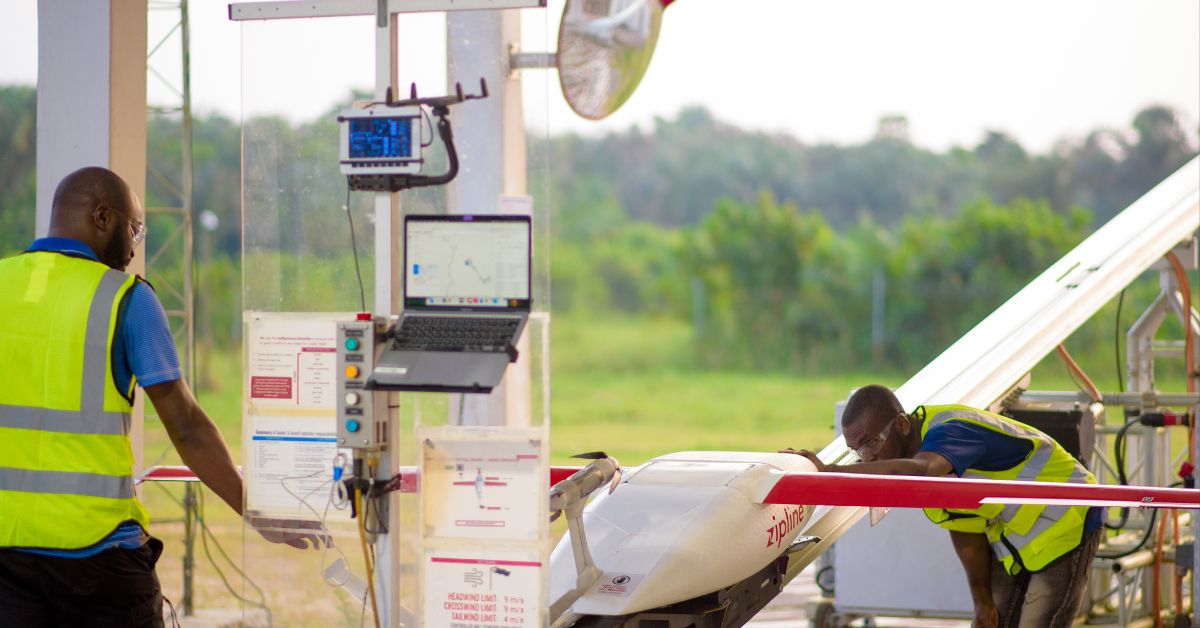
Rwanda has signed an expansion agreement with US-based drone logistics company Zipline to scale autonomous medical delivery systems, under a $150 million “pay-for-performance” funding from the US Department of State.
The deal triggers the release of US funding designed to scale Zipline’s AI-driven medical delivery infrastructure across Africa, after the company secured national expansion commitments from governments on the continent.
The development, which was announced in a statement on Thursday, marks the first milestone in a US experiment to push African governments to adopt drone logistics as permanent national infrastructure rather than donor-funded pilot projects.
This now positions Rwanda as the first country in the world with nationwide autonomous logistics coverage and the first in Africa to deploy Zipline’s urban delivery system and an autonomous delivery testing centre. The agreement aims to cut delivery times for vaccines, blood, and essential medicines, potentially strengthening health outcomes and national healthcare systems.
“Rwanda and Zipline have been working together for years to harness technology for the good of our people. We have witnessed the extraordinary impact of drone delivery — saving time, saving money, and saving lives,” said Paula Ingabire, Rwanda’s Minister of ICT and Innovation.
Under the agreement, Rwanda will introduce Zipline’s urban delivery system, Platform 2 (P2), in Kigali, where about 40%of the country’s healthcare demand is concentrated. The system enables fast, quiet, and precise deliveries in dense urban areas. Rwanda will also add a new long-range distribution hub in Karongi District, complementing existing hubs in Muhanga and Kayonza, and expand service coverage to more than 11 million people.
“Today, Rwanda is doing it again. This is a global first — not because the technology exists, but because the leadership exists,” Caitlin Burton, CEO of Zipline Africa, said, adding that the partnership sets a new global standard for deploying innovation.
The US government will provide upfront infrastructure funding, while the Rwandan government will pay for ongoing operations. Zipline will also establish its first overseas AI and robotics testing facility in Rwanda to support aircraft testing, safety systems, and next-generation logistics software development.
Since launching operations in Rwanda in 2016, Zipline has partnered with national governments to supply blood and essential medicines to more than 5,000 hospitals and health facilities. After its expansion in Rwanda, Côte d’Ivoire, Kenya, and Nigeria are expected to follow.