

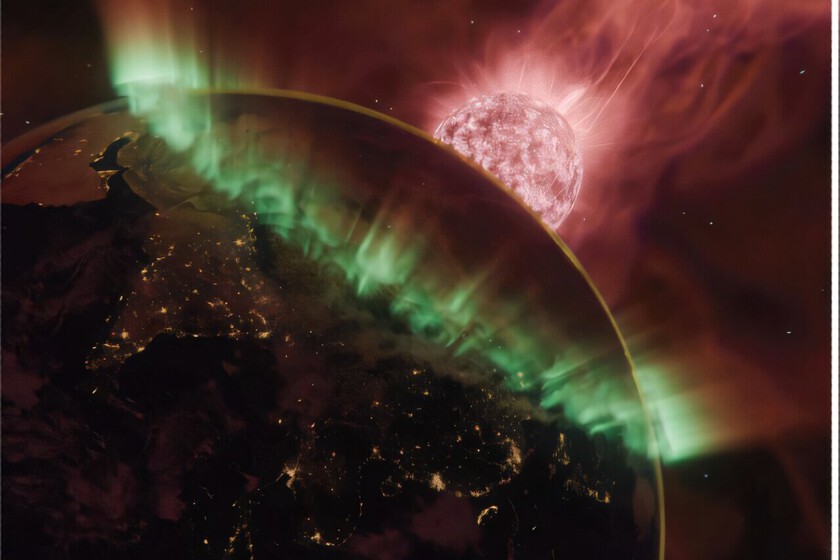
It is well known that geomagnetic storms and solar winds can significantly affect telecommunications devices on Earth. However, we have always had one piece of information that reassured us quite a bit in that regard: the saturation of geomagnetic storms. This means that there is a limit beyond which, no matter how much the intensity of the storm increases, the harmful electrical currents that are normally generated in our atmosphere do not continue to intensify. It would mean that we have already seen the worst side of this solar phenomenon and, although it has been quite worrying, it has not been devastating.
The problem is that now a team of scientists from NASA and Lancaster University have observed that, in reality, this saturation phenomenon was the result of a statistical error known as regression to the mean. It seems that the intensity of electric currents can continue to increase. And of course, that is very worrying.
too far. The intensity of the solar winds is measured by spacecraft located at Lagrange point 1 (L1), much closer to the Sun than to the Earth. This is no coincidence. It was done on purpose, because it allows them to be detected with some margin of action before they impact our planet. However, there is a problem, since the intensity with which these solar winds actually arrive is not the same as that measured in L1.
To know the real intensity with which they reach Earth, a calculation is made by extrapolating with distance. This gives us approximate data, but never exact. For them to be truly accurate, the intensity of the solar winds should remain constant all the way to Earth and that is not the case. They can intensify or weaken. All of this leads to a margin of error in the calculations. Furthermore, the very magnitude that is measured in the ships in L1 can already lead to calculation errors, which would increase this margin even further.
Regression to the mean. When many calculations are made that contain errors, something known as regression to the mean occurs, where the most extreme values are possibly overstated. That is, the solar winds that were considered more extreme may not have been so extreme. On the other hand, the effects of geomagnetic storms on Earth are easy to measure accurately, since they are measured directly on Earth. And this is where the problems begin.
We are relating values on Earth with oversized data from the Sun. What we consider a maximum response on Earth is actually because the solar storms were not as big as they seem. That is why the curve is flattened. The scientists of the study that has just been published consider that with more real data on the intensity of the solar winds the curve would not flatten. It would continue to rise.
Solar winds and electric currents. The Sun is surrounded by a gas made up of electrically charged particles, known as plasma. These are continually in motion, giving rise to what are known as solar winds. The problem is that, sometimes, when solar activity is very high, they move with much more intensity. So much so that they can shoot towards the Earth.
Luckily, our planet has a magnetic field that, in principle, acts like a bubble, protecting us from these charged particles. It does what it can, but if the solar winds are very intense, because the great solar activity has unleashed a geomagnetic storm, the particles end up overcoming that barrier and reach our atmosphere. There, electrical currents are formed that are measured to analyze the effects of this activity on Earth.
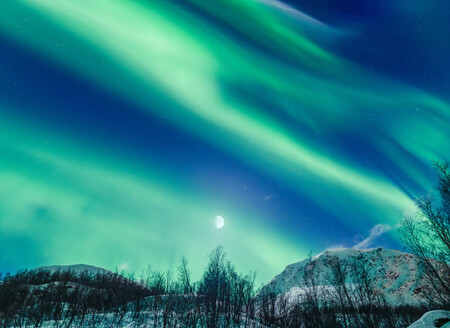
Auroras are the result of electrical currents that form in the atmosphere.
From northern lights to satellite failures. When these charged particles reach Earth, two types of effects can occur. On the one hand, the northern lights, which are the result of the emission of light in different colors when the atoms present in atmospheric gas molecules are excited. On the other hand, these currents can affect our electrical and telecommunications systems, causing problems of varying severity. There have already been some very serious phenomena, such as the Carrington Event of 1859, in which telegraphic communications around the world failed. Already in the era of satellites, the largest was the Quebec blackout of 1989, with which the entire electrical network of this Canadian province collapsed in just 92 seconds.

We have to shorten distances. The authors of the study that has just been published point out that, to understand the true magnitude of geomagnetic storms and solar winds, spacecraft that measure their intensity must be placed much closer to Earth. They have already analyzed a million nearby data and the results have not been encouraging. Therefore, prevention is more essential than ever. And, taking into account that the saturation phenomenon that so reassured us is not real, what happened in Carrington and Quebec would be dwarfed by what could happen in the future.
Image | Nithin Sivadas NASA Goddard Space Flight Center
In | Auroras are seen across Europe, including the south, during the largest geomagnetic storm since 2005


