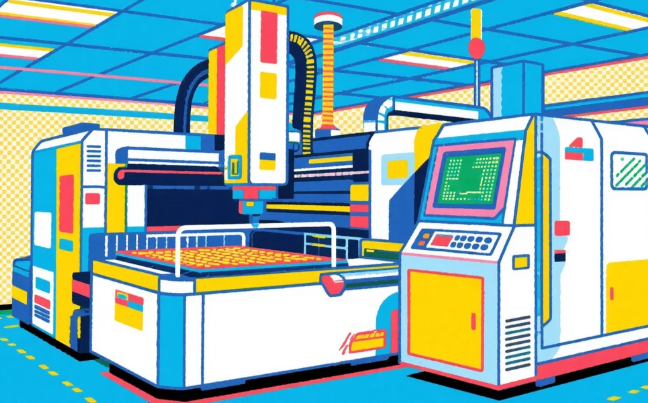
Semiconductor Manufacturing International Corp., operator of China’s largest semiconductor fab, is going to get even bigger after announcing plans to buy the remaining 49% stake of a smaller foundry it already controls.
SMIC said it will acquire the rest of Semiconductor Manufacturing North China Corp. for 40.6 billion yuan (around $5.79 billion) to assume full control of its chip fabrication business.
The deal, which was first outlined in September, will see SMIC issue 547.2 million A-shares to SMNC’s five shareholders. They include the China Integrated Circuit Industry Investment Fund, the Beijing Semiconductor Manufacturing and Equipment Equity Investment Centre, Beijing E-Town International Investment & Development and Zhongguancun Development Group.
SMNC was founded in June 2013 with significant government funding to build up China’s domestic manufacturing industry. It initially focused on 45-nanometer semiconductors, but has since advanced its manufacturing process to 12nm chips. It also manufactures key components, such as 12-inch integrated circuit wafers for different process technologies.
In the first half of 2025, SMNC and another SMIC subsidiary, Semiconductor Manufacturing Beijing Corp., generated a combined 8.87 billion yuan ($1.24 billion) in revenue, growing more than 22% from the previous year. The two units delivered a net profit of 125 million yuan, SMIC’s filings show.
The deal comes at a time when China has been making significant strides towards self-sufficiency in the chipmaking industry. Beijing has invested heavily in developing its domestic chip manufacturing capabilities in response to U.S. export restrictions that seek to prevent it from obtaining the most advanced types of processors.
As China’s biggest chipmaker, SMIC is one of the companies at the forefront of China’s chipmaking industry, and it has collaborated closely with Huawei Technologies Co. Ltd. as it strives to challenge Nvidia Corp. and other leaders in the artificial intelligence industry. This summer, Huawei announced a major breakthrough with the launch of its CloudMatrix 384 system, which was built on SMIC’s fabs. Huawei claimed that it could deliver 300 petaflops of compute performance, exceeding the 180-petaflop limit of Nvidia’s GB200 NVL72 system. It also claimed greater memory and bandwidth, although the tradeoff is that it uses significantly more energy.
SMIC is also working with Alibaba Group Holding Ltd. on a new 5nm chip that’s customized for AI inference workloads, and is thought to be one of the main entities involved in the development of a prototype extreme ultraviolet lithography machine, which is critical for advanced chip manufacturing. EUV has always been the biggest problem for China’s chipmaking industry. The most advanced machines are only made by a single company, AMSL Holding N.V. in the Netherlands, but it no longer exports them to China, in compliance with U.S. sanctions.
Last week’s report by WCCFtech said SMIC built the prototype with the assistance of former AMSL employees. However, it’s said that the machine won’t be ready for mass production until around 2030. However, at that point, China may finally be able to achieve parity with the U.S.
Image: News/Dreamina
Support our mission to keep content open and free by engaging with theCUBE community. Join theCUBE’s Alumni Trust Network, where technology leaders connect, share intelligence and create opportunities.
- 15M+ viewers of theCUBE videos, powering conversations across AI, cloud, cybersecurity and more
- 11.4k+ theCUBE alumni — Connect with more than 11,400 tech and business leaders shaping the future through a unique trusted-based network.
About News Media
Founded by tech visionaries John Furrier and Dave Vellante, News Media has built a dynamic ecosystem of industry-leading digital media brands that reach 15+ million elite tech professionals. Our new proprietary theCUBE AI Video Cloud is breaking ground in audience interaction, leveraging theCUBEai.com neural network to help technology companies make data-driven decisions and stay at the forefront of industry conversations.