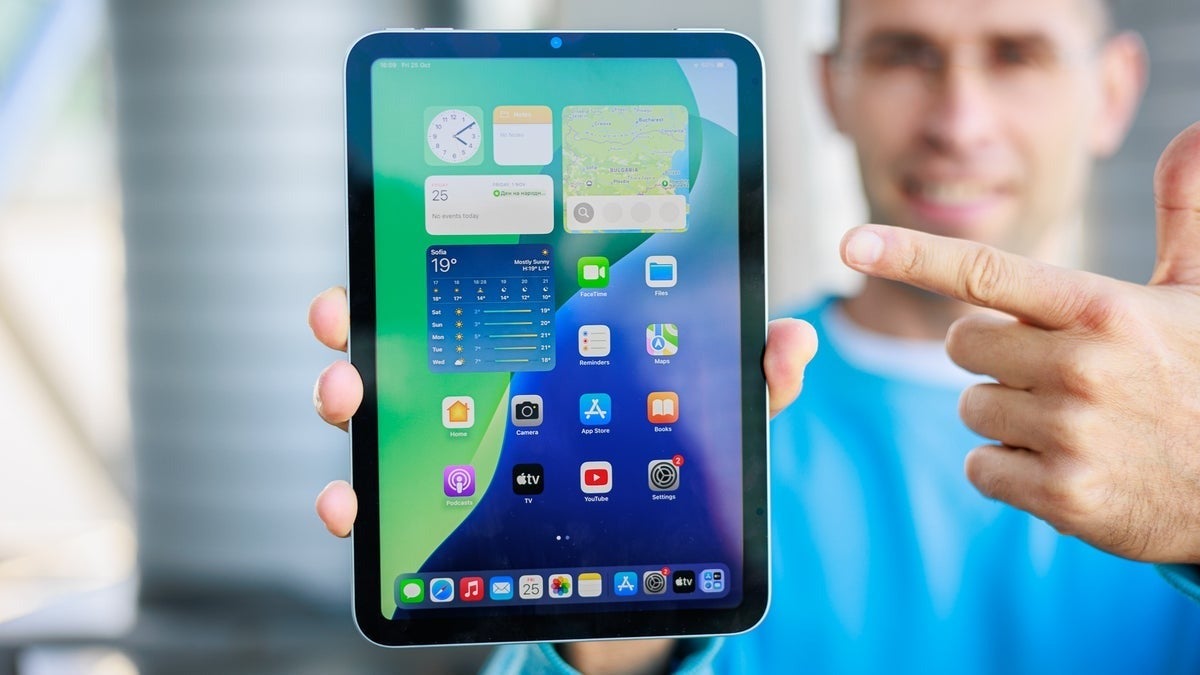
When you start to think about the implications of OLED tech in the smallest iPad model — that’s when some really exciting possibilities come to mind!
Growing the screen, keeping it mini
The ongoing consensus is that Apple may utilize the flexible OLED tech to give the iPad mini that “iPhone X treatment”. With no need for LCD controllers, there’s some room for the tablet’s bezels to shrink.Instead of making it smaller overall, however, Apple will probably use the extra real estate to grow the screen. As per reputable sources — from the current 8.3-inches up to 8.7 inches.
Personally, I’ve always enjoyed the iPad mini… from a distance. It feels incredible to have a tablet that small in the hand, but the screen was just a hair too small for me to really dig it. Maybe that tiny increase will be all I need to replace the iPad Pro M1 that I am using.
A prettier display
LCD screens can be great, and Apple’s been using top-notch LCD tech for years now. But the fact is that… OLED just has a higher ceiling and the ability to be superior.Deeper contrast, because when an OLED screen displays black, it simply turns the pixels off. We call that “true black” because a black area on an LCD screen still has a gray-ish backlight. Contrast doesn’t just improve colors and brightness; it inherently makes the image look sharper, too.
Plus, refreshing OLED pixels is much more consistent, as each pixel is commanded by its own controller. Which leads me to my next point:
Solving an age-old issue
Ever since the first iPad mini came out, it had a sort of a mechanical “bug” built into its design — the dreaded “jelly scrolling” effect. Basically, when rapidly moving through an article or book, or a gallery of images, the words or the pictures, bounce, bop, and stretch and don’t look “fixed” in place.It can be a fun effect to observe, you can get used to it, but some still find it annoying and “low quality”.
The iPad mini uses LCD tech. That means that the on-screen content refreshes pixel by pixel, left to right for every row. That scan happens 60 times per second.
The display controller on an iPad mini is located on its vertical side, so it has proportionally more rows to refresh. And a full cycle at 60 FPS takes 16.67 ms to complete — enough time for your eyes to “catch” the lag between the pixels.
Yes, an iPad Air uses the same tech, but the Air has its controller mounted on the shorter top/bottom frame. And it’s a bigger display, so it’s harder for the eyes to detect discrepancies in the image from one side of the screen to the other within those 16 milliseconds.
The iPad mini (2018) will be even more
Here’s a tidbit of information I didn’t know — an iPad mini is the favorite tablet of many medics or pilots. In hospitals, it’s “the white coat tablet” of choice, in aviation it’s “the electronic flight bag”, as it’s used to replace massive stacks of paper charts. And, something I did know — gamer addicts like myself like to carry around an iPad mini to get their mobile fix. It can easily be propped anywhere and connected to a controller, or used as a handheld when on-the-go.
Well, all of those people are about to be really happy with the next iPad mini model, as it’s apparently going to get IP 68 rating. That’d make it an even more valuable “In the field” tablet.
The first appearance of an Apple 2 nm chip?
Current speculation has it that the iPad mini will be powered by the next Apple A20 silicon. That’s supposed to be the first time Apple upgrades from a 3 nm architecture (which is already crazy advanced, even in 2026) to 2 nm. It’s the same chip that’s meant to go into the iPhone 18 later this year.
Well, if rumors are correct — the iPad mini A20 should arrive this Spring. That’d make the aforementioned medics, pilots, and gamers pretty happy. And me? I’ll try out all the guitar software I can get on it and check for audio latency. Hashtag living the dream.