Social media is now a key communication channel for government, making it easy to reach constituents quickly, clearly, and at scale.
At Hootsuite, we work closely with government organizations and see firsthand how social media supports modern public communication.
Let’s take a look at how all levels of government, from municipal to provincial to federal, can and should use social media.
Key takeaways
- Social media is a powerful tool for government. It helps agencies share updates, launch campaigns, communicate during crises, and more.
- Authenticity drives engagement. People respond best when government accounts and officials sound human, transparent, and genuine.
- Social listening helps you stay one step ahead. Tracking conversations lets government teams spot misinformation and respond with clarity.
- Strong guardrails are a must. Security, compliance, and clear social media policies are non-negotiable. Tools like Hootsuite make it easier to stay organized and secure.
Social media gives governments a direct way to communicate with the public, build trust, and respond in real time.
Let’s take a look at the benefits of social media in government:
Engage with the public
Social media is always a solid place to keep the general public informed and updated about important issues. Whether it’s TikTok, X, Facebook, or somewhere else entirely, these platforms let you meet the public where they already are.
For example, the Toronto Police Traffic Unit hosts regular AMA (ask me anything) sessions on TikTok. A representative fields questions from the audience — everything from “Can I drink coffee at a red light?” to “Are after-market steering wheels legal?”
Source: Toronto Police Traffic Unit
When done right, communicating with constituents online helps build trust and credibility. The key is actually engaging (not just broadcasting) and responding to people who follow you. More on this later!
If you’re serious about using social media to mobilize voters, check out Nextdoor, an app that local governments use to organize town halls, educate residents on safety issues, and engage community groups.
Show people who you really are
When used strategically, social media allows government officials to build a personal brand rooted in authenticity and transparency.
That matters, because politicians don’t exactly have the best reputation. Social media offers an opportunity to shift public perception by communicating openly, consistently, and like an actual human.
Take Alexandria Ocasio-Cortez (commonly known as AOC), for example. As the U.S. Representative for New York’s 14th Congressional District, she uses X (Twitter) to speak directly to constituents by showing up as herself. No overly polished press releases or political jargon.

Source: AOC
As a result, AOC has grown her following from 500K in 2018 to more than 12 million in 2026. And on Bluesky, she became the first person to reach 1 million followers.
Generally speaking, social media also helps humanize politicians, making them more accessible to the general public. Of course, this can backfire if a politician posts social media content deemed socially unacceptable.
Which is why anyone hitting “publish” on social media posts from an official government account needs clear guidelines (psst: a social media policy can help).
Crisis communication
During crises, the public often turns to social media first to seek out information, manage fear, and follow breaking updates. At the same time, governments are expected to provide leadership and act as a reliable source of truth.
However, social media can quickly become a breeding ground for misinformation. For example, during the COVID-19 pandemic, almost 50% of US adults saw fake news about the crisis.
To counter this, governments need to invest in social media listening. Monitoring conversations helps identify false narratives and respond with clear, accurate updates from official channels.
Quick disclaimer here: not every incorrect comment needs a response. Some claims are too inaccurate or too fringe to justify engagement. But if you see many social media users spreading the same misinformation, use official channels to set the record straight.
Need more intel? Read this guide on how to manage a social media crisis in 9 steps and set your organization up for success.
Launch and grow campaigns
Social media is a powerful tool for launching political campaigns and building public support.
For politicians, social platforms essentially function like a virtual town hall. They provide a direct way to introduce initiatives and ideas.
Social media is also an effective testing ground for campaign messaging. The stakes are low, feedback is immediate, and engagement metrics make it easy to see what resonates.
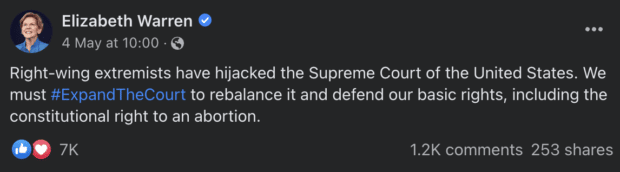
On top of that, politicians can use social media to publicly align themselves with key issues and movements. For example, Elizabeth Warren used social media to communicate her position on the U.S. Roe v. Wade decision, reinforcing her stance directly with her audience.
TL;DR: Used strategically, social media helps campaigns grow faster, adapt messaging in real time, and meet voters where they already are.
Low cost (but high stakes)
Social media offers political campaigns a low-cost, highly measurable way to build awareness, grow influence, and engage voters.
Before social media, governments and politicians depended on traditional outreach like TV ads, newspaper placements, and door-to-door flyers — all high-cost channels with limited visibility into actual impact.
Social media changes that. Just as important, performance is fully measurable, making it easier to track spending, evaluate results, and understand which campaigns deliver the strongest return.
Want to go deeper? Check out our guide on how to track, prove, and improve your social media ROI for valuable tips and insights on measuring campaign performance.
#1 Social Media Tool for Government
Engage citizens with the only tool that makes it easy to communicate, deliver services, and manage crises.
Book a Demo
Government agencies can face real challenges on social media, including messaging mishaps, loss of control over content, and public scrutiny.
Understanding these risks helps governments decide when, how, and if social media is the right tool to use.
Here’s what to watch out for:
Messaging is tricky to get right
Even well-intentioned government messaging can backfire if it’s not carefully tested and reviewed.
In 2014, South Dakota launched a campaign to warn people against jerking the steering wheel when swerving on black ice. The hashtag chosen — “Don’t Jerk and Drive” — was intended to be attention-grabbing, but its double meaning quickly overshadowed the message.
Ultimately, the campaign was pulled, and Trevor Jones, secretary of the Department of Public Safety, said in a statement, “This is an important safety message, and I don’t want this innuendo to distract from our goal to save lives on the road.”
The takeaway is simple: messaging should always be tested for tone, interpretation, and unintended meanings before going live. Otherwise, you’ll have a public affairs issue on your hands.
Public scrutiny is inevitable
On social media, audiences fact-check in real time, so accuracy and authenticity matter.
A clear example comes from Congressman Eric Swalwell, who once tweeted a photo of a Pride flag with the caption, “I fly these flags 365 days a year.” Members of the public quickly noticed the flag still had visible creases from being unpacked moments earlier, calling the claim into question.
Public platforms are unforgiving, so if you’re going to say something publicly, be prepared to back it up.

Pro tip 💡: Managing social for a U.S. government official or agency? Resist the urge to block critics or delete comments. Public accounts often function as public forums, and removing dissent can create First Amendment issues.
Viral moments are uncontrollable
On social media, public figures should expect their words, images, and moments to be turned into memes.
Content shared online is easily remixed, repurposed, and spread far beyond its original context. Once that happens, control over how it’s used is basically gone.
(In case you missed it, below is the infamous Bernie Sanders meme that spread like wildfire across social media in early 2020).
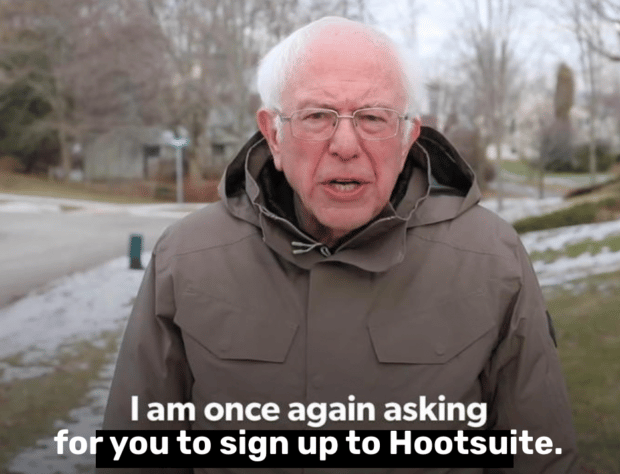
Most political memes are lighthearted. But proceed with caution: assume anything you post can be turned into a meme, whether you intended it or not.
Sometimes, social isn’t the right move
Not every political situation benefits from public social media attention. While social media is excellent at amplifying messages, that same amplification can create pressure, misinformation, or derail government business.
For example, in February 2022, WNBA star and American citizen Brittney Griner was detained in Russia on a drug-smuggling allegation with little to no fanfare on social media.
This lack of public attention was a conscious choice. At the time, geopolitical tensions were already high due to Russia’s invasion of Ukraine, and there was concern that public pressure could turn Griner into a bargaining chip — particularly given her visibility as a Black, openly lesbian athlete.
There were no major public callouts from President Joe Biden or other senior U.S. officials during the early stages of her detention. In this case, restraint was part of the strategy.
Using social media effectively in government requires a clear strategy, the right tools, and strong guardrails.
Here are our top five tips for getting started:
- Learn where your constituents spend time online
- Share relevant, valuable content and information
- Keep residents engaged
- Stay secure
- Remain compliant
1. Learn where your constituents spend time online
Understanding where your target audience hangs out online can help you avoid wasting valuable time, effort, and resources in irrelevant spaces.
A clear example is Zohran Mamdani, mayor of New York City. From his campaign announcement in 2024 right through the final week of the race, Mamdani’s team leaned into short, emotionally charged videos on TikTok — a social media platform dominated by Gen Z.
And it worked: exit polls showed Mamdani winning 78% of voters aged 18 to 29— TikTok’s core audience — proving that the right platform can make all the difference.

Source: Zohran Mamdani
If you need help understanding how to uncover your target audience on social media sites, check out this guide on how to find your target social media audience to get started.
2. Share relevant, valuable content and information
Build audience trust and engagement by sharing relevant and interesting content. Do this consistently, and audiences will naturally turn to you as a legitimate source of information.
The BC Parks Instagram account does this well. The organization uses Instagram to share information, tips, and insights into what’s happening across the province’s extensive roster of parks.

Source: yourbcparks
3. Keep residents engaged
Social media is all about creating community, so government officials, lawmakers, and official government accounts need to engage with their audiences.
This means replying to messages, joining conversations, and answering questions. You never know whether your response will change a voter’s mindset.
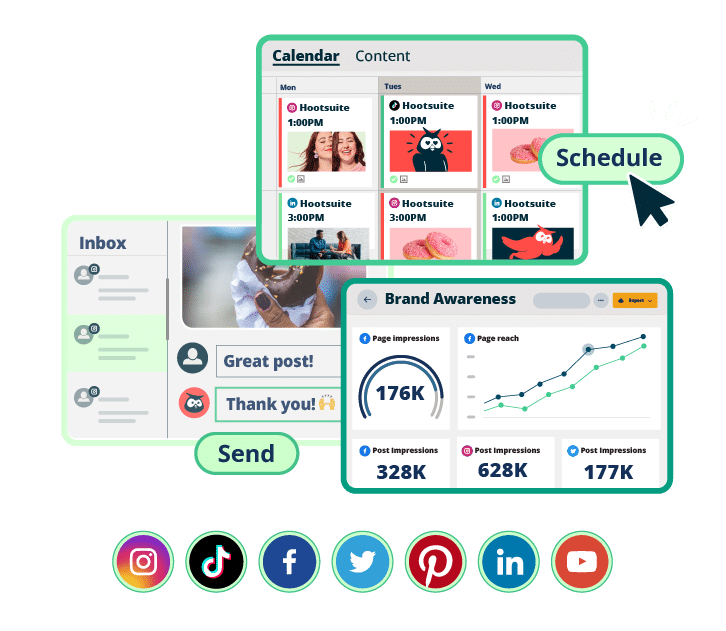
If you’re struggling to keep up with all the messages you receive, onboard a tool like Hootsuite to streamline your comms into one tidy dashboard.
With Hootsuite’s Inbox, you can manage all of your social media messages in one place. This includes:
- Private messages and DMs
- Public messages and posts on your profiles
- Dark and organic comments
- Mentions
- Emoji reactions
… and more.
The all-in-one agent workspace makes it easy to:
- Track response times and CSAT metrics
- Track the history of any individual’s interactions with your social accounts across platforms, giving your team the context needed to personalize replies
- Add notes to individual constituents’ profiles (Inbox integrates with Salesforce and Microsoft Dynamics)
- Handle messages as a team, with intuitive message queues, task assignments, statuses, and filters
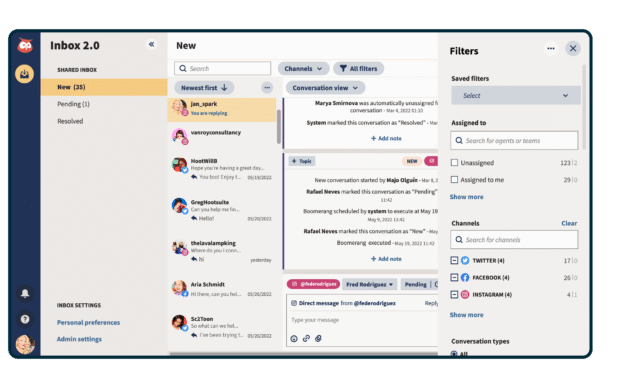
Plus, Inbox comes with handy automations:
- Automated message routing
- Auto-responses and saved replies
- Automatically triggered satisfaction surveys
- AI-powered chatbot features
4. Stay secure
Social media security is essential for maintaining public trust in government communications.
A compromised account can quickly undermine credibility and confidence. On top of that, U.S. federal agencies are required to use cloud services that meet strict security standards, known as FedRAMP.
One of the simplest ways to reduce risk is by managing social accounts through a centralized social media management platform.
For example, Hootsuite is FedRAMP-authorized and comes with two-factor authentication for an additional layer of security. This keeps your official social media accounts secure.
Plus, when you centralize your social media management with Hootsuite, you have complete control to review and approve messages, log all activity and interactions, and set up post review and approvals.
If you need more details, read through our step-by-step guide to social media security for more tips on how to protect your organization online, whether or not you use Hootsuite.
5. Remain compliant
Compliance is non-negotiable for government social media, and it needs to scale across teams.
For large organizations with multiple people posting, clear social media guidelines help ensure everyone stays aligned and compliant. These best practices should cover what’s allowed (and what isn’t), how data is handled, and even expectations around tone and voice.
If you manage social for a government or agency using Hootsuite, our partners’ social media archiving integrations make it easy to stay compliant with the Freedom of Information Act (FOIA), General Data Protection Regulation (GDPR), and other public records laws.
Public expectations around government communication have changed. Today’s audiences expect content that’s timely, engaging, and human, without crossing legal or ethical lines.
The most effective government teams are adapting by creating compelling social content while remaining fully compliant and secure.
How often should you post on social media in government?
Our research found that government institutions post on Facebook more often than on other social platforms — an average of 16.1 times a week. While TikTok sits on the opposite side of the scale with only an average of 2.4 weekly uploads.
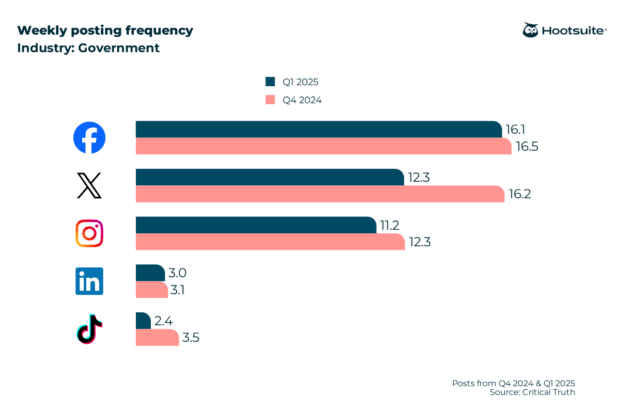
That said, every government agency and official’s ideal posting schedule is unique, and you should test different posting frequencies to find out what works best for your audience.
Average engagement rates in government
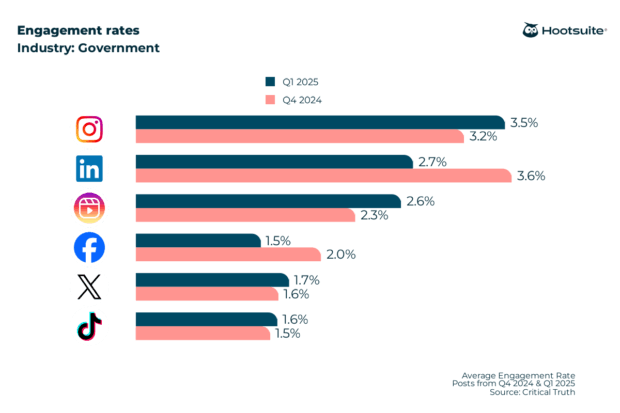
Here are the industry averages across all major social networks as of March 2025:
- Instagram: 3.5%
- LinkedIn: 2.7%
- Instagram Reels: 2.6%
- Facebook: 1.5%
- X (Twitter): 1.7%
- TikTok: 1.6%
Follower growth rate in the government sector
If your social media strategy revolves around growing your audience, make sure you’re setting realistic goals. Here is how other government profiles are doing in Q1 2025:
- TikTok: 0.7%
- Instagram: 2.17%
- Facebook: 1.38%
- LinkedIn: 0.39%
- X (Twitter): 0%

For more government-specific research, including the best times to post, the most engaging content formats, and network-specific breakdowns of the stats above, check out our dedicated post on government social media benchmarks.
CDC
During the COVID-19 pandemic, the U.S. Centers for Disease Control and Prevention was understandably a little busy. But that didn’t stop the government agency from pulling off effective COVID-related campaigns and messaging on social media to help keep the general public informed.

Source: CDC
Washington State Dept. of Natural Resources
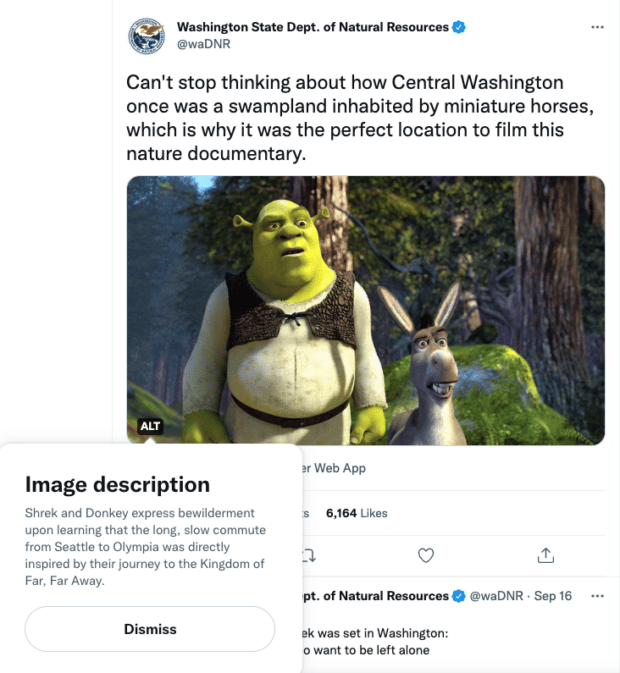
Government social media doesn’t have to be dry or boring — just ask whoever’s running social accounts for the Washington State Department of Natural Resources.
Their account offers timely, relevant information packaged in meme-friendly posts that often go viral.

Source: The Washington State Department of Natural Resources
Their alt text game is pretty strong too:
Source: The Washington State Department of Natural Resources
FDA
The US Food and Drug Administration is pretty much in charge of saying whether a product or foodstuff is safe for the public to use or not. So, it’s important that their social media channels share factually correct information.
Here’s an example of how the FDA has used social media to this effect.

Source: FDA
Biden #BuildBackBetter
46th President of the United States, Joe Biden, used social media to gain leverage and grow momentum for his Build Back Better campaign throughout 2020 and 2021.
By leveraging the power of the hashtag, Biden’s team was able to ensure a catchy slogan and a measurable campaign by analyzing the success and trends of the hashtag.

Source: Joe Biden
FAQ: Social media in government
How do government agencies use social media effectively?
Government agencies use social media effectively by sharing clear, timely information and engaging directly with the public. Posting updates, answering questions, and explaining decisions in plain language helps build trust online.
What are social media best practices for government and public sector organizations?
The best social media practices for government agencies include being accurate, authentic, consistent, and compliant. Having clear guidelines and approval can also help teams stay on message while avoiding mistakes or legal issues. Hootsuite makes this easier by letting teams manage posts in one place, review and approve content before it goes live, and keep records for compliance.
What are the risks of social media use in government?
The main risks of social media use in government are misinformation, security breaches, and public backlash. Posts can spread quickly, so errors, unclear messaging, or hacked accounts can damage credibility if not handled carefully.
How does social media improve public engagement for government agencies?
Social media improves public engagement by making government more accessible. People can ask questions and share feedback in real time, which helps agencies build stronger relationships with their communities.
What are examples of successful government social media campaigns?
Successful government social media campaigns meet people where they are and speak their language. Examples include Alexandria Ocasio-Cortez using X to tweet about policy in her own voice, Zohran Mamdani reaching young voters on TikTok, and local agencies hosting live Q&As to answer public questions directly.
Inform and engage on social media with Hootsuite. From a single dashboard, you can schedule and publish content to every network, monitor relevant conversations, and measure public sentiment around programs and policies with real-time social listening and analytics. See it in action.