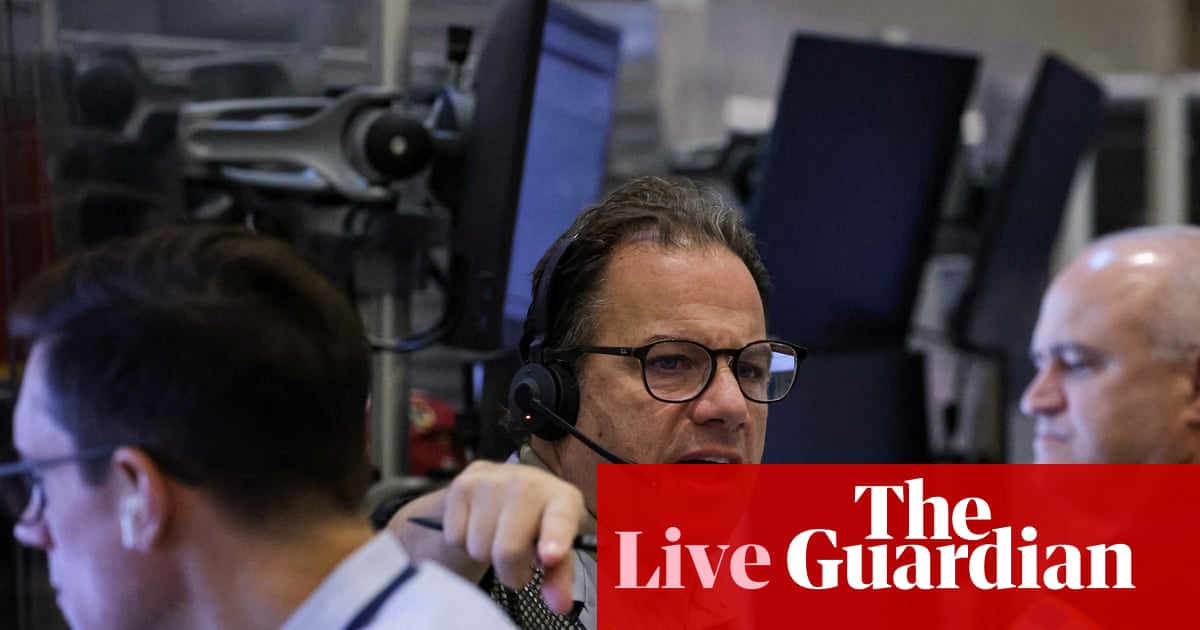
Introduction: Market selloff continues
Good morning, and welcome to our rolling coverage of business, the financial markets and the world economy.
Global markets are racking up their fourth day of losses in a row, as concerns over technology valuations are worrying investors.
Asia-Pacific stocks have dipped to a one-month low today, amid signs that the enthusiasm that has driven stocks higher in recent months is fading, with shares, risky currencies and crypto assets all sliding
MSCI’s broadest index of Asia-Pacific shares outside Japan has lost 1.8%, slipping to its lowest level since mid-October. South Korea’s KOSPI has lost 3.5%, and Hong Kong’s Hang Seng is down 1.9%.
Japan’s Nikkei 225 is also having a very rough day, down over 3%, on concerns over an escalating dispute with China over Taiwan
Last night, the US stock market fell, with the S&P 500 share index closing at its lowest level in a month.
European stock markets are heading for losses when trading begins at 8am GMT too.
Various reasons are being cited for the mood change. Investors are fretting that US interest rates may not be cut as quickly as hoped, following hawkish commentary from some policymakers.
Jitters are building ahead of AI behemoth Nvidia’s results on Wednesday night.
The huge sums of money being committed by AI companies to fund their infrastructure is also raising eyebrows, especially as it is being increasingly funded by debt.
Last night, Amazon raised $15bn in its first US dollar bond offering in three years, adding to a spree of jumbo debt sales by technology firms as they race to fund artificial-intelligence infrastructure.
Michael Brown, senior research strategist at brokerage Pepperstone, explains:
Those Nvidia earnings, incidentally, once again stand as a major macro risk, as enthusiasm around the whole AI frenzy seems to ebb, with the market having shifted from an ‘all capex is good capex’ mood, to one where whether firms are actually able to monetise that expenditure has become the million (or more!) dollar question.
On that note, Amazon kicking-off a six-part bond sale didn’t help matters much yesterday, following hot on the heels of similar sales from Meta and Alphabet in recent weeks, and further fuelling concern that AI expansion is now being fuelled by debt, and not by free cash flow, in turn exacerbating jitters over the sustainability of all the spending that we currently see.
The agenda
-
10am GMT: Treasury Committee hearing on risks and rewards of embracing crypto
-
1pm GMT: Huw Pill, Bank of England’s chief economist, to give speech at Skinners Hall, London
-
3pm GMT: US factory orders and durable goods data for August (delayed by lockdown)
Key events
Ireland’s finance minister steps down to join World Bank
Lisa O’Carroll
Ireland’s long-standing finance minister Paschal Donohoe is to step down to join the World Bank as its managing director.
Donohoe, who has been in finance or public expenditure departments for the past 10 years, will also step down from his job as head of the Eurogroup, the alliance of member states who use the euro currency.
The Irish cabinet was given the surprise news on Tuesday and was told that the appointment of Donohoe to the board of the World Bank had been approved on Monday night.
Donohoe has been a stalwart of Irish politics during Brexit years, covid and beyond and his steady hand made him seem as a potential front runner for taoiseach.
But he lost out on a key opportunity last March 2024 when the leadership of his Fine Gael came up with Simon Harris quickly amassing enough support within the party to take over following the resignation of the former Taoiseach Leo Varadkar.
He has been tipped for international jobs ever since, including the head of the International Monetary Fund, however he has always professed loyalty to his position in the Irish cabinet or missed out to other candidates.
His resignation could trigger a cabinet reshuffle but it will also prompt what is likely a hard by-election in Dublin central, a constituency shared in the multi seat system by Sinn Féin leader Mary Lou Donald, and in which Gary Hutch – who had links with the Hutch criminal gang – also ran in last November’s general election.
Donohoe’s departure is a significant blow to the Fine Gael and Fianna Fáil partnership and to the EU as one of the longest serving ministers attending EU summits.
He played a significant role in protecting Ireland’s economic strategy in relation to foreign investment and corporate tax when under serious international attacks from the likes of France and a court case, which Ireland ultimately won, over the Apple’s corporate tax.
Julia Pyke, joint managing director of the nuclear power project Sizewell C, said:
Cornwall Insight’s analysis shows exactly why Britain needs more nuclear, not less.
A stable, low-carbon baseload from projects such as Sizewell C avoids the expensive system charges that households are now paying for and protects the UK from volatile markets from overseas.
She said the RAB (regulated asset base) contribution, a new charge on UK electricity bills to help fund new nuclear power stations, is little more than £10 a year,
but it unlocks at least 60 years of clean, reliable, homegrown power that can stabilise bills for generations and creates tens of thousands of British jobs and opportunities which completely transforms communities.
Cornwall Insight: Energy price cap to dip by 1% to £1,733 annual bill from January
The forecaster Cornwall Insight has issued new forecasts for the January energy price cap.
The energy regulator Ofgem’s price cap is expected to dip by 1%, taking it down by £22 to an average bill of £1,733 a year for a typical household from January.
But analysts at the specialist consultancy said they expect the price cap to tick higher again from April.
Jess Ralston, energy analyst at the Energy and Climate Intelligence Unit, said:
As temperatures drop, many will be worried about how they are going to pay their energy bills. Rumoured cuts to home insulation schemes at the budget next week could leave the most vulnerable households facing higher bills for years to come and exposed to the kind of price spikes we’ve seen over the past few years.
Low levels of investment into infrastructure like schools has been mirrored in our electricity system and that is now catching up with us. But an upgraded power grid will enable the UK to use more of its own renewable power, making it less reliant on foreign gas imports and less at the mercy of the kinds of foreign price swings that saw household bills soar.
Crest Nicholson warns on profits amid ‘subdued’ summer sales and budget uncertainty
The housebuilder Crest Nicholson has put out a profit warning after “subdued” sales over the summer, and also blamed uncertainty around the government’s tax policy ahead of the 26 November budget.
The shares tumbled 13% on the news.
The company is closing one divisional office and will cut 50 jobs, including staff at the site and some “selective other roles” across overhead functions.
Crest said its adjusted profit before tax for the year to 31 October would be at the low end, or slightly below, its range of £28m to £38m,
reflecting a housing market that has remained subdued through the summer, and the continued uncertainty surrounding government tax policy ahead of the forthcoming budget.
It cautioned that near-term market conditions were likely to remain challenging.
The company expects to complete 1,691 homes this year, at the lower end of its range of between 1,700 and 1,900 homes, including 35% affordable units.
Its sales rate was 0.51, compared with 0.48 in 2024, although it dropped to 0.45 in the last 13 weeks of its financial year.
It has sold five land parcels from larger sites as it trims its landbank, and is working on a new house type range.
Rival builder Taylor Wimpey has also reported a drop in sales in the key autumn period.
Eight firms under investigation in crackdown on additional online fees
Britain’s competition watchdog has begun investigations into eight companies about their online pricing practices, expressing concern over additional fees and sales tactics such as “drip pricing” and “pressure selling”.
The Competition and Markets Authority (CMA) said it was looking into the ticket sellers StubHub and Viagogo; AA Driving School and BSM Driving School; the US gym chain Gold’s Gym; and the retailers Wayfair, Appliances Direct and Marks Electrical.
The investigations are the first launched by the CMA using its new consumer protection powers. The watchdog said it had concerns over practices including drip pricing – when consumers are shown an initial price and then face additional fees in the checkout process – and the use of misleading countdown timers, which are banned under the new regime.
The investigations follow a cross-economy review by the CMA since April of more than 400 businesses in 19 sectors to assess their compliance with price transparency rules.
The watchdog has also written advisory letters to 100 businesses across 14 sectors outlining concerns about their use of additional fees and sales tactics. It is publishing new guidance for businesses to help them comply with the law.
The regulator’s new powers enable it to decide whether consumer laws have been broken, rather than having to go through the courts. If the CMA finds there has been an infringement of the law, it can order businesses to pay compensation to affected customers, and can fine companies up to 10% of global turnover.
European shares slide as volatility surges
Europe’s major share indices are down by more than 1%, as the sell-off spreads across global markets.
The UK’s FTSE 100 index fell by 0.9%. Germany’s Dax is down 1.3%, France’s CAC and Italy’s FTSE Mib both lost 1.5%, and Spain’s Ibex dropped 1.6%.
A gauge of eurozone volatility – the equivalent of Wall Street’s “fear gauge” VIX – surged to its highest level since the US regional bank sell-off in mid-October.
Deutsche Bank analysts led by Jim Reid said:
It’s been a challenging start to the week as markets brace for two key events: Nvidia’s earnings tomorrow night and the US payrolls report on Thursday.
For now, equities remain under pressure, with the S&P 500 (-0.92%) posting a third consecutive loss [on Monday] for the first time since September and marking its worst three-day run since April (-2.61%) with futures down another half a percent as I type this morning. Concerns swirling around the AI trade pushed Nvidia (-1.88%) to another decline.
In addition to the AI concerns, the risk-off tone was reinforced by the latest signals from the Fed, as investors continued to price out the likelihood of a December rate cut. Futures now imply just a 41% probability, down from 43% on Friday – with the highest rate priced for the December contract since late August.
Klarna boss reveals he’s nervous about AI spending splurge
The boss of buy-now-pay-later group Klarna has also warned about the tech industry’s multibillion-dollar dash to build data centres to power AI models.
Sebastian Siemiatkowski told the Financial Times that the huge sums being poured into computing infrastructure made him “nervous”.
He said:
“I think [OpenAI] can be very successful as a company but at the same time I’m very nervous about the size of these investments in these data centres. That’s the particular thing that I am concerned about.”
FTSE 100 falls 1%
Britain’s stock market has opened in the red, as the sell-off in global markets reaches Europe.
The blue-chip FTSE 100 share index has dropped by 101 points, or just over 1%, to 9,675 points, further away from the record high of 9,930 points set last week.
Mining stocks are among the big fallers, with Fresnillo down 6.4% and Endeavour Mining losing 4.7%.
The FTSE 250 index of medium-sized companies is also sliding, down 1.15%.
Britain to outlaw tickets touts, minister says
Britain is set to ban the resale of tickets to live events like music concerts and shows at inflated prices, UK housing minister Steve Reed has declared.
Reed told BBC News that said the practice of “ticket touting” – people buying tickets to sell them on at multiples of their face value – was hugely damaging for individuals who had to pay “through the nose” to attend.
Reed insisted:
“We are committed to ending the scandal of ticket touts.”
Reed was speaking a day after news broke that reselling a ticket at anything more than the price at which it was originally bought will be banned.
As my colleague Rob Davies reported:
Reselling tickets for profit is to be outlawed under plans due to be announced this week, the Guardian has learned, as the government goes ahead with a long-awaited crackdown on touts and resale platforms such as Viagogo and StubHub.
Ministers had been considering allowing touts – and ordinary consumers – to sell on a ticket for up to 30% above the original face value, as part of a consultation process that ended earlier this year.
2025 was suposed to be a big year for Bitcoin, with a pro-crypto president in the White House.
But it hasn’t quite worked out that way, as Victoria Scholar, head of investment at interactive investor, explains:
“Bitcoin is extending losses, trading around $90k, shedding around 2% fuelled by concerns about overvaluations in the tech sector and broader risk-off sentiment that is causing a ripple effect across global markets. Bitcoin has turned negative for 2025, after peaking on 6th October at an all-time high above $126k and has subsequently shed about 28.5%. Earlier it briefly broke below $90k for the first time in seven months.
This year was meant to be the year of the bitcoin bulls supported by a highly crypto friendly administration in the White House and Trump’s ‘less is more’ approach towards regulation.
However, fears of an AI bubble and concerns about the market’s heavy dependence on a handful of tech giants have caused investors to dial back their exposure to speculative assets such as bitcoin. There’s a general sense of nervousness that has captured the market mood lately and bitcoin appears to be in the firing line. Plus with hints that the Fed might not cut rates next month, riskier non-yielding assets like bitcoin look less attractive in a higher interest rate environment.”
Monday’s selloff in US stocks has set off some alarm bells for technical traders.
Both the S&P 500 share index and the tech-focused Nasdaq Composite closed below their 50-day moving averages, according to Dow Jones Market Data.
Marketwatch says this is a “worrysome” development, explaining:
The S&P 500 had consistently closed above its 50-day moving average from May 1 through last Friday — marking 138 consecutive trading days.
But on Monday, the index snapped its longest stretch above this average since the 149-trading-day period that ended on Feb. 26, 2007.
Crypto market has lost $1.2tn as traders shun speculative assets
More than $1tn has been wiped from the cryptocurrency market in the past six weeks.
According to data from CoinGecko, the global cryptocurrency market cap today is $3.15trn, down from $4,379trn on 7 October.
The Financial Times blames concerns about lofty tech valuations and the path of US interest rates for this sell-off in speculative assets, adding:
The total market value of more than 18,000 coins tracked by data provider CoinGecko has tumbled 25 per cent since a market peak on October 6, wiping about $1.2tn from their combined capitalisation.
Bitcoin hits lowest since April
Bitcoin has fallen to its lowest level since April, as the cryptocurrency sector is hit by a sharp selloff.
The world’s largest crypto coin dropped as low as $89,286 this morning, a seven-month low, meaning it has lost all its gains in 2025.
Bitcoin has now fallen by almost a third since hitting a record high at the start of last month.
Such volatility isn’t that unusual, though, as Tony Sycamore, analyst at IG, explains:
Bitcoin, the canary in the risk coalmine, slips below $90k for the first time in seven months as its decline starts to display more impulsive rather than corrective characteristics.
That said, it is notable that its ~29% pullback from the record $126,272 high of early October is now on par with the ~31.5% pullback witnessed at the $74,434 Liberation Day low, coming from the January $109,356 high.
Google boss warns ‘no company is going to be immune’ if AI bubble bursts
The head of Google’s parent company has warned that every company would be affected if the AI boom were to unravel.
Sundar Pichai, the CEO of Alphabet, has told the BBC that the growth of artificial intelligence (AI) investment had been an “extraordinary moment”, but cautioned that there was some “irrationality” in the current AI boom.
Pichai argued that the excitement around AI is very rational, given its potential.
But he also cautioned that there are moments when the tech industry “overshoots”, citing the excess investment we saw in the early days of the web.
Asked whether Google would be immune to the impact of the AI bubble bursting, Pichai said the tech giant could weather that potential storm, but added:
“I think no company is going to be immune, including us.”
More here.
Introduction: Market selloff continues
Good morning, and welcome to our rolling coverage of business, the financial markets and the world economy.
Global markets are racking up their fourth day of losses in a row, as concerns over technology valuations are worrying investors.
Asia-Pacific stocks have dipped to a one-month low today, amid signs that the enthusiasm that has driven stocks higher in recent months is fading, with shares, risky currencies and crypto assets all sliding
MSCI’s broadest index of Asia-Pacific shares outside Japan has lost 1.8%, slipping to its lowest level since mid-October. South Korea’s KOSPI has lost 3.5%, and Hong Kong’s Hang Seng is down 1.9%.
Japan’s Nikkei 225 is also having a very rough day, down over 3%, on concerns over an escalating dispute with China over Taiwan
Last night, the US stock market fell, with the S&P 500 share index closing at its lowest level in a month.
European stock markets are heading for losses when trading begins at 8am GMT too.
Various reasons are being cited for the mood change. Investors are fretting that US interest rates may not be cut as quickly as hoped, following hawkish commentary from some policymakers.
Jitters are building ahead of AI behemoth Nvidia’s results on Wednesday night.
The huge sums of money being committed by AI companies to fund their infrastructure is also raising eyebrows, especially as it is being increasingly funded by debt.
Last night, Amazon raised $15bn in its first US dollar bond offering in three years, adding to a spree of jumbo debt sales by technology firms as they race to fund artificial-intelligence infrastructure.
Michael Brown, senior research strategist at brokerage Pepperstone, explains:
Those Nvidia earnings, incidentally, once again stand as a major macro risk, as enthusiasm around the whole AI frenzy seems to ebb, with the market having shifted from an ‘all capex is good capex’ mood, to one where whether firms are actually able to monetise that expenditure has become the million (or more!) dollar question.
On that note, Amazon kicking-off a six-part bond sale didn’t help matters much yesterday, following hot on the heels of similar sales from Meta and Alphabet in recent weeks, and further fuelling concern that AI expansion is now being fuelled by debt, and not by free cash flow, in turn exacerbating jitters over the sustainability of all the spending that we currently see.
The agenda
-
10am GMT: Treasury Committee hearing on risks and rewards of embracing crypto
-
1pm GMT: Huw Pill, Bank of England’s chief economist, to give speech at Skinners Hall, London
-
3pm GMT: US factory orders and durable goods data for August (delayed by lockdown)