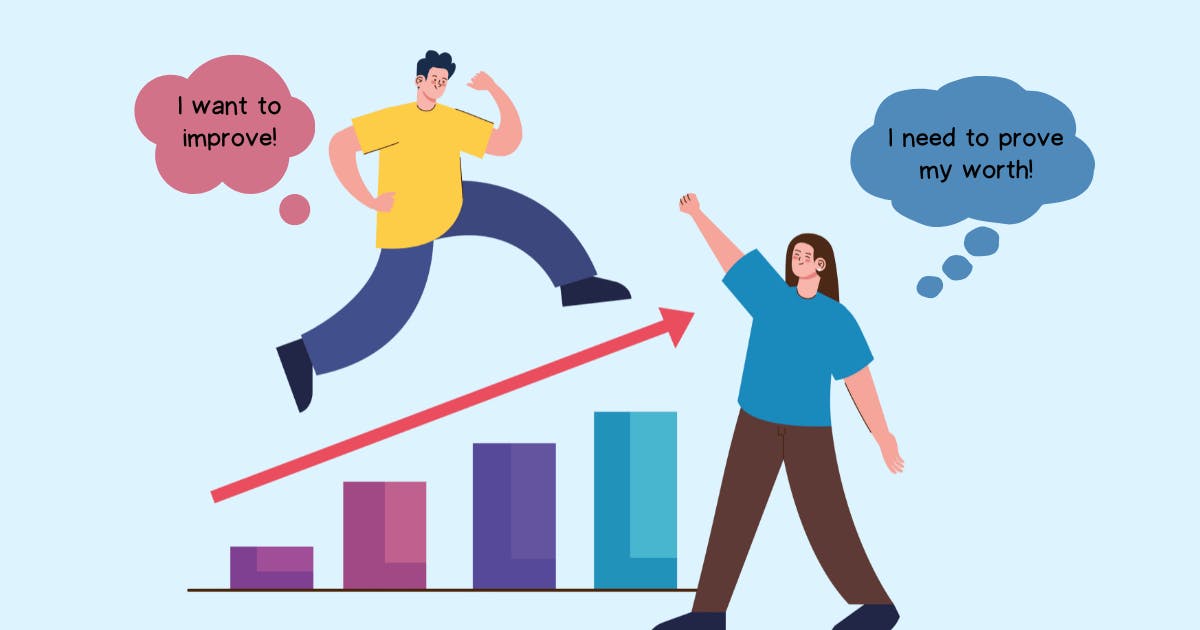
What drives your actions at work—the desire to prove yourself or the desire to improve yourself?
Proving yourself is about establishing your worth, raising your self-esteem, and showing others how knowledgeable, talented, and skilled you are. People who try to prove themselves turn every moment into a contest—someone else must lose for them to win. How can they outsmart others with a better argument? How can they find flaws in their logic? How can they show the value they bring to the team?
Competitive mindset keeps them constantly stressed and anxious about how they’re perceived—do others like them, are they admired for their skills, do people see the effort they put in? Approval and validation from others is the key focus area that drives their thinking. They evaluate every opportunity based on how it benefits them as opposed to what’s good for their team. They argue tirelessly to prove their point because accepting they’re wrong undermines their competence. Every day at work seems like a battle to be fought and a race to be won.
Improving yourself involves measuring yourself against your own past self—how much are you learning, what’s getting better, are you evolving each day? People who focus on improvement turn every moment into a learning opportunity—it’s not about winning or losing, but making progress each day. What are they missing? What are the gaps in their skills? What can others teach them?
Curiosity mindset keeps them excited and focused as every new challenge is an opportunity to learn something new and grow their skills—pleasure is not in reaching the destination, but the journey they take. They don’t attach their identity to their point of view and show willingness to listen to others when a better perspective shows up. They aren’t concerned about being liked or popular because they build strong relationships with others by working together and not against them. Their self-esteem isn’t fragile and dependent on external validation—they lead with an internal measure of their worth. Every day at work feels like a joy ride with many twists and turns.
Moving from proving to improving gives you a sense of control over your decisions, actions, and the way you want to lead your life. You no longer have to pretend or be someone else just to please others. You don’t have to worry about being judged or criticized when you measure yourself against an inner scorecard, not external pressures or ego.
Why waste time proving over and over how great you are, when you could be getting better? Why hide deficiencies instead of overcoming them? Why look for friends or partners who will just shore up your self-esteem instead of ones who will also challenge you to grow? And why seek out the tried and true, instead of experiences that will stretch you?
― Carol S. Dweck
It starts with the desire to be a better person each day—prioritizing learning and growth over external measures of worth. These 5 practices can help you make that shift.
Ask questions with the intent to learn; don’t show off intelligence.
When your focus is to prove yourself, you use every opportunity to put a spotlight on your work—why your ideas are better, the quality with which you delivered something, and how you were praised for your work. You keep highlighting your achievements to earn trust and be seen as more credible. You show off intelligence by using jargon, over-complicating the problem, and exaggerating the possibility of a failure.
In order to be the smartest person in the room, you try to outshine others—by interrupting, challenging them, and questioning their decisions. You disagree with them only to make yourself heard.
No need to waste time on it. I can tell you that it won’t work.
I have a better solution.
Let me handle it. I know how to do it.
But trying to outwit others or self-trumpeting all the time does not make others like you. Quite the opposite—they resent you for showing up as a know-it-all or always one-upping them. Your knowledge, experience, and skills are valuable, but you don’t have to brag about them or put others down to be seen. By shifting from proving to improving, you can get the attention and build the influence to drive meaningful change at work.
Instead of leading with answers, show the attitude to learn by asking meaningful questions. When your intent is to collaborate, not overshadow or trick others, it makes them more likely to value your inputs and acknowledge your experience.
Can you share some data and insights on how this will work?
I need your feedback on another solution that might be better suited to this problem. Would you like to hear it?
This appears to be a challenging problem. What ideas do you have?
Questions ignite meaningful conversations that aren’t about who is right and who is wrong. They encourage problem-solving with a shared goal to find the best solution. They challenge everyone to think creatively and show openness to accept differences of opinion. Questions unlock improvement.
We awaken by asking the right questions. We awaken when we see knowledge being spread that goes against our own personal experiences. We awaken when we see popular opinion being wrong but accepted as being right, and what is right being pushed as being wrong. We awaken by seeking answers in corners that are not popular.
― Suzy Kassem
Trying hard to prove yourself leads to distance and repulsion, while working on improving yourself builds trust and connection. Don’t lead with answers. Ask questions. Make your knowledge, experience, and skills visible without boasting.
Sign up for new opportunities, don’t sit inside comfort zone
When proving is the goal, comfort and safety take priority over new opportunities. You keep doing things you’ve already mastered because they come easily to you—you don’t need to re-establish your worth or worry about the delivered value. You let go of a new opportunity that has unknowns and uncertainty involved because doing it comes at a certain risk.
The fear of not doing it well and the impact it will have on the image and reputation you have built for yourself scares you from stepping into the unknown.
What if you don’t know how to do it?
What if it fails?
What if it doesn’t work as expected?
But staying within your comfort zone prevents you from improving. You refuse to take on tasks that will require building new skills. You let go of projects that require navigating complexity. The desire to prove makes you give up on excellent growth opportunities. Without the skills needed to take on higher-level responsibilities, you get stuck in your job and role. Relying on expertise for too long makes you redundant—others who have caught up to you or those who have moved ahead will be more in demand.
Instead of working within a safety net, take one step outside it. Sign up for opportunities that require you to stretch, that make you uncomfortable, and challenge you to grow your abilities. Your value will multiply by taking these steps and failing rather than staying where you are.
What’s making me uncomfortable? How can I put together a plan in place to tackle it?
What gaps in knowledge and skills can prevent me from meeting my objective? How can I bridge this gap?
Who can I reach out to for the help and support I need?
Proactively building new skills keeps you better prepared to tackle future needs. They build the courage and confidence to face their fears instead of letting them stop them from embracing difficulties. Stepping up in times of need also makes you come across as someone who can be counted on and trusted to lead. Make embracing challenges your goal, not showcasing your talent.
You will never improve in life if you’re always living on easy street. Strength and progress can be gained if only you just step outside of your comfort zone.
― Dee Waldeck
Doing the work that lies in your zone of expertise keeps you mired in mediocrity, while expanding beyond it into the stretch zone unleashes your potential and multiplies your impact. Stand out at work by building skills that lead to long-term growth, not short-term wins.
Seek feedback with focus on criticism, not praise
When you ask for feedback with the intent to validate yourself or seek approval, a positive response raises your self-esteem, makes you feel worthy, and enables you to believe in yourself. However, even a hint of criticism puts you off—you feel attacked, targeted, and may even engage in self-doubt with the belief that you don’t have what it takes. Taking feedback personally or attaching it to your identity makes criticism feel like a threat, something that hurts your credibility and makes your work matter less.
When someone points out gaps in your approach or suggests a better alternative, you take it the wrong way and hold it against them. When your manager tells you that your work needs improvement, you begin to justify and turn defensive.
They must be jealous.
They don’t value me.
I am not good enough.
Engaging in feedback conversations that make you feel good about yourself without highlighting areas where you need to improve may temporarily boost your self-esteem, but they’ll do nothing to advance you in the direction of your goals. Without getting clear, actionable feedback on habits you need to change, skills you need to build, and knowledge you need to expand, you’ll be locked in an illusion of greatness—you’ll be trapped with a false belief about your competence, which will prevent you from embracing opportunities required to evolve and excel.
Criticism stings. It’s hard. At times, it may even be unfair. But it’s also necessary. It’s what shows you the path when you’re stuck. It’s what gives you direction when you’re lost. It’s what gets you back on track when you’re distracted or lose focus. It’s what helps you stay grounded, truthful, and real. Seek feedback from people who have valuable things to contribute, even if they make you uncomfortable.
Who might have valuable information about my performance on this project, idea, or strategy?
What’s wrong with it? How can I make it better?
What might I be missing, and who can give me feedback on it?
Channeling constructive criticism into useful signals can help you unlock your potential. You can bridge the gap between how you see yourself and how others perceive your work. Showing curiosity to learn from others also builds positive relationships at work—when they see that you value their inputs, they’re more likely to engage with you and stay honest. Consider feedback as a growth catalyst, not a dagger.
Feeling bad is not just an unfortunate consequence of hearing honest feedback, it is a necessary consequence. Anxiety and sadness serve a key motivational function—they make your brain want to take action to get rid of them. Negative feelings focus attention and resources on the task at hand. They are like fuel for your fire.
— Heidi Grant
Praise can bolster your ego and make you feel capable, successful, and respected. But seeking only praise can turn you blind to your flaws. Criticism isn’t meant to undermine your confidence. It’s a powerful tool when viewed through the lens of growth. Seek it actively and often.
Acknowledge mistakes to prevent future errors, don’t hide them
Mistakes have a negative connotation. They evoke strong feelings of shame, disappointment, and regret. You may hide mistakes with the worry that accepting them will damage your image and hurt your reputation. If others know about your errors, they may not trust you, or you may be passed up for better opportunities. You try to portray an image of perfection because anything less will put your knowledge and experience at risk.
You may also synonymize mistakes with defeat. One mistake and you lose interest and drop out—you just don’t want to look stupid. Mistakes for you aren’t disappointing and temporary; they are powerful forces that pull you down by casting a shadow over months of effort and hard work.
I am worried about what others will think about me.
I don’t want to look incompetent.
I am scared of failing.
But not acknowledging mistakes or using them as an excuse to quit prevents you from learning valuable lessons—what went wrong, why it occurred, what changes are required to get back on track, and how you can prevent this from happening again. Accepting mistakes and learning from them ignites curiosity to do better next time. It gives you the confidence to face the challenges and obstacles in your path. It shows the power of consistency and persistence.
Fear of mistakes also creates a strong desire to play it safe. When evaluating opportunities, your inner voice may tell you to stick to the known, do things you have always done before, avoid experimentation, ignore challenges, and reject opportunities that are risky. Constant vigilance to “avoid mistakes at all costs” can lead to further stress and anxiety. Treat mistakes as a temporary diversion that requires you to reevaluate your path, but does not prevent you from reaching your destination.
Am I giving up because I am worried about failing?
What risks can I see upfront, and how can I plan for them?
What changes to the strategy can help me continue without having to quit?
A mistake is an experience, choice or concept it is necessary for us to have or make in order to evolve beyond it. Errors can be the launchpad of great ideas.
― Stewart Stafford
Mistakes are not terrible personal failings that need to be denied or justified; they are inevitable aspects of life that can help you grow. Stop hiding. Let yourself be seen as a flawed human being who makes mistakes and fails at times.
Approach others with the intent to collaborate, not compete
When your focus is to be recognized, seen, and rewarded individually for your work, you see people on your team as competition and try to fly solo instead of being a collaborative team member. You hide information to have an upper edge. You refuse to help out to gain appreciation for your work, as others are struggling. You don’t communicate often, which leads to misunderstandings and confusion. Thinking that others’ disadvantages can be your advantage, their challenges can be your opportunity, and their failures are your moments to shine, attract attention, and flaunt your achievements, can make you engage in behavior that benefits you, even at the cost of teamwork.
Believing that others’ success can lower your chances of succeeding makes you extremely cautious about how your contributions benefit you and not others.
I am here to get my work done, not help others.
I have to do what’s best for me.
If they succeed, I’ll fail.
But seeing others as competitors instead of partners breaks down collaboration—wrong assumptions are made, deadlines are missed, and misunderstandings become a common phenomenon instead of a one-off thing. Victim mentality and rivalry lead to wasted time as everyone tries to protect themselves by offloading blame to others—there are long debates, complaints, disagreements, and unnecessary discussions instead of focusing on resolving issues, designing solutions, and working hard to provide quality deliverables.
Instead of trying to win alone, invest in succeeding as a group. You can create more impact and contribute your true value by seeing others as people on your team and not your rivals. Working together can lead to better generation of ideas, quick resolutions, and the shared camaraderie can have positive effects on the mental well-being of everyone involved in the effort. Share ideas, help others, give credit. Treat others as your allies, not your means of leverage.
How can we work better together as a team?
What do others know that I might be missing?
In what ways can I help others or seek their help to achieve shared goals?
Collaborators don’t steal others’ ideas, take advantage of people, or sit back while others accomplish their tasks for them. Collaborators take action to ensure that everyone with whom they work can enjoy the maximum potential outcome.
― Raoul Davis Jr.
When you look at others with the desire to beat them, individual goals become a primary focus area instead of collective wins. But your success does not matter when your team loses in the end. Change your goal from competing to collaborating. Succeed together, not alone.
Summary
- The goal to prove your worth makes you come across as boastful, needy, and insecure, while the desire to improve yourself earns you respect, builds your skills, and prepares you to take on whatever comes next.
- When you flaunt your achievements or try to show off your work, you come across as an egoist and a self-centered person. Others try to avoid you instead of leveraging your knowledge and experience. Instead of boasting, showcase your value by asking meaningful questions and helping others arrive at their own solutions.
- Ambiguity and uncertainty scare you off when your goal is to maintain your image and establish your expertise. You stay inside your comfort zone and keep doing the work you’ve always done before. But staying within your comfort zone and rejecting new opportunities makes you stagnate as others move ahead. Instead of playing it safe, take risks by signing up for activities that require you to navigate complexity, build new skills, and solve problems you’ve never solved before.
- Praise brings happiness, satisfaction, and pride. But, while it boosts your self-esteem momentarily, it prevents you from investing in long-term growth. Not knowing where you’re falling short keeps you blind to your own flaws and inadequacies. Instead of seeking constant praise, ask for criticism of your work. Look for ways to do better, not proving you’re the best.
- Mistakes seem bad when you tie them to your competence. You try to hide them as you worry they’ll damage your credibility and hurt your reputation. But failing to learn from mistakes keeps you from preventing them in the future. Instead of treating mistakes as personal failings, treat them as opportunities to reduce your errors. Improve your future by accepting the present mess.
- When others’ success is considered a threat to your own accomplishments, you prioritize individual goals over collective team success. But, treating people on your team as your competitors makes you achieve less. Instead of focusing on winning, work on better ways to collaborate and fulfil shared goals. Partner with people. Treat them as your allies, not your rivals.
This story was previously published here. Follow me on LinkedIn or here for more stories.