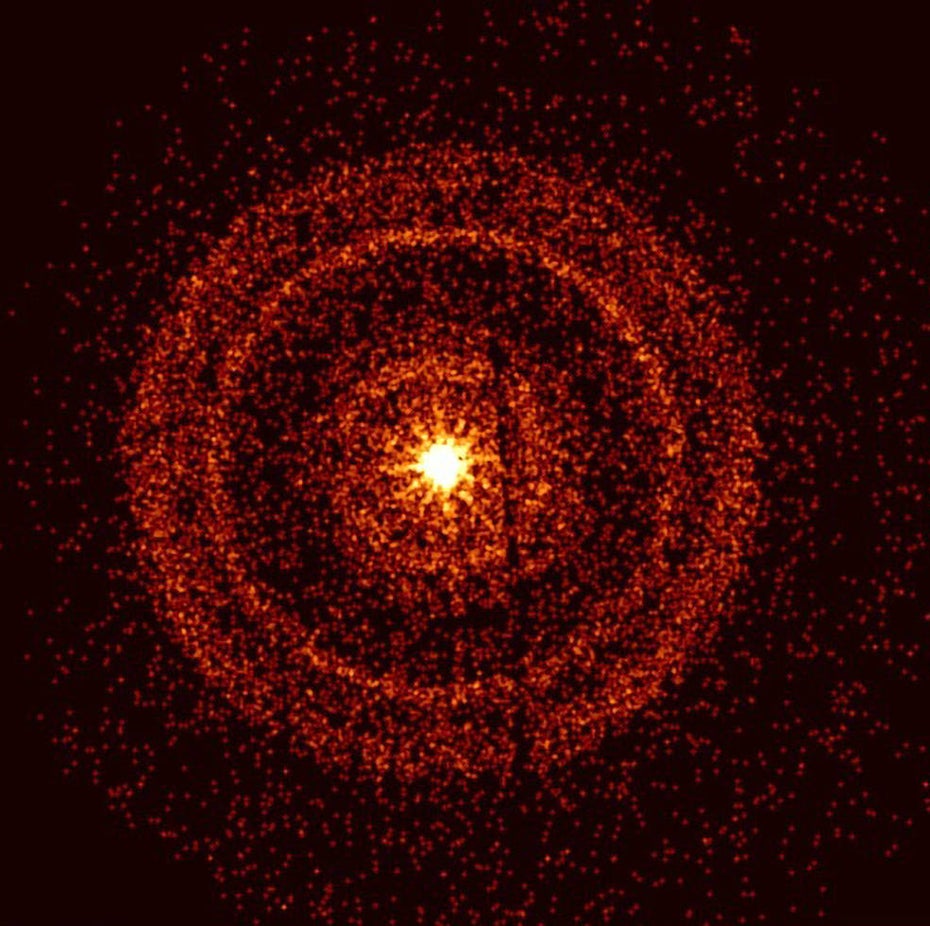
The US space agency Nasa is currently taking highly unusual approaches to protect the proven Swift gamma ray observatory from an uncontrolled and imminent crash. As the US broadcaster CBS News reports, a $30 million rescue mission is expected to start this week, in which the US company Katalyst Space Technologies will send an autonomous spacecraft into space.
The telescope, which has been active since 2004, is currently losing a lot of height because significantly intensified solar activity is expanding the Earth’s atmosphere and thereby continuously increasing air resistance in low Earth orbit. Swift is currently orbiting at an altitude of around 360 kilometers. However, if the observatory sinks below the limit of around 297 kilometers, the “point of no return” is reached and rescue is technically impossible. Since the telescope will reach this critical point in October 2026 according to current estimates, the space agency switched off all scientific instruments in February as a precaution in order to at least delay the crash.
A robot with gripping arms as a rescuer
The actual rescue attempt will be carried out by the newly developed spacecraft called Lift, which, however, still has to prove its practical suitability in space. The vehicle is dropped into its target orbit aboard an air-launched Pegasus rocket from an aircraft over the Pacific Marshall Islands. This refrigerator-sized robot has fold-out solar panels and three gripping arms, the ends of which are visually reminiscent of the hands of Lego figures. They are supposed to physically grab the spinning satellite. This is a risky maneuver that so far only exists on paper for this American robot and its success is anything but guaranteed.
After the successful launch, Lift is expected to need a full month to catch up with Swift at its current altitude of around 360 kilometers, followed by another two months for the careful transport to a safe orbit of around 600 kilometers. By far the biggest hurdle in this endeavor is the fact that when Swift was originally designed, it was never intended for external repair or even such a capture maneuver by mechanical hands.
Risks and a look into the future
Accordingly, according to those responsible for the commissioned startup, there is absolutely no guarantee that the mission will be successful, which is why Shawn Domagal-Goldman, the responsible NASA director for astrophysics, openly admitted that initially no one believed in the technical feasibility of this project. However, the only alternative to this attempt would be the complete loss of the observatory, which, according to scientific mission manager Nicky Fox, there is simply no budget to replace completely in the current economic situation.
Top Article
${content}
${custom_anzeige-badge}
${custom_tr-badge}
${section}
${title}
For Katalyst Space Technologies, this extremely risky venture serves as fundamental proof of the future viability of complex services in orbit, so much so that CEO Ghonhee Lee is already planning to deploy hundreds of such robots to maintain satellites or build data centers. However, if the current and historically unique maneuver fails, it will undoubtedly cause a significant setback to the emerging market for commercial space repairs.
However, an actual success of the Swift rescue would have far-reaching consequences for other valuable and aging equipment in space, as the much larger Hubble Space Telescope, among other things, is also suffering from the increasing loss of altitude. As the startup’s managing director optimistically predicts, a more developed generation of the robot could be ready in a few years to lift this prominent and scientifically irreplaceable observatory into a safe orbit in 2028.