Whoever is free of contradictions should cast the first stone, but Jeff Bezos plays in another league.
On the one hand, he is the father and founder of a company that has made delivery logistics its watchword (Amazon), space tourism with Blue Origin or is behind AWS, one of the large cloud companies necessary for those resource-hungry data centers. On the other hand, Bezos also has his philanthropic side, which he develops in foundations such as his Bezos Earth Fund, aimed at fighting climate change. Yes, the same man with the private jet and the megayacht.
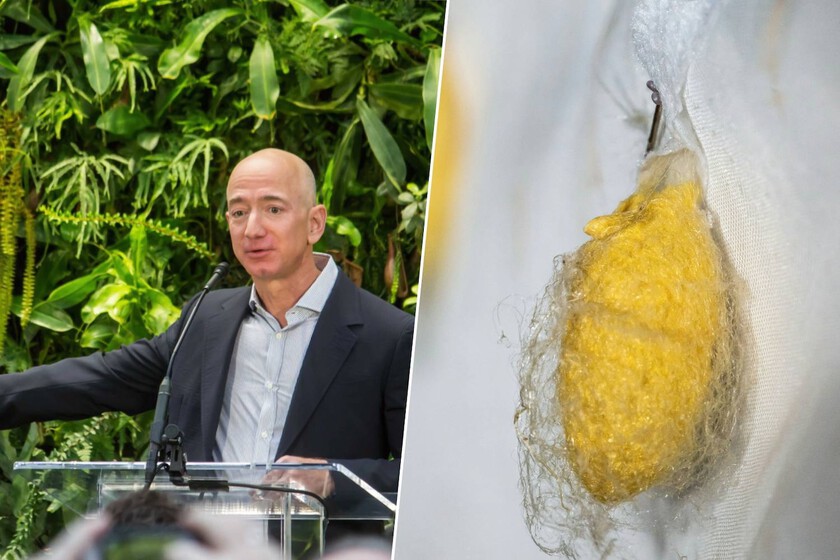
And it recently invested $34 million precisely in its “Bezos Earth Fund” to develop next-generation sustainable textiles from bacteria, agricultural waste and other biological sources. The objective is to create materials that require less oil, are biodegradable and sooner or later are capable of replacing polyester, viscose or even cotton, a material of natural origin but whose production for textiles consumes a lot of water.
The investment. These 34 million dollars are divided into four projects assigned to four top-level research entities:
- 11.5 million for Columbia University and the Fashion Institute of Technology to develop textile fibers made by bacteria that feed on agricultural waste.
- 10 million dollars for Berkeley, Stanford and Caltech to develop biodegradable fibers inspired by the spider web, but without the arthropod or using plastics.
- 11 million dollars for Clemson University to genetically modify cotton with the aim of improving its performance and so that it sprouts with the desired color.
- 1.5 million for the Cotton Foundation to restore the largest non-GMO cotton seed bank in the world.
Why is it important. Because fashion is the second most polluting industry: it is responsible for 8% of total carbon emissions and 20% of global wastewater, and forecasts point to an increase in greenhouse gas emissions of 50% by 2030. And that’s just for production.
Once we have used it, there is another problem inherent to synthetic textiles: microplastics. The European Environment Agency estimates that synthetic textiles account for between 16% and 35% of microplastics reaching the oceans each year, with between 200,000 and 550,000 tonnes entering the marine environment annually.
Context. The textile industry does not stop growing. In fact, in the last 20 years fiber production has almost doubled: from 58 million tons in 2000 to 116 in 2022 and with an estimate of reaching 147 million by 2030. Meanwhile, only 1% of the clothing produced is recycled to make new clothes, according to the Ellen MacArthur Foundation.
The situation is so alarming that the UN Secretary General has already warned that fast fashion is accelerating an environmental catastrophe and the solutions involve either doubling the useful life (which goes hand in hand with making clothes last longer), something that according to experts could reduce greenhouse gas emissions by 44 percent. The other option is to use a new generation of recycled and/or more sustainable textiles.
In detail. Given that automation and advances in the textile industry have already been optimizing the production process, what Bezos and his team intend to do is solve the problem at the source, that is, change the base material by improving it. Thus, for cotton the objective is to integrate color, improve performance and resilience by tapping into the biology of the plant. In the case of bacterial fabrics, Columbia’s approach is to create a digital map to learn how cells make it in order to replicate it.
Yes, but. The biggest challenge is the jump from the laboratory to the factory. Synthetic spider silk fibers have been promising a textile revolution for decades without having reached real industrial scale. There are already sustainable textile startups like Spiber or Circulose marketing alternatives to traditional fabrics, but their presence is testimonial. And $34 million may be a lot for most people, but it’s pocket change to change an industry like textiles, valued at $1.3 trillion and employing more than 300 million people across the value chain, according to the Ellen MacArthur Foundation.
In addition, sustainable fibers are usually more expensive, difficult to produce on a large scale and are only profitable for large brands if volume and quality are adequate. It takes something more to convince against fast fashion alternatives and amazingly cheap clothing like Shein.
In | We already know why Jeff Bezos invests so much money in space: he believes that in 20 years millions of people will live there
In | When Jeff Bezos asked his parents for $240,000 to found Amazon, they asked him only one thing: “What is the Internet?”
Cover | Flickr and David Clode