A drama is being experienced at all levels in the Middle East, in this case I am referring to the most recent conflict. In addition to the tremendous toll on human lives and the impact on people’s lives, the world of technology is not left out. Although we are aware that in a globalized world any conflict of the importance of the one currently developing in Iran affects economies, perhaps what we did not expect is that it would have an effect so important and drastic on the infrastructure of Artificial Intelligence. While large players spend billions of dollars on data centers, the danger is not only in sustainability or lack of energy resources, but it is possible that the production of hardware components, specifically HBM memory, will be seriously affected. And much more than it may seem.
To understand the magnitude of the risk, it is essential to understand the role of HBM (High Bandwidth Memory). Far from being a standard component, the HBM uses a complex 3D stacked DRAM chip architecture that are integrated into the same physical package as the GPU, eliminating the historical bottleneck known as the “memory wall.” In generative AI infrastructures, the raw power of accelerators (such as those from NVIDIA or AMD) It’s useless if they can’t ingest terabytes of data almost instantly. The HBM acts as that ultra-high-speed highway that feeds the massive calculations of the clusters, becoming the most critical and scarce component for training and executing large language models (LLMs). Without HBM, the AI infrastructure simply suffocates.
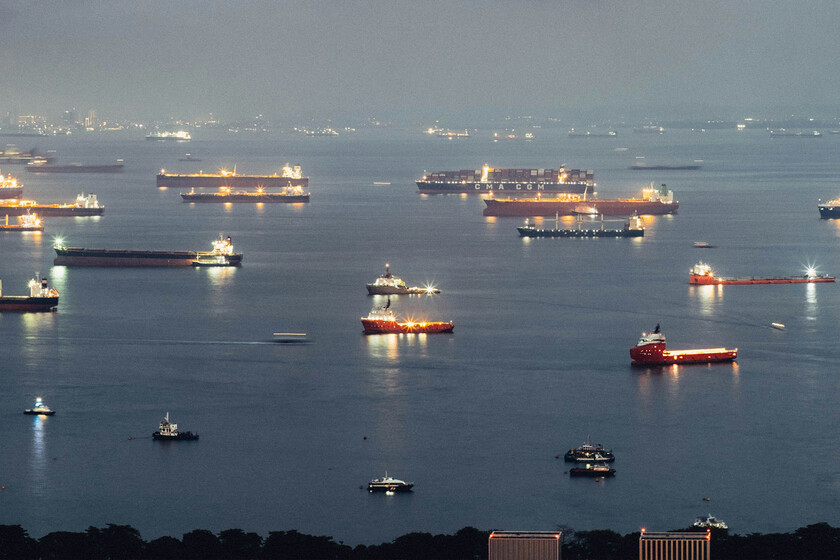
But what exactly is happening? The South Korean stock market sounded the alarm: the KOSPI plummeted 12.06% on March 4, 2026, its biggest drop since 9/11. accumulating a decline of more than 19% in two days. The direct cause was the escalation of the conflict between the US, Israel and Iran, which responded by threatening to close the Strait of Hormuzthrough which 20% of the world’s oil transits according to the US Energy Information Administration (EIA). For South Korea, this threat is existential: 70.7% of its crude oil comes from the Middle East and more than 95% of that volume transits through the strait itself, according to the Korea International Trade Association.
Samsung and SK Hynix are half of the KOSPI
What does this have to do with data center memory? The first clue is that Samsung Electronics and SK Hynix represent approximately 50% of the KOSPI capitalization. This concentration turns any semiconductor shock into a blue-chip index event, what Morningstar calls “single-name concentration risk.” Samsung fell 12% and SK Hynix fell 10% in the March 4 session, according to CNBC, and yet neither has issued a profit alert or modified its order book for 2026-2027.
Goldman Sachs places SK Hynix with more than 50% HBM market share and the industry consensus values the memory market by 2026 at $440 billion with 30% year-on-year growth. The massive sell-off in stocks responds to fear on the part of investors, not due to real problems in the factories: the KOSPI volatility index reached its highest level since 2008. The drop is real, but the cause is not operational: it is energy, financial and geopolitical.
Expensive energy, HBM at risk
The immediate risk for HBM production is not the demand that is expected to skyrocket and cannibalize other markets such as PCs.but the energy cost of manufacturing and its second-round effects on Korean industrial inflation. According to the Korea International Trade Association, a 10% increase in the Price of oil reduces the volume of Korean exports by 2.48%; The Hyundai Research Institute projects that a $100 oil scenario would subtract 0.3 points from 2026 Korean GDP and add 1.1 points to inflation. Added to this is that the country only has 3.5 million tons of LNG reserves, enough for between two and four weeks of stable demand, according to Kpler: there is no temporary cushion to absorb a prolonged interruption such as the one that is occurring due to the aforementioned blockade of the Strait of Hormuz. And here comes the crux: The new generation plants of SK Hynix (M15X) and Samsung (P5 in Pyeongtaek) consume energy intensively and any stress due to lack of energy supply will have a devastating effect on prices, availability…
Structural demand for High Bandwidth Memory for AI data centers has not changed in 48 hours, but the risk framework under which the supply chain operates has. Samsung and SK Hynix have signed the supply of 900,000 DRAM wafers per month for OpenAI’s Stargate project, and Gartner projects a 47% increase in DRAM prices during 2026. The consensus of Goldman Sachs, UBS, Nomura and JPMorgan is that HBM’s structural deficit persists until 2027, supported by NCNR contracts (non-cancellable, non-returnable): agreements in which if the hyperscaler cancels the order it loses the money, which de facto blocks the offer available to Microsoft, Google and Amazon until the end of 2026. What has died with the KOSPI crash is not the cycle, it is the illusion that South Korea is a technology supply infrastructure immune to geopolitical shocks.
Potential contagion to NVIDIA and hyperscalars
Korean risk is transmitted to Western technology markets through two channels. The first is the liquidation of global technology stocks to cover the winds of crisis coming from Seoul, which can pose a financial risk for these companies. The second is the physical disruption of HBM’s supply chain with direct influence on AI data center expansion plans in Europe and the US.

The S&P 500 fell about 1% on March 4, a subdued response that reflects that institutional investors have not yet priced in a prolonged disruption. But if the Strait remains closed for more than four weeks, manufacturing costs will escalate dramatically. A sustained interruption could mean a 60% cut in its crude oil imports for South Korea: this scenario must be taken into account to correct AI infrastructure growth forecasts.
Although HBM memory captures strategic attention, the domino effect on traditional hardware is inevitable. The same South Korean foundries that support the AI ecosystem produce the vast majority of the DRAM (DDR5/LPDDR5) and NAND Flash memory that powers standard servers, smartphones, and the global PC market. A sustained energy shock does not discriminate by use case: linearly increases the cost of any silicon wafer. A scenario that was already worrying but that with the conflict becomes even more dramatic.