
Deepfake tech can now generate synthetic media that is virtually indistinguishable from authentic content. Surfshark’s data revealed that deepfake-related scams defrauded victims of $1.1 billion globally in 2025. This represents a threefold increase from 2024.
If human senses can be easily deceived, what foundation remains for establishing digital trust? Scott Stornetta, a co-inventor of blockchain timestamping cited in the Bitcoin whitepaper, envisions applying distributed trust mechanisms to solve this identity crisis.
The goal is not winning an unwinnable detection race against generation tools but rendering the entire detection paradigm irrelevant.
The Collapse of Visual Evidence
During a recent interview with Binance, Stornetta detailed the severity of this shift, “We’re moving into a world where due to AI, while it has so many benefits, we’re also moving into a world where seeing is no longer believing,” Stornetta explained. “The question in my mind has been the last couple of years. Is there a way to use similar principles of distributing that trust broadly so that even if you can’t trust your eyes, you can trust that the person you think you’re interacting with is in fact that person.”
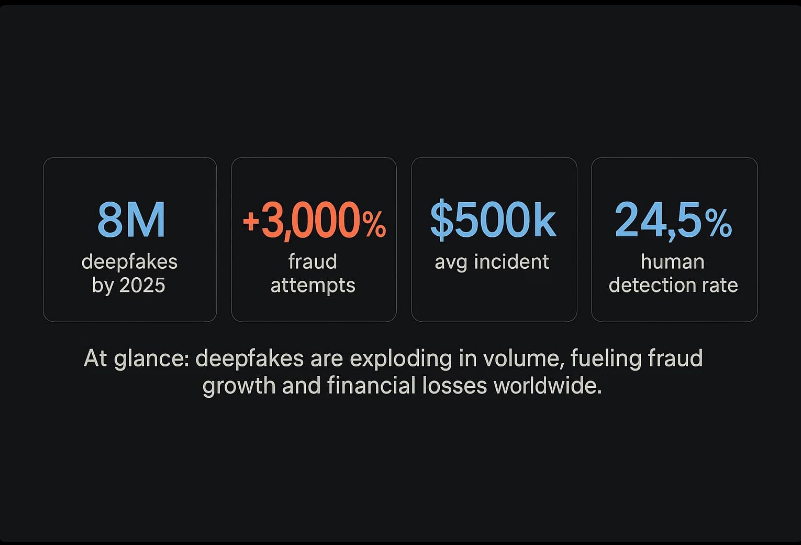
This challenge is accelerating as deepfakes reached a high enough realism to reliably fool non-expert viewers last year. DeepStrike tracked a significant increase in deepfakes—from 500,000 online deepfakes in 2023 to 8 million in 2025. This accounts to nearly 900% annual growth. SurfShark’s analysis shows over 80% of the $1.1 billion in related losses took place on social platforms.
Dr. Nadia Naffi from UNESCO characterizes this as a crisis of knowing itself. Our standard mechanisms for establishing truth face an unprecedented epistemological assault.
Why Detection Is a Losing Battle
Relying on software to catch synthetic media is a flawed strategy. Detection tools lag behind creation technologies in an unwinnable arms race. This creates the liar’s dividend, where the sheer volume of synthetic media allows bad actors to dismiss authentic recordings as probable fakes. Neither belief nor disbelief in digital evidence can be easily justified.
The World Economic Forum warns that moderate-quality face-swapping models utilizing camera injection techniques can deceive biometric systems, identifying five trends that will accelerate this risk over 12 to 15 months.
Stornetta compares the current anxiety to the famous Indiana Jones marketplace scene, where a menacing swordsman builds tension until the protagonist draws a revolver. The narrative questions how society will cope with worsening deepfakes, but the solution requires a different tool. The answer is implementing systems that render detection unnecessary.
Distributed Trust as the Foundation
Blockchain offers a way to establish verifiable provenance. “The narrative is that these deep fakes are going to get worse and worse. And how will we cope?” Stornetta stated. “There’s this dramatic build up, and the answer in fact is we can make deep fakes irrelevant and just move on.”
His core principle suggests that just as developers distributed trust across many people to make a trusted third party obsolete, similar architecture can verify identity. Sovereign implementations are underway with Bhutan rolling out its National Digital Identity platform on Ethereum. The project is scheduled for early 2026 and its success would mean that Bhutan could become the first country to anchor a population-scale identity system on a public network.
According to Vitalik Buterin, decentralized digital identity empowers people by giving them more secure control over their data and their online lives. Indeed, blockchain enables digital scarcity by allowing creators to record content authenticity on a public ledger. And no one can change the data there once the blocks are added to the chain.
Real-World Implementation Signals
Bhutan’s identity initiative aligns with its broader digital asset strategy, holding approximately 6,370 BTC worth $725 million and partnering with Binance Pay for tourism ecosystem payments. In regions with rapid digital adoption, the urgency is acute.
A Smile ID report found the crypto industry witnessed the highest cases of identity fraud in Africa compared to other sectors, noting that biometric digital identity systems are harder to fake than traditional text-based ID methods. WEF research confirms deepfake attacks increasingly target KYC processes.
Financial institutions documented sophisticated face-swapping assaults in the report. Industry analysis highlights that agentic AI and stablecoins are among five major trends redefining anti-money laundering in 2026, making robust digital identity systems essential. Binance Co-CEO Richard Teng recently commented on this, “With agentic AI emerging, crypto and stablecoins will become the mode through which agentic AI facilitates activities such as booking hotels, making payments, and more.”
Binance’s End of Year Report demonstrates this pivot and details 24 AI initiatives across compliance and over 100 AI models deployed for anti-fraud controls.
Trust Without Seeing
The ultimate goal is not to win an endless detection arms race, but to build an infrastructure that makes synthetic media completely irrelevant to trust decisions. From powering global payments to securing personal identity, blockchain principles are rapidly becoming the foundational underlayer for the AI era.
The technological capacity to authenticate reality independent of visual evidence already exists. As Stornetta suggests, the core challenge moving forward is no longer theoretical capability, but widespread implementation and adoption.
:::tip
This story was distributed as a release by Jon Stojan under HackerNoon’s Business Blogging Program.
:::