That the world is divided into blocks or powers is nothing new. What we live today is the foundation of what we will live in a few centuries, just as our society has been shaped by the empires that preceded us. For example, the Greeks laid the foundations of Western civilization and the Romans laid the foundations of today’s roads. But… what was happening in other parts of the world while Socrates or Philip II did their things?
That’s where this graph comes into play, which is great for simplifying the life of empires and their influence throughout history.
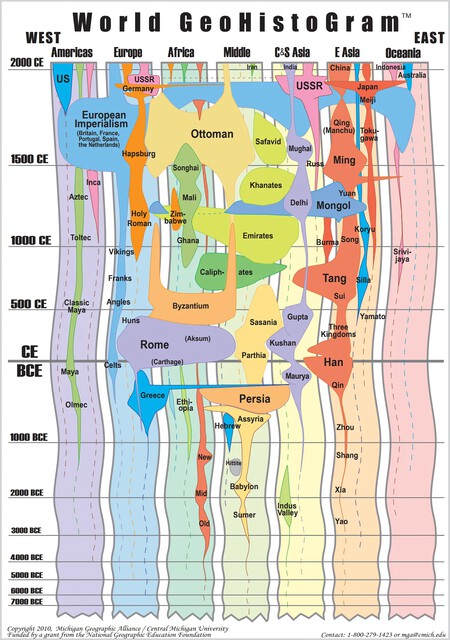
Simplifying empires. At WorldOfSoftware we have already seen some graphics that seek to put visual order in the history of humanity. There are some that are tremendously elaborate and others that, while similar to the one you have above, are still somewhat complex due to the amount of information they show. The one we show you is a work from the Michigan Geographic Alliance created as a tool to work on.
It’s called the World GeoHistogram and it combines geography and time into a unified visual framework that clearly shows the rise and fall of empires. History is not a zero-sum game in which, when one falls, another immediately arises. It is somewhat more complicated, but precisely this graph allows us to appreciate in a very visual way not only the empires that follow one another, but also those that occur in parallel and with which they may come into conflict.
It is organized in a very simple way, with lines that are “roads” that represent each of the world’s territories, and one of the first conflicts we see is with Greece, Persia and Alexander the Great.

Fleeting expansion. It is a perfect example of how two great empires develop in unison. The Greeks and Persians had expansionist desires, but there came a point, with Alexander the Great, when these ambitions clashed with those of the neighboring empire. We can see how the blue spot of Greece grows rapidly through North Africa, the Middle East and Asia, encountering the Persians.
It was a fleeting expansion that lasted only a few years and we can see that, after its influence, Greece did not return to what it was, giving way to other empires such as the Roman one. But speaking of expansions, a notable one is that of the Mongols, who made the same movement as Alexander, but from East Asia to the Middle East and even part of Europe. In its expansion, it collided with other civilizations, but there came a point when they simply vanished and the Middle Ages began.

Parallel powers. The caliphates, the Sassanids or the Byzantines also expanded their power for centuries, while in Europe the Celts or Vikings conquered territory, but were not an empire as such. Now, in the Late Middle Ages, things began to move in Europe. After years of empires such as the Holy Roman Empire, France, Holland, Portugal, England and Spain began to flourish as powers, and all with the same objective: to obtain land.
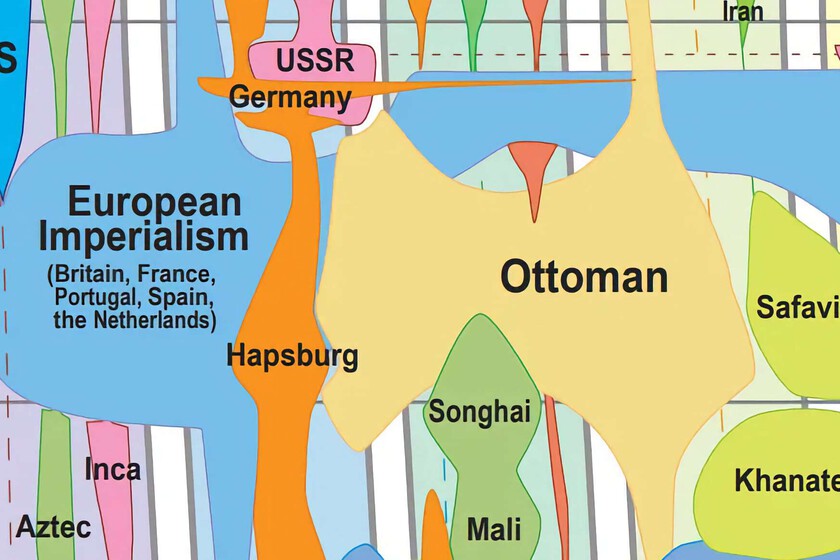
This European imperialism is shown perfectly in the graph, where we can see that they moved throughout all the territories. In some they had more or less influence, but they were there for a long period of time until it was cut short with the world wars. However, this “European empire” developed in parallel to another also of colossal size: the Ottoman Empire.
It also perfectly reflects how America had empires that followed one another, such as the Olmecs, Mayans or Aztecs… until they were nipped in the bud with colonization.
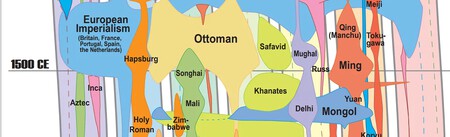
Long lasting. We haven’t talked about China and Japan because the ambition was… different. Japan, until the arrival of the Meiji, developed on its island. They had contact with the Mongols and the Ming, but it was not until the aforementioned Meiji and the first Sino-Japanese War when they began to be interested in other territories. Before the Second World War, this ambition was consolidated in China, but also in the territories of Oceania and, like the European empires, it was nipped in the bud after the Second World War.
In China things were different. By population and organization, China is the only empire (oversimplifying) that has existed for more than 2,500 years. They have gone through different eras (Qin, Han, Tang, Ming or Qing), but almost always focused on their territory, without those expansionist desires of the Mongols or the overseas conquest of the Europeans, Ottomans and Romans.
After World War II, the world was divided into two large blocks, led by the United States and the Soviet Union. But the end of the Cold War and the fall of the USSR marked the United States as a hegemonic power. And, in recent decades, China has emerged as another great pole of power

It’s not perfect. Like the graph, I have excessively compressed the information, since, as I said, history is not a zero sum, but a set of elements that take time and are highly complex. In fact, the graph itself, although very visual, has some limitations. For example, societies that do not fit the “big empire” model are left out.
Those without centralized states, written records or expansive territorial control, such as indigenous American or sub-Saharan cultures, are not represented. But, despite that, it is a great graph that allows you to follow a narrative with empires from before 3,000 BC to the present day.
Imágenes | Visual Capitalist, Michigan Geographic Alliance
In WorldOfSoftware | The Allies took the beaches of Normandy by force. Before them, a Spanish spy paved the way