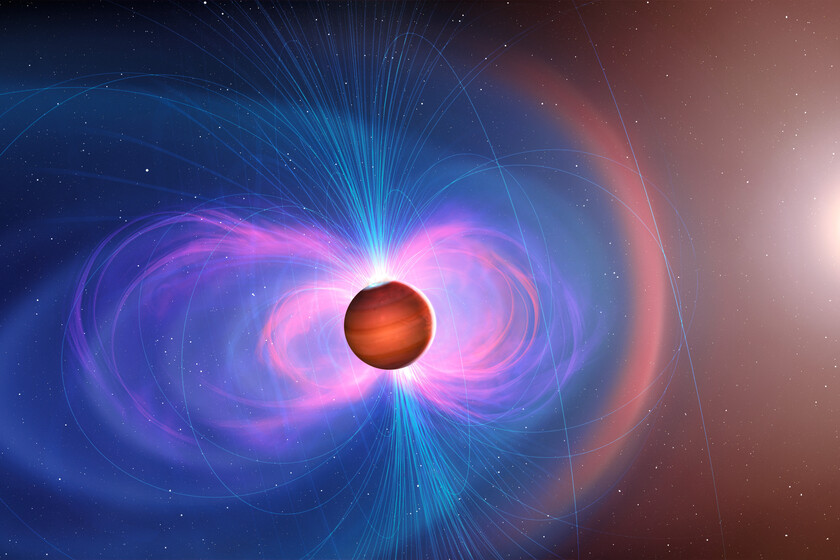
Hot Jupiters are fascinating planets. They orbit so close to their star that they sometimes have orbits of less than a day. Solar radiation is very high, so much so that sometimes these planets are practically evaporating. And they are usually tidally locked. That is, they have one face always facing the Sun and the other always facing the opposite side. As a result, one side is much hotter than the other and receives more radiation, so the gases in its atmosphere ionize, transforming into plasma and moving at high speeds. Put very briefly, they have the strongest winds of all the known planets.
However, recently a team of scientists led from the Côte d’Azur Observatory in France has discovered something very strange. Seven hot Jupiters in which the winds flow much slower than expected. The only explanation that seems logical for this phenomenon is that they are surrounded by a magnetic field. And it is great news, since, if confirmed, it would be the first detection of magnetic activity beyond our solar system.
Totally counterintuitive. The speed of a planet’s winds can be measured by tracking the vaporized iron present in the gases in its atmosphere. The authors of the study that has just been published did so with 7 hot Jupiters thanks to two instruments: MAROON-X, from the Gemini North telescope, and ESPRESSO, from the Very Large Telescope (VLT). When analyzing the results they saw that these planets had very high speeds, between 2 and 7 kilometers per second. The winds of our own Jupiter, the fastest in the solar system, are 0.4 km/s, to give us an idea. What happens is that these winds went slower the hotter the planet was.
One of the authors of the study, Vivien Parmentier, has described it as something “totally counterintuitive”, since the logical thing is that the higher the temperature, the faster the wind flows. The key must be in the presence of a magnetic field. In fact, with all this temperature and speed data, they have even been able to calculate its intensity.
The thing is about temperatures. Generally, the higher the temperature, the greater the difference between the dark and light sides of the planet and the more excited the ions in the plasma are, so the wind generally moves faster. The logical and expected thing would be that the higher the temperature of a hot Jupiter, the faster its wind. The speeds are very high, but much slower than expected. Furthermore, they are slower the hotter the planet is. The best explanation for this event is the presence of a magnetic field.
Magnetic activity and wind. When a magnetic field acts on a moving charged particle, it is affected by something known as the Lorentz Force. Very briefly, what happens is that the speed changes direction. The particle does not stop, but goes from flowing freely to being confined within the magnetic field. Every time he encounters his lines, they make him change direction. If we see this as a whole for the entire plasma, since it cannot move freely, its speed decreases. This would explain why a magnetic field was slowing down the wind. But why does it brake more the higher the temperature?

Auroras on Earth
The secret is inside. The magnetic field of a planet is directly related to the movement of the liquid metals inside it. For example, in the case of the Earth, the movement of molten iron and nickel on the outside of its core generates electrical currents, which give rise to a geomagnetic field that extends into space. They are responsible for us having that magnetic field that protects us from the sun’s inclemencies.
The higher the temperature of a planet, the more violently the molten metals inside it move and, therefore, within limits, the more intense the magnetic field will be. In turn, the more intense it is, the more it will slow down the winds.
Possible auroras. The location of auroras on Earth is related to the magnetic field. Another of the authors of the study, Bibiana Prinoth, points out that she likes to imagine that one of these Jupiters has a sky “covered by curtains of colorful light that dance over a planet that is half in perpetual day and half in endless night.”
What is it for?. Now that we know that some exoplanets have a magnetic field, we could also take it into account when selecting habitable planets. Logically, hot Jupiters are not candidates at all. However, other less inhospitable planets may also have this protective shield.
We already know that it is not enough to just be in the habitable zone. Other qualities, such as housing a sufficient amount of water or being far from supermassive black holes, are conditions that can help us refine the search much better. Each new discovery brings us a little closer to that great discovery.
Image | Gemini International Observatory/NOIRLab/NSF/AURA/M. Garlick | Magnificent
In | The Zoo Hypothesis: Why Aliens Likely Know About Us and Don’t Want to Contact Us