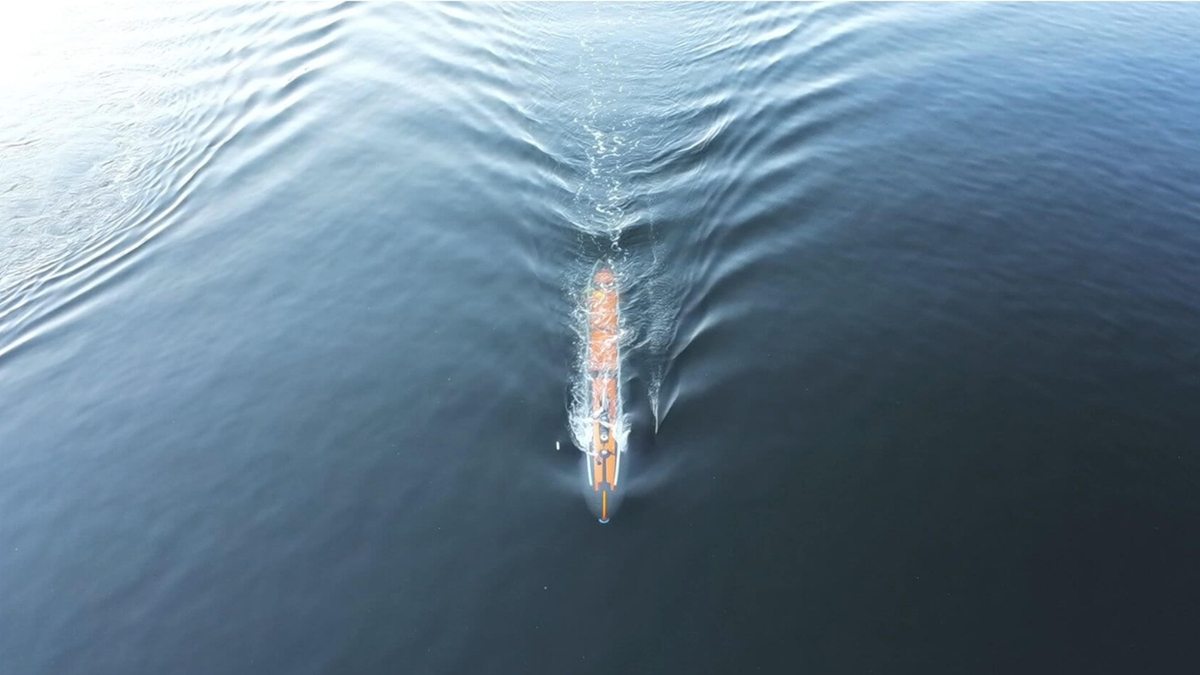
The Envoy underwater drone from Canadian company Cellula Robotics has set a new record by traveling more than 2,000 km in total immersion for 385 hours.
The Canadian company Cellula Robotics Ltd.based in British Columbia, announced that its autonomous underwater vehicle (AUV) called Envoy smashed the advertised performance specs.
The machine accomplished a mission of 385 hoursor more than 15 days, remaining constantly submerged. During this test, he traveled more than 2000 kilometers (1257 miles), a distance that marks a turning point for the exploration and monitoring of the seabed.
Powered by a hydrogen fuel cellthis feat demonstrates unprecedented endurance for autonomous underwater operations and paves the way for longer, more complex and more efficient missions.
How was this drone able to achieve such a feat of endurance?
The performance of the Envoy underwater drone is linked to advanced technology. The drone executed a mission profile simulating real-world conditions with more than 4000 turns and maneuvers complexes that place heavy demands on energy reserves.
It was a real stress test. The fact that this drone sous-marin exceeding its own objectives in such a demanding scenario proves the maturity and reliability of its design.
With its 8.5 meters long and 3.7 tonnes, this AUV (Autonomous Underwater Vehicleor autonomous underwater vehicle) is designed for long-term missions.
Endurance is the sinews of war in this sector because each recovery and redeployment operation of a machine is costly and complex, and often dependent on weather conditions. A battery life of 15 days can completely change the situation.
What is the secret technology behind this record autonomy?
The heart of the system is its energy. The Envoy is not powered by traditional batteries, whose capacity is limited, but by a much denser energy source: thehydrogen.
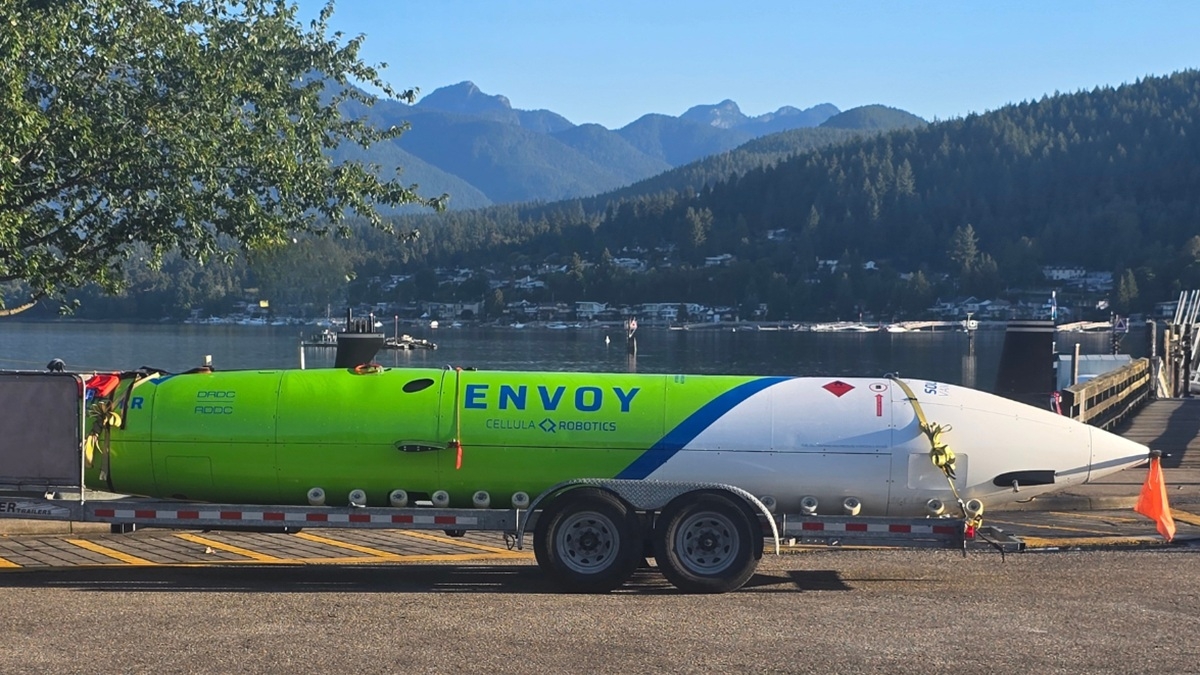
The drone carries a fuel cell PEM (Proton Exchange Membraneor proton exchange membrane) of 1.2 kW, developed by the American company Infinity Fuel Cell and Hydrogen, Inc. This system produces electricity on board continuously.
The principle is extremely efficient: the reaction between hydrogen and oxygen only produces electricity and water. No polluting emissionsand above all, a very low thermal and acoustic signaturewhich is a considerable asset for sensitive military or scientific applications.
The engine turns into a ghost of the deepcapable of operating in complete discretion for weeks.
Why is such a long mission a real turning point?
This endurance radically changes the economic and logistical equation of missions at sea. Fewer recoveries mean less downtimereduced costs and much more continuous and consistent data collection.
For the underwater operationsparticularly offshore where logistics are a headache, it is the end of the incessant ballet of surface ships coming to recover and redeploy the drones every few dozen hours.
The Envoy is also equipped with a suction anchor that allows it to attach to the seafloor for long-duration stationary missions, even in harsh environments.
Its applications are vast: mapping of the seabed, inspection of critical infrastructure (pipelines, submarine cables), scientific research or even surveillance and national defense.
What does this advance portend for the future of marine exploration?
This success is not an isolated event; it confirms a basic trend where hydrogen is emerging as a future solution for autonomous robotics with high endurance.
We are already seeing this technology emerge in aerial drones for reconnaissance missions. Applying it to the underwater domain, which is much more restrictive, is a a true feat of engineering.
Cellula Robotics CEO Neil Manning emphasizes this point: “ The significance of this result is not just the distance, but that it was achieved in a mission profile that reflects real underwater operations ».