The Invisible Cost: Pollution as the Missing Line Item
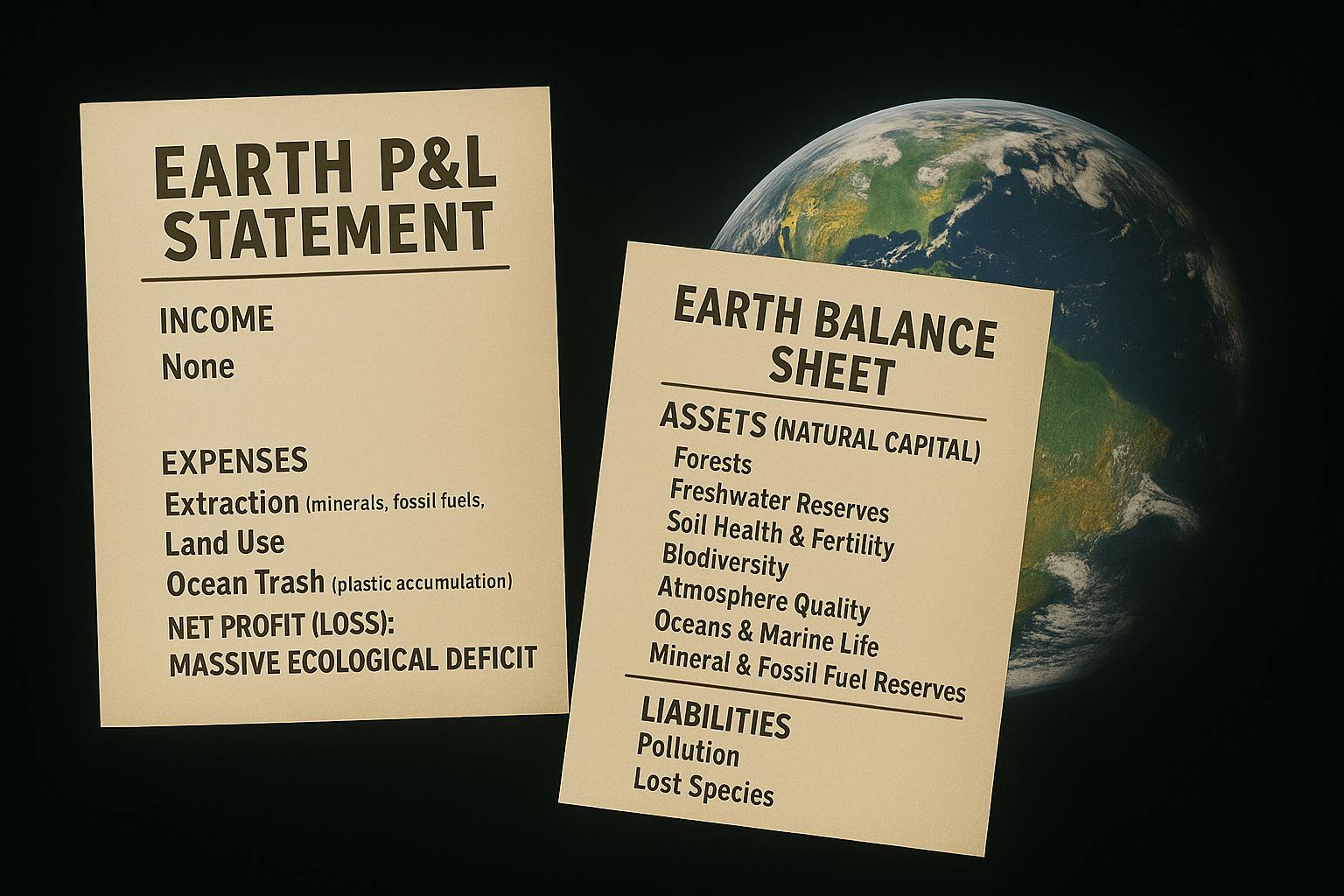
Every profitable company has a balance sheet. Assets. Liabilities. Equity. Revenue. Expenses. But there’s one line item that’s been missing for centuries: the cost of pollution.
This isn’t an oversight. It’s a fundamental flaw in how we account for value. And it’s not just about corporations—it’s about our entire economic system.
Let’s trace how we got here and why it matters now.
Part 1: The Historical Context—From Ignorance to Irresponsibility
1- The Age of Ignorance (Pre-20th Century-1950’s)
For most of human history, we genuinely didn’t know. Industrialization created wealth, jobs, and progress. The smoke from factories? A sign of prosperity. The waste in rivers? Unavoidable. The pollution in the air? Invisible.
The Accounting Reality:
– Factories produced goods → Revenue recorded
– Materials purchased → Expenses recorded
– Pollution created → Nothing recorded
It wasn’t malicious. It was ignorance. We didn’t understand the long-term costs. We didn’t have the science. We didn’t have the tools to measure impact.
The Balance Sheet:
Assets: Factory, Equipment, Inventory
Liabilities: Loans, Payables
Equity: Owner's Capital
Revenue: Sales
Expenses: Materials, Labor, Overhead
Pollution Cost: [Missing]
2- The Age of Knowledge (20th Century)
By the mid-20th century, we knew. Rachel Carson’s “Silent Spring” (1962) exposed pesticide damage. The Cuyahoga River caught fire (1969). Smog killed people in London (1952). We had the science. We had the evidence.
The Accounting Reality:
– Factories produced goods → Revenue recorded
– Materials purchased → Expenses recorded
– Pollution created → Still nothing recorded
This wasn’t ignorance anymore. This was a choice. A choice to externalize costs. A choice to let future generations pay. A choice to keep pollution off the balance sheet and not talk about it as there was no clear solutions.
Why? Because accounting for pollution would have:
– Reduced reported profits
– Lowered stock prices
– Made industries less competitive
– Required massive capital for cleanup
So we didn’t. We created regulations (sometimes). We set limits (often weak). We fined polluters (rarely). But we never put pollution on the balance sheet.
3- The Age of Responsibility (21st Century)
Today, we can’t claim ignorance. We have:
– Satellite imagery showing global pollution
– Real-time air quality monitoring
– Ocean plastic tracking
– Climate models predicting impacts
– Cost estimates for cleanup
The Accounting Reality:
– Factories produce goods → Revenue recorded
– Materials purchased → Expenses recorded
– Pollution created → Still nothing recorded
We know. We measure. We document. But we still don’t account.
Part 2: The Accounting Problem—Externalities and Balance Sheets
What Are Externalities?
In economics, an externality is a cost or benefit that affects a third party who didn’t choose to incur it. Pollution is a negative externality.
The Classic Example:
– Factory produces goods → Sells them → Records profit
– Factory emits pollution → Air/water/soil damaged → Cost borne by society
– Society pays for: Healthcare, cleanup, environmental damage, climate change
The Accounting Problem:
The factory’s balance sheet shows profit. Society’s “balance sheet” shows debt. But there’s no connection. No accounting link. No way to balance the books.
The Missing Liability
In proper accounting, if you create a cost, it should be a liability. But pollution costs are:
– Uncertain: How much damage? When will it manifest?
– Distributed: Who pays? Everyone? No one?
– Delayed: Costs appear years or decades later
– Unpriced: No market value for clean air/water/soil
So we treat them as zero. Zero liability. Zero cost. Zero responsibility.
The Real Balance Sheet (What It Should Show):
Assets: Factory, Equipment, Inventory
Liabilities: Loans, Payables, Pollution Liability
Equity: Owner's Capital
Revenue: Sales
Expenses: Materials, Labor, Overhead, Pollution Cost
Net Income: [Lower]
The Actual Balance Sheet (What It Shows):
Assets: Factory, Equipment, Inventory
Liabilities: Loans, Payables
Equity: Owner's Capital
Revenue: Sales
Expenses: Materials, Labor, Overhead
Net Income: [Artificially High]
Why Intangible Asset Accounting Doesn’t Work for Pollution
You might think: “But accounting does handle intangible items. Companies have goodwill, patents, trademarks, brand value. Why can’t we account for pollution the same way?”
Here’s the critical difference: Current accounting treats intangibles as assets, not liabilities. And it only works when they can be valued and amortized.
How Intangible Assets Work in Current Accounting:
Intangible Assets (What We Account For):
– Goodwill: Value of acquired companies beyond their assets
– Patents: Exclusive rights to inventions
– Trademarks: Brand recognition and value
– Software: Developed technology
– Customer relationships: Acquired customer bases
n The Accounting Treatment:
Intangible Asset → Recorded as Asset → Amortized over time → Reduces value gradually
Example:
– Company acquires another company for $100M
– Tangible assets: $60M
– Goodwill (intangible): $40M
– Goodwill recorded as asset, amortized over 10-40 years
– Each year: Amortization expense reduces asset value
– Balance: Asset value decreases, but it was paid for, so it balances
n Why This Works:
– Intangible assets have value (someone paid for them)
– They can be valued (purchase price, market value, appraisals)
– They amortize (decline in value over time)
– They balance (asset = what was paid for it)
n Why Pollution Doesn’t Fit This Model:
Pollution as a Liability (What We Don’t Account For):
– Air pollution: Damage to atmosphere
– Water pollution: Contamination of water systems
– Soil pollution: Degradation of land
– Climate change: Global environmental costs
The Accounting Problem:
Pollution Created → No Value Paid → No Asset Recorded → No Amortization → Liability Never Recorded
Why Current Intangible Accounting Fails:
1. Pollution is a Liability, Not an Asset
– Intangible accounting handles assets (things of value)
– Pollution is a liability (cost, damage, obligation)
– Different accounting treatment required
2. Pollution Has No Purchase Price
– Intangible assets are valued because someone paid for them
– Pollution has no purchase price – it’s a byproduct, not an acquisition
– No transaction to base valuation on
3. Pollution Can’t Be Easily Valued
– Intangible assets can be appraised, compared, market-tested
– Pollution costs are:
    - Uncertain (when will damage manifest?)

    - Distributed (who pays? everyone? no one?)

    - Delayed (costs appear years later)

    - Unpriced (no market for clean air/water/soil)
4. Pollution Doesn’t Amortize
– Intangible assets decline in value over time (amortization)
– Pollution accumulates over time (gets worse, not better)
– Amortization model assumes value decreases—pollution assumes cost increases
5. Pollution Doesn’t Balance
– Intangible assets balance because they were paid for
– Pollution has no corresponding payment or asset
– Creates imbalance: cost created, nothing recorded
The Fundamental Mismatch:
Intangible Asset Model:
Purchase → Asset Recorded → Amortized → Value Declines → Balances Over Time
Pollution Cost Model (What We Need):
Pollution Created → Liability Should Be Recorded → Cost Accumulates → Never Balanced
Current accounting structure for intangible assets is simply not appropriate for global pollution and its consequences because:
– It’s designed for assets, not liabilities
– It requires purchase prices and valuations that don’t exist for pollution
– It assumes amortization (declining value), but pollution accumulates (increasing cost)
– It balances through payment, but pollution has no corresponding payment
We need a new accounting framework for pollution—one that recognizes it as a liability, values it through damage assessment, and balances it through cleanup funding.
The Global Balance Sheet Imbalance
This isn’t just about individual companies. It’s about the global balance sheet.
Global Assets (What We Count):
– Factories, infrastructure, technology
– Natural resources (oil, minerals, land)
– Human capital, knowledge
– Financial assets
Global Liabilities (What We Count):
– Government debt
– Corporate debt
– Personal debt
Missing Global Liabilities (What We Don’t Count):
– Pollution damage to air, water, soil
– Climate change costs
– Biodiversity loss
– Health impacts
– Future cleanup costs
The Imbalance:
Our global balance sheet is fundamentally unbalanced. We’ve recorded the assets (wealth created) but not the liabilities (pollution costs). We’ve been running a massive accounting error for centuries.
Part 3: Asset-Backed vs. Non-Backed Wealth
Traditional Accounting: Asset-Backed Wealth
Traditional accounting rules have been built on asset-backed wealth, assuming wealth is backed by assets and is balanced by them:
– Gold standard: Currency backed by gold
– Asset-backed loans: Debt backed by collateral
– Company value: Stock price backed by assets and earnings
The Principle:
Value = Backed by something tangible. Assets balance liabilities. Everything balances.
The Accounting Equation:
Equity = Assets - Liabilities
This works when:
– Assets are tangible (gold, land, equipment)
– Liabilities are known (loans, payables)
– Value is backed by something real
Modern Reality: Non-Backed Wealth
But here’s the problem: Most modern wealth isn’t backed by assets.
Fiat Currencies:
– US Dollar: Not backed by gold since 1971
– Euro: Not backed by any physical asset
– Most currencies: Backed by government promise, not assets
Cryptocurrencies:
– Bitcoin: Not backed by any asset
– Ethereum: Not backed by any asset
– Most cryptocurrencies: Backed by network value, not assets
Digital Assets:
– Stocks: Often valued at multiples of assets
– NFTs: Valued by demand, not underlying assets
– Intellectual property: Valued by potential, not physical assets
n The New Accounting Reality:
Value ≠ Backed by Assets
Value = Backed by Trust, Demand, Network Effects, or Nothing
The Accounting System’s Identity Crisis
Our accounting system was built for asset-backed wealth. But we’re living in a non-backed world. This creates fundamental questions:
Question 1: What Backs Value?
– If currency isn’t backed by gold, what backs it?
– If stocks trade at 10x book value, what’s the real value?
– If pollution costs aren’t on balance sheets, are balance sheets accurate?
Question 2: How Do We Balance?
– If assets aren’t tangible, how do we value them?
– If liabilities are uncertain (pollution), how do we account for them?
– If value is based on trust, what happens when trust erodes?
Question 3: Is Our Accounting System Obsolete?
– Built for physical assets → Now we have digital assets
– Built for known liabilities → Now we have uncertain externalities
– Built for asset-backed value → Now we have trust-backed value
Part 4: Valuing Pollution—The Path to Balance
The Goal: Not Blame, But Balance
This isn’t about pointing fingers as we’re all guilty, corporations and consumers. It’s about balancing the books with Nature. If we can value pollution damage, we can create equal wealth to fix it.
The Principle:
Pollution Damage Value = Cleanup Funding Requirement
If pollution has cost $X trillion in damage, we need $X trillion to clean it. Not as punishment. Not as blame. As balance.
How to Value Pollution?
1: Cost of Cleanup
– How much to remove CO₂ from atmosphere? → Value of CO₂ pollution
– How much to clean ocean plastic? → Value of plastic pollution
– How much to remediate soil? → Value of soil pollution
2: Cost of Damage
– Healthcare costs from air pollution → Value of air pollution
– Agricultural losses from soil contamination → Value of soil pollution
– Climate change adaptation costs → Value of climate pollution
3: Market-Based Pricing
– Carbon credit prices → Value of carbon pollution
– Environmental credit markets → Value of various pollutions
– Insurance costs for climate risk → Value of climate pollution
4: Replacement Cost
– Cost to replace lost ecosystems → Value of biodiversity pollution
– Cost to restore natural systems → Value of environmental pollution
The Global Pollution Liability Estimate
While exact numbers are debated, estimates suggest:
Climate Change Costs:
– Historical emissions: Trillions in damage
– Future adaptation: Trillions more
– Total: Estimates range from tens to hundreds of trillions
Air Pollution Costs:
– Healthcare: Hundreds of billions to trillions annually
– Lost productivity: Hundreds of billions annually
– Total: Trillions over decades
Water Pollution Costs:
– Cleanup: Hundreds of billions to trillions
– Health impacts: Hundreds of billions
– Ecosystem damage: Trillions (unquantified)
Soil Pollution Costs:
– Remediation: Trillions globally
– Agricultural losses: Hundreds of billions annually
– Total: Trillions
Ocean Pollution Costs:
– Plastic cleanup: Hundreds of billions
– Ecosystem damage: Trillions (unquantified)
– Fisheries impact: Hundreds of billions
n Total Global Pollution Liability:
Estimates vary widely, but most analyses suggest hundreds of trillions in cumulative pollution costs globally. This is the missing liability on our global balance sheet.
n The Accounting Solution: Pollution as a Global Liability
Step 1: Acknowledge the Liability
Global Balance Sheet (Current):
Assets: $X trillion
Liabilities: $Y trillion (debt, payables)
Missing: $Z trillion (pollution costs)

Global Balance Sheet (Accurate):
Assets: $X trillion
Liabilities: $Y trillion + $Z trillion (debt + pollution)
Step 2: Create Matching Wealth
If pollution liability = $Z trillion, we need $Z trillion in wealth to balance it. This isn’t debt. This is new wealth creation to match the liability that we forget to write on the books for centuries.
Step 3: Fund Cleanup
The $Z trillion in new wealth funds:
– Carbon capture facilities
– Ocean cleanup operations
– Soil remediation
– Air purification
– Reforestation
– All earth cleaning technologies
The Balanced Equation:
Pollution Liability ($Z trillion) = Cleanup Funding ($Z trillion)
Part 5: The Currency Solution—Non-Backed Wealth for Non-Backed Liabilities
The Paradox
We have:
– Non-backed currencies (fiat, crypto) creating wealth
– Non-backed liabilities (pollution costs) creating debt
But we’re trying to balance them with:
– Asset-backed accounting (traditional system)
– Asset-backed funding (debt, taxes, ROI requirements)
n The Mismatch:
Non-backed problems need non-backed solutions. Non-backed liabilities need non-backed wealth.
How Non-Backed Currencies Can Balance Non-Backed Liabilities
Traditional Approach (Doesn’t Work):
Pollution Liability → Need Funding → Borrow Money (Debt) → Can't Repay → System Fails
New Approach (Could Work):
Pollution Liability → Create Non-Backed Wealth → Fund Cleanup → Balance Achieved
The Key: If pollution liability isn’t backed by assets (it’s an externality), the funding to fix it doesn’t need to be backed by assets either. It just needs to be calibrated to value.
n The O Blockchain Model: Calibrated Wealth for Calibrated Liabilities
O Blockchain offers a solution: water price-based global currency system that’s:
– Not backed by assets (unlimited supply)
– Calibrated to value (water price in each local market)
– Can create wealth for public good (pollution cleanup)
– Doesn’t require debt, ROI or confidence/trust to stay strong and stable
How It Works:
1. Acknowledge Pollution Liability
– Calculate global pollution costs
– Record as liability on global balance sheet
– Don’t assign blame—assign value
2. Create Matching O Coin Wealth
– Generate O coins equal to pollution liability value
– Calibrated to water price (stable, universal)
– Not debt—new wealth creation to balance the missing line item!
3. Fund Cleanup Operations
– Allocate O coins to earth cleaning projects
– Carbon capture, ocean cleanup, reforestation, etc.
– Projects funded by matching wealth, not debt – Funding based on deliveries and performance.
4. Balance the Books
Pollution Liability (Historical) = O Coin Allocation (Cleanup Funding)
The Accounting:
Global Balance Sheet (Balanced):
Assets: $X trillion
Liabilities: $Y trillion (debt) + $Z trillion (pollution)
Equity: $X - $Y - $Z trillion

Cleanup Funding: $Z trillion (O Coin allocation)
Result: Pollution liability matched by cleanup funding
Why This Works
1. Matches the Nature of the Problem
– Pollution is non-backed (externality, not asset)
– Funding is non-backed (O Coin, not asset-backed)
– Both are calibrated to value (water price, cleanup cost)
2. Doesn’t Require Blame or Responsibility
– Not about punishing polluters
– Not about assigning fault
– About balancing the books
3. Creates Sustainable Funding
– Not debt (doesn’t need repayment)
– Not taxes (doesn’t require political will)
– Not ROI (doesn’t need profit)
– Just balance (liability = funding)
4. Aligns with Modern Currency Reality
– Fiat currencies aren’t asset-backed
– Cryptocurrencies aren’t asset-backed
– O Coin isn’t asset-backed
– All are value-calibrated n
Part 6: Rethinking Accounting for the 21st Century
The New Accounting Principles
Old Principle: Value must be backed by assets
New Reality: Value can be calibrated to universal measures
n Old Principle: Liabilities must be certain and quantifiable
New Reality: Uncertain liabilities (pollution) can be estimated and matched
Old Principle: Wealth creation requires assets or debt
New Reality: Wealth can be created through algorithm calibration
n Old Principle: Balance sheets must balance assets and liabilities
New Reality: Balance sheets must balance all costs (including externalities) with all wealth (including calibrated currency)
The Updated Global Accounting Equation
Traditional:
Equity = Assets - Liabilities
Updated:
Equity = (Assets + Calibrated Wealth) - (Liabilities + Externalities)
Where:
– Calibrated Wealth: Currency created through value calibration (O Coin)
– Externalities: Costs not on traditional balance sheets (pollution)
– Balance: Externalities matched by calibrated wealth
The Global Balance Sheet (Corrected)
Assets:
– Physical assets (factories, infrastructure)
– Natural resources
– Human capital
– Technology and knowledge
Liabilities:
– Traditional debt (government, corporate, personal)
– Pollution costs (newly recognized and finally recorded!)
Equity:
– Traditional equity
– Calibrated wealth for cleanup (O Coin allocation)
Balance:
Assets = Liabilities (including pollution) + Equity (including cleanup funding)
Conclusion: Balancing the Books for Future Generations
For centuries, pollution has been the missing line item. First from ignorance. Then from choice. Now from necessity—we must account for it.
This isn’t about blame. It’s about balance. If pollution has created $Z trillion in costs, we need $Z trillion to fix it. Not as punishment. As accounting.
Our accounting system, built for asset-backed wealth, is struggling with non-backed realities. Fiat currencies. Cryptocurrencies. Pollution externalities. All non-backed. All need new accounting.
O Blockchain offers a path: calibrated wealth based on basic human needs(water). Water price-based currency that can create wealth to match pollution costs. Not debt. Not taxes. Not ROI. Just balance with stability.
The question isn’t whether we should account for pollution. We must!
The question is: How do we value and fund the cleanup?
With calibrated, non-backed currency that matches the non-backed nature of pollution liability, we can finally balance the books of nature. For ourselves. For future generations. For the planet. Without taxing current or next generations!
The missing line item has been found. Now let’s balance it with technology!
O International is a French Non-Profit Association dedicated to the design, creation and promotion of a stable digital currency system based on global water prices. Learn more at https://o.international
## References & Further Reading
– Externalities in Economics (various economic textbooks)
– Environmental Accounting (EPA, academic research)
– Carbon Pricing and Markets (IEA, World Bank reports)
– Fiat Currency History (Federal Reserve, central bank reports)
– O Blockchain: Water-Based Currency System (o.international)
:::tip
Note on Data: Pollution cost estimates vary widely by methodology, timeframe, and scope. This article uses conceptual frameworks rather than specific numbers to avoid inaccurate claims. For specific cost estimates, consult environmental economics research and climate impact studies.
:::
:::info
This article is published under HackerNoon’s Business Blogging program.
:::