South America has long lived under a fragile balance between military modernization, internal tensions and the constant influence of external powers. That balance is shaking again today, with a turbulent regional scenario marked by the renewed push by the United States around Venezuela and a continent that observes how security, autonomy and defense once again occupy a central place on the strategic agenda.
This context explains an unprecedented naval project.
The assault of Colombia. Yes, Colombia has begun one of the most ambitious industrial and military transformations in its recent history by beginning the construction of its first frigate manufactured in national territory.
The Strategic Surface Platform project marks the country’s entry into the small group of Latin American nations capable of designing and building highly complex combat ships. It is not only a military decision, but a strategic commitment to autonomy, knowledge and control of the full cycle of its naval capabilities.
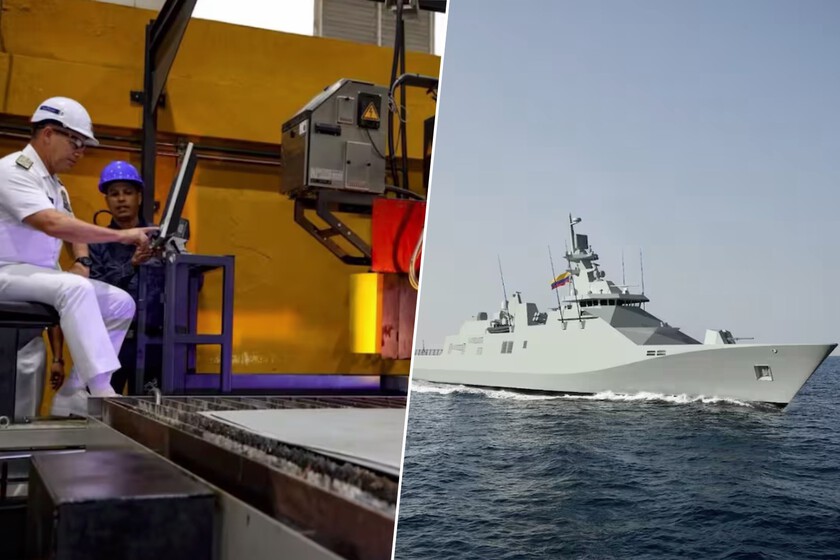
Cotecmar and shipyard maturity. Responsibility for the project falls on Cotecmar, which for the first time assumes the complete construction of a frigate for the Colombian Navy. The media has talked these days about the beginning of sheet cutting as a symbol of the culmination of years of investment in engineering, production processes and industrial infrastructure.
In this way, the nation leaves behind the role of simple buyer or assembler and begins to control the design, integration and maintenance of a strategic platform.
Designed to last. They said in Defense that the PES is built under an advanced modular architecture based on the SIGMA 10514 design from the Dutch Damen shipyard.
With more than 107 meters in length and nearly 3,000 tons of displacement, it will be the largest warship ever built in the country. Plus: block construction will allow optimization of time, quality and future modernizations without compromising the basic structure of the ship.
Fleet renewal. These frigates will give rise to the Gran Almirante Padilla class, called to become the new core of Colombian surface escorts. The plan includes up to five units, which will allow a progressive and sustained renewal of the fleet over the next decade.
In the background: replace veteran ships and ensure modern capabilities in anti-aircraft, anti-submarine, surface and electronic warfare.
Operational versatility. There is much more, since the PES has been conceived as a multipurpose ship capable of operating both in naval combat scenarios and in surveillance missions, protection of sea routes and international cooperation. Furthermore, its flexible and digitalized design places it among the most modern frigates in Latin America, and the most powerful in terms of war technology. On paper, this versatility will expand Colombia’s strategic room for maneuver in the Caribbean and the Pacific without the need for specialized fleets for each mission.
Technology and strategic autonomy. Beyond its military power, the program reinforces industrial autonomy by allowing maintenance, updating and modernization to be carried out in the country itself.
The frigate will also be prepared to operate under standards compatible with NATO, facilitating exercises and combined operations with allies. In other words, Colombia thus gains operational independence without having to give up international interoperability.
Economic impact. It is the last of the legs in the global analysis of the movement. The PES program will have, a priori, a driving effect on the economy and specialized employment, with thousands of direct and indirect jobs until the delivery of the first unit scheduled for 2030.
However, its true scope is structural: to consolidate an industrial base capable of sustaining future naval projects and positioning Colombia as a relevant player in the regional defense industry. If you want and from that perspective, the frigate is not simply a ship, it is a declaration of long-term intentions.
Image | Defense
In WorldOfSoftware | Brazil has been following a path reserved for few powers for years: that of developing its own nuclear submarine
In WorldOfSoftware | Neither drones nor fighters nor elite soldiers: the US entered Venezuela disguising a 20th-century tactic as technology. XIX