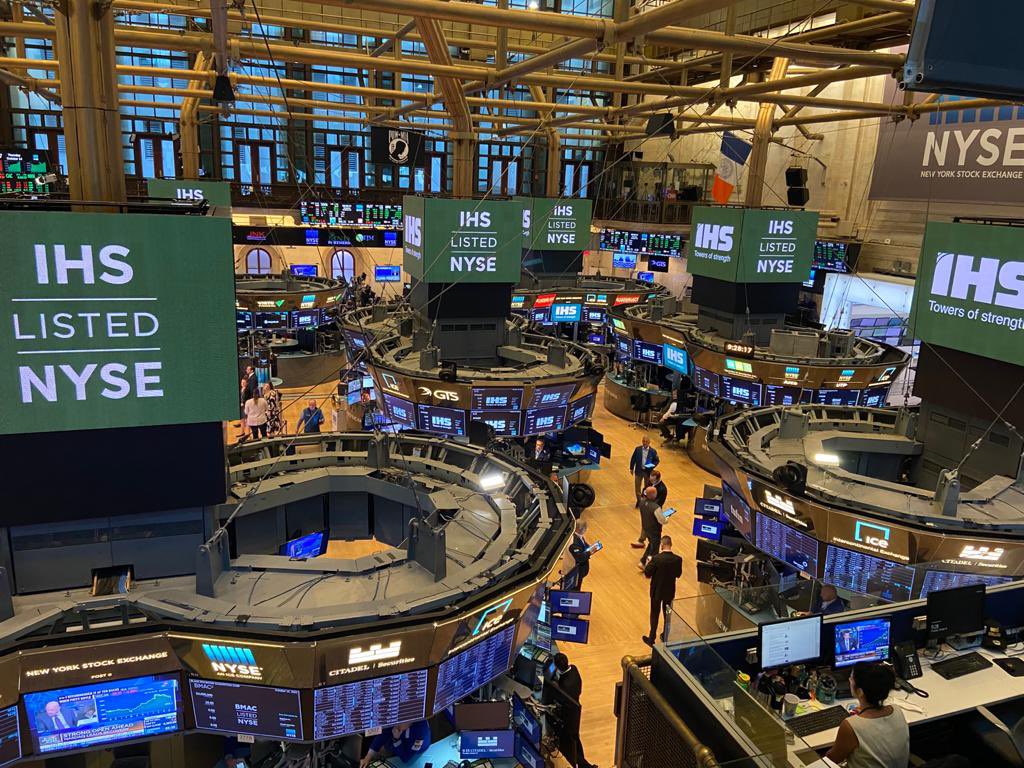
MTN Group, Africa’s largest telecommunication company, is spending $2.2 billion to regain control of nearly $4.8 billion worth of telecom towers across Africa from IHS Holdings. At the same time, it is assuming responsibility for one of the sector’s largest debt burdens.
The transaction values the tower operator at roughly $2.9 billion in equity and implies an enterprise valuation of about $6.2 billion, including its Latin American operations. Once ongoing divestments are completed, MTN will retain an African tower portfolio worth approximately $4.8 billion.
The deal arrives as IHS faces growing balance-sheet pressure. After years of expansion financed largely with dollar-denominated debt, currency volatility, rising diesel costs, and looming maturities have tightened the company’s finances. Asset sales across multiple markets have followed, as refinancing conditions for standalone tower operators deteriorate.
Integration into MTN would provide access to a stronger balance sheet and a reliable anchor tenant at a critical juncture for the company.
Balance sheets moving in opposite directions
In 2025, IHS sold its Rwandan subsidiary, including 1,467 sites, to Paradigm Tower Ventures. On February 11, 2026, it agreed to sell its 51% stake in I-Systems in Brazil. On February 17, the company moved to divest its Brazilian and Colombian holdings for an enterprise value of $925 million.
IHS’s debt profile has become increasingly strained. As of the third quarter of 2025, the company carried $3.27 billion in borrowings, about 85% denominated in foreign currency, with significant maturities due between 2026 and 2027.
That debt structure has become harder to manage across operating environments shaped by currency volatility and rising energy costs.
Diesel remains a primary power source for telecom towers across much of Africa, exposing operators to fuel inflation and supply disruptions. At the same time, local currency depreciation has increased the real cost of servicing dollar-denominated debts, while revenues remain tied to long-term lease contracts negotiated years earlier.
Those contracts provide revenue stability but limit pricing flexibility, leaving tower companies slower to respond when operating costs surge.
Although IHS reported more than $1 billion in liquidity, including unrestricted cash and available credit facilities, the company has cautioned that sustaining operations and funding growth beyond the near term would depend on stronger cash generation or additional financing.
MTN enters the transaction from a position of relative balance-sheet strength. The group reported net debt of $2.54 billion as of December 2024 and liquidity of about $2.28 billion as of September 2025, supported by improving operating cash flows and dividend upstreaming from key subsidiaries.
With net debt-to-EBITDA around 0.4×, meaning its debt is less than half of one year’s operating earnings, MTN has the capacity to assume leverage that would likely prove more expensive for a standalone tower operator to refinance in current markets.
The group reported net debt of $2.54 billion as of December 2024 and liquidity of $2.28 billion as of September 2025.
Once IHS’s assets and liabilities are consolidated, MTN’s net debt could rise toward $4.8 billion, pushing leverage closer to the 1.0 to 1.2× range, roughly equivalent to one year of operating earnings
In practical terms, MTN is choosing to absorb short-term balance-sheet pressure in exchange for long-term control over infrastructure it already depends on, and already pays billions annually to use.
Internalising lease payments
IHS generated $1.33 billion in revenue as of September 2025 and reported income of $210.4 million for the period.
As of Q3 2025, about 62% of IHS’s revenue came from MTN operating companies, particularly MTN Nigeria. Every year, MTN pays tower lease fees that ultimately become revenue and profit inside IHS. Buying the company effectively turns those payments into internal transfers. Instead of paying rent, MTN captures the margin.
At the end of 2024, lease liability across MTN Group stood at $4.65 billion. After the acquisition, MTN says revenue earned from MTN’s operating companies will be eliminated, removing a significant portion of tower rental expenses and generating roughly $1.1 billion in savings.
A return to infrastructure ownership
The acquisition marks a strategic return to asset ownership after years in which telecom operators globally pursued tower outsourcing to unlock capital. Owning the infrastructure allows MTN to internalise lease economics, capture embedded margins, and coordinate network investment decisions more tightly across markets.
That flexibility matters as operators prepare for denser 5G deployments, fibre expansion, and rising energy costs. Energy optimisation alone could materially change tower economics in markets where diesel remains a dominant cost driver.
By integrating tower ownership, MTN expects to improve cost predictability, eliminate tower rental expenses, and increase third-party tenancy across sites.
The company has emphasised that IHS will maintain an arms-length open-access policy, allowing competitors such as Airtel to continue leasing space and generating wholesale revenue. Airtel accounted for roughly 15% of IHS revenue as of Q3 2025.
But MTN will now jointly control decisions around densification, power solutions, and long-term infrastructure investment. In short, MTN expects to create more value by owning tower infrastructure rather than leasing it. For IHS, the deal resolves many of its near-term financing pressures.
Integration and governance
MTN plans to fold IHS into its digital infrastructure subsidiary, Bayobab, as a standalone unit, maintaining separate governance and management to preserve operational continuity.
Existing contracts between MTN operating companies and IHS will continue uninterrupted, ensuring service continuity for MTN and its competitors.
The transaction will proceed under Cayman Islands merger rules and requires shareholder approval as well as regulatory clearance across each operating jurisdiction.
MTN has already secured over 40% of votes, its own stake combined with Wendel’s 19%, towards the two‑thirds needed.
Nigeria’s Ministry of Communications, Innovation, and Digital Economy has said it will review the transaction in line with its objective “to ensure that any market consolidation or structural changes protect consumers, safeguard investments, and preserve the long-term sustainability of the sector.”