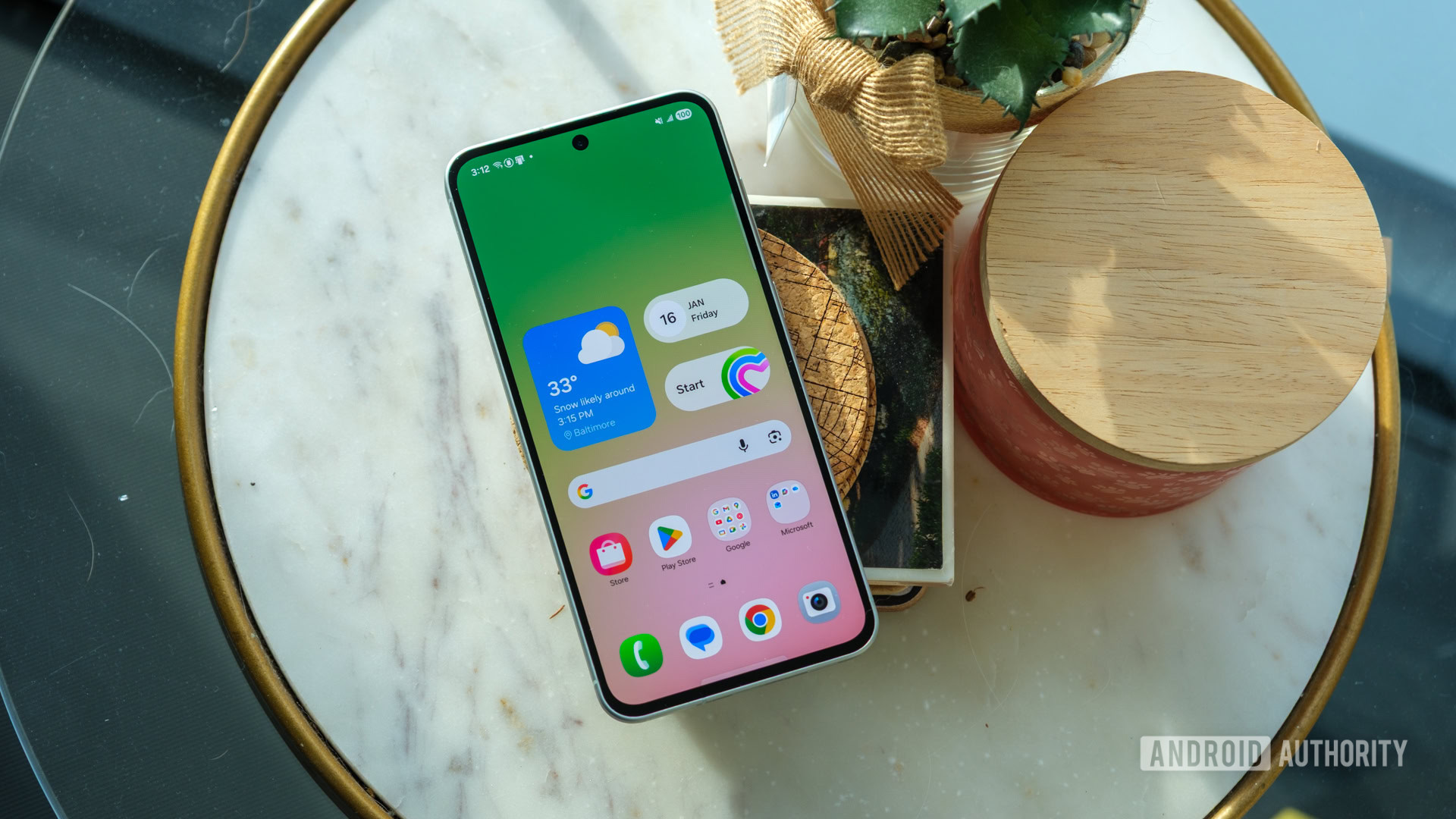
$500 Samsung Galaxy A56 5G does a lot of things well, mostly in terms of design and battery, but its performance is merely fine, and the lack of wireless charging feels like an oversight. It’s a serviceable enough phone, but put against other Galaxy devices, it’s hard to see why you’d pick the middle, and things get even more competitive when you look at the competition from other brands.
It’s been a few years since Samsung has offered its top-level Galaxy A device officially in the US — since 2023, in fact. Back then, its Galaxy A54 5G challenged Google’s Pixel 7a as its closest rival, combining a triple-camera system and a robust 5,000mAh battery to win users away from the simplicity of Pixel UI and the reliability of Google’s image processing. By all accounts, it was a good $500 phone, offering more than enough bang for your buck.
Then, it disappeared. Well, Samsung decided not to offer the Galaxy A55 5G in the States, anyway, making its sub-flagship Fan Edition the go-to option instead. And over the course of that break, the affordable Android market has changed entirely. Rivals like OnePlus and Motorola have stepped up their game, and Google’s Pixel A series is better than ever.
So, now that Samsung wants to reclaim its mid-range market share, it has a much steeper hill to climb — one that I’m not entirely sure the Galaxy A56 5G can make it to the top of. Here’s why I think Samsung might have missed its window.
A hint of Galaxy designs to come?
Ryan Haines / Android Authority
As someone who’s spent time with just about every Galaxy A launch over the last few years, I’ve had quite a lot of fun with them. Do they often earn headlines? No, almost never, but I’ve noticed that they’re frequently used as testing grounds for Samsung to work out its design kinks. Usually, what it does to its Galaxy A launches, it will also do to the flagship Galaxy S series — even if it takes a year or two.
To see what I mean, look no further than the Galaxy A14 5G. That phone, which is now almost three years old, was the first to abandon its camera bump in favor of three corner-mounted rings, beating the Galaxy S24 series to market by just a few months. Interestingly, it also helped speed up Samsung’s pivot from slightly rounded frames to sharp, angular ones, because not every design change is a good one, I guess.
But what does any of this have to do with the Galaxy A56 5G? Well, just like its Galaxy A26 and A36 siblings, it looks like Samsung’s top Galaxy A device represents the start of something new — or, maybe old. Yes, after a few years of equating mid-range to minimalist, Samsung has finally brought back a camera bump. All three of the Galaxy A56’s rear sensors (which I’ll talk about in a bit) sit on one pill-shaped bump in the top left corner of the phone, and I couldn’t be happier.
Seriously, I’m actually excited about something this simple. I never thought I would be, especially when mid-range options from Motorola, OnePlus, and more make big camera bumps look commonplace, but this feels like something that Samsung so badly needed. It takes the Galaxy A56 5G from looking like a generic phone that Apple would use in its iPhone vs Android comparisons to, well, something just a little bit more exciting than that.
It’s a good thing I’m excited about the camera bump, too, because the rest of the Galaxy A56 5G sticks to Samsung’s generic script. There’s a slight bump on the right for the power button and volume rocker, but the rest of the frame is smooth and sharp, just like Galaxy A devices of the last few years. It’s comfortable enough to hold, sure, but maybe not the most exciting to look at.
I’m holding out hope that Samsung phones look more like this going forward.
Otherwise, I have to give Samsung some credit for its Galaxy A56 5G color choices. The usual suspects, Awesome Graphite and Awesome Lightgray, aren’t much to look at, but Awesome Pink and Awesome Olive are much nicer — if a little Elphaba and Glinda coded. I’d barely call the Awesome Olive a shade of olive at all, though; it’s much paler and almost gray in most lighting conditions.
Less fun, however, is the glossy finish that Samsung chose for its rear panel of Gorilla Glass Victus Plus. It catches the light nicely, but picks up fingerprints with the best of them — so much so that I can’t always clean the phone by simply putting it in and out of my pocket.
Anyway, let’s move on to the piece of Samsung’s design that you’ll actually look at: the 6.7-inch Super AMOLED panel. At this point, it’s a foregone conclusion that cheap Samsung phones will have great displays, and the Galaxy A56 5G is no exception. Its panel is bright and sharp, almost perfectly matching its predecessor. I turned to it in my time of great need — watching the group stage draw for this year’s World Cup — and had no complaints about the display itself.

Ryan Haines / Android Authority
The Galaxy A56 5G was also a generally solid companion as I worked my way around Sacramento ahead of running the California International Marathon. I had no problems trusting it for navigation through the downtown area and around the Sacramento State campus, relying on Samsung’s large battery and sharp display to keep me generally on the right track, despite my occasional side quests.
The phone also had the honor of serving alongside the TCL NXTPAPER 60 Ultra as my at-home entertainment over the Christmas holidays. This largely meant bingeing the entire final season of Stranger Things because I’m locked out of my parents’ Netflix whenever I’m not under their roof, as well as streaming an audiobook in half-hour chunks whenever I needed some quiet while visiting relatives.
And, of course, its IP67 rating was more than good enough to handle the cold, foggy mist of Northern California, even though the weather made me want to hide away in my Airbnb rather than adventure out. Should the Galaxy A56 5G take a tumble (it hasn’t yet), I expect the Gorilla Glass Victus Plus and aluminum frame to come out without a scratch.
Fine performance is, well, not quite enough

Ryan Haines / Android Authority
While the Galaxy A56 5G’s exterior certainly feels like a preview of flagship phones to come (I hope), its internals aren’t so rosy. I mean, the in-house Exynos 1580 is fine, and it’s an expected upgrade over the Galaxy A55’s Exynos 1480, but it doesn’t have the supporting cast to set the world on fire. Its 6GB of base RAM and 128GB of storage are about what you’d expect for the money, which no longer feels like enough to be noteworthy in the $500 Android market.
And yes, I know the idea that “good enough” isn’t good enough can be a tricky one to wrap your head around, but that’s a testament to just how good the mid-range Android market is right now. When you stack an Exynos chip up against the likes of the Pixel 9a’s Tensor G4 and the OnePlus 13R’s Snapdragon 8 Gen 3, it needs to bring a little spice. It needs to at least match its competitors in terms of RAM and storage, but instead comes up 2GB short of the Pixel and 6GB short of the OnePlus 13R — quite the gap.
Of course, there’s always a chance the gap exists only on paper, which is why we run our standard set of benchmarks on every device we review, from $200 to $2,000. So, I did just that, testing the Galaxy A56 5G’s CPU and GPU against some of the best cheap Android phones.
At first, I thought the Galaxy A56 5G was shaping up just as I feared it would, coming up short of everything except for its low-powered predecessor in both the single-core and multi-core sections of the Geekbench 6 test. And no, it’s not great that the mid-ranger can’t muster a spot on the podium, but the CPU-centric Geekbench test is the least comprehensive of our bunch.
Had the Galaxy A56 faltered again in the more intense PCMark Work test, which pushes the CPU through a few more tasks, I would have taken more of an issue. Instead, the Exynos 1580 chipset kicks into gear, topping the Snapdragon 8 Gen 3 in the OnePlus 13R and the Tensor G4 in Google’s mid-range Pixel 9a. It’s a better indicator of how the phone should handle a mixed workload, though it’s still only part of the battle.

Ryan Haines / Android Authority
When we flip over to the GPU side of our gauntlet, the Galaxy A56 5G falls back down to its place at the bottom of the pile. Yes, it still beats the previous Galaxy A55 5G across all 20 runs of the test, but that’s about it. The mid-ranger still starts (and finishes) below its rivals from Google and OnePlus, making it an option for light gaming at best. To Samsung’s credit, the Galaxy A56 boasts some of the best stability of the phones tested, barely tailing off despite 20 minutes of testing. However, this raises the question: would you rather burn twice as bright or twice as long?
I’ve also noticed one or two stumbles where I didn’t expect them, lending to my worries about sustained performance. I booted up Pokémon TCG Pocket once again over the holidays, purely because I needed a way to waste time, and found that the Galaxy A56 could merely stumble through my power needs. Then again, it’s been a while since I’ve played, so I did start with a pretty hefty update.
I’d trade some of the Galaxy A56 5G’s battery life for a bit more power, no question.
Anyway, I think my answer on power usage is somewhere in between — I’d happily burn a little brighter even if I couldn’t run for as long. Unfortunately, I found myself thinking that quite a lot during my time with the Galaxy A56. It’s a fine phone, and it cruises through the basics just as easily as you’d expect, but it doesn’t feel as polished as Google’s Pixel 9a, and the fall-off from the Galaxy S25 FE’s Exynos 2400 chipset is noticeable.
In fact, I’d much rather spend the money to put either of those phones in my pocket, preferring their power, AI features, and longevity over the course of their seven years of updates, which makes the extra cost of Samsung’s sub-flagship hardly noticeable. If you really can’t work the additional $150 or so for the Galaxy S25 FE into your budget, though, the Galaxy A56 is good in a pinch.

Ryan Haines / Android Authority
It’s a more than decent battery performer, too, which has helped to ease some of my stress. I didn’t have the highest of hopes for Samsung’s combination of yet another 5,000mAh battery with its Exynos 1580 chipset, yet the Galaxy A56 came through. It lasted longer in our controlled testing than Google’s Pixel 9a — a phone that the company boasted had its best battery on a Pixel. Samsung edged the mid-ranger in almost every leg, and when it fell behind, the margins were pretty tight.
Likewise, I found myself able to push through at least a day and a half between charges, which was especially helpful in California. Between the long days of adventuring and the jet lag, I fell asleep more than once before I was ready to. That meant forgetting to charge my Galaxy A56 and starting the next day with a partially charged cell. Conveniently, though, the Galaxy A56 now supports the same 45W wired charging as Samsung’s top-tier Galaxy flagships.

Ryan Haines / Android Authority
Interestingly, though, that 45W support doesn’t actually translate to charging as fast as the Galaxy S25 Ultra. Instead, the Galaxy A56 5G turns in a performance that lasts about 75 minutes from empty to full, which is an improvement nevertheless. It’s almost perfectly centered between the Moto G Stylus (2025) and the Pixel 9a, which makes sense, as the former supports 68W charging while the latter is capped at 23W.
Samsung is also hoping you’ll be happy with its wired charging upgrade, as there’s, well, no wireless charging to tap into. Both of its rivals above offer wireless speeds, but Samsung would rather take that odd step backwards. Anyway, you’ll need a capable 45W charger if you want to spend as little time tethered to power as possible, so you might want to check out a few of our favorite chargers.
Classic Samsung cameras, for better and worse

Ryan Haines / Android Authority
I’m happy to carry on with the idea that the Galaxy A56 is probably a preview of flagship designs to come, but one area where that’s almost certainly not the case — at least not really — is with its cameras. Although we may see the raised pill shape over the next few generations (it’s already on the Galaxy Z Fold 7), we almost certainly won’t see the same trio of sensors. That’s for the best.
See, Samsung’s budget-minded sensors are usually the one dead giveaway that you’re exploring a less expensive smartphone. Yes, the 50MP primary camera is the same as you’ll find on the flagship Galaxy S25 — both are 1/1.56-inch sensors with 1.0µ pixels and apertures of ƒ/1.8 — but that’s where the similarities end. Instead of keeping the same ultrawide sensor, the Galaxy A56 switches to a smaller one while expanding its field of view by a few more degrees.
And then, there’s the third camera… the dedicated macro sensor. I know there usually has to be some sort of sacrifice to set a $500 phone apart from its superiors, but I don’t know of anyone who wants to pay for fixed macro focus at this price point. Both the Galaxy S25 and the Fan Edition mid-ranger spring for telephoto sensors, and even Google makes it easy by sticking to two sensors but packing one with macro focus.
So, as you could probably imagine, I’ve mostly treated this like a two-camera smartphone, and here’s what I’ve captured:
For several years, the standard Samsung camera experience went something like this: open the camera app, snap a photo, and look at how saturated the reds and greens are. Now, there’s only a little of that. Yes, the red Christmas ornaments to the right are pretty punchy, but I wouldn’t say the bricks to the left or the yield sign on the far side are quite the same.
In fact, the photo of the yield sign was taken on the morning after Christmas, yet it seems like it might have been captured at dusk. It’s not nearly as bright as the overcast sky would have suggested, as the lighting conditions were probably closer to those of the glass bottle mosaic. I’ll give Samsung’s portrait detection some credit, though, as it worked well on both human and decorative subjects.
Giving the primary sensor some more interesting subjects yields some more interesting results. I absolutely love the colors captured in the sunset, both in the sky itself and in the reflection on the building on the far right. I appreciate that Samsung didn’t sacrifice the harbor’s texture, either, as it could have easily come out looking like glass. I’m not quite as sold on the strange lighting in the sky on the right side, though, which makes the clouds look far too bright for what they were in late December.
Although I bashed the ultrawide sensor for being small, I have to give it a tiny bit of love for holding onto details all the way up the brick building in the center. No, you can’t quite read the far end of what’s painted on the building, but it’s more due to the angle than to the detail of the sensor. The detail under the schoolhouse roof on the left is good, too, though it could easily have been lost to shadow.
And then, there’s the macro sensor. Man, it’s just not good. It may be 5MP compared to the common (and cheaper) 2MP, but the reds and greens are both punched to the moon, and there’s a blue cast to the background in both images. Mix in the fact that you need to hold your subject so incredibly still to avoid motion blur, and I’m not sure what the intended use is for such a sensor. Again, it’s a hardware choice that could have been a software feature.
Since we’re already in the weeds of the Galaxy A56’s limitations, let’s keep rolling with the fact that it doesn’t zoom very well. The lack of a telephoto sensor means it tops out at 10x digital zoom, and the details are already struggling. Both the 1x and 2x samples are good enough, mainly because the latter still uses an optical crop. I don’t mind the 4x sample too much, either — it’s a little bit oversharpened, but not painfully so.
At 10x zoom, however, I already start to feel like Samsung’s processing is doing too much work, especially if you look for details in the pole on the right edge of the photo. It just doesn’t look quite as natural as it probably should.
As for the selfie camera, it’s fine. Not great, but fine. It’s a 12MP sensor that matches its more premium siblings on paper, and I’m glad to see it pick out the texture of my blue shirt, but everything looks a little flat if you ask me. There’s not much shadow or variation in my face in portrait mode, and it seems like the area under my hat is artificially brightened. Maybe it would have been different on a sunny day, but I can’t say I’m impressed with cloudy, even skies.
If you want a closer look at any of the samples above, you can check them out (and a few more) at this Google Drive link.
Also, before I move on, I should mention that the Galaxy A56 5G supports 4K video at 30 frames per second from both the front and rear cameras, as well as 1080p recording at 60 frames per second. That’s not great for a $500 phone, especially when the Pixel 9a does 4K at 60fps and 1080p at up to 240fps. So, again, I think Samsung would much prefer you spend a bit more on your next phone instead of buying this one.
The Galaxy A56 is a decent phone stuck in no-man’s land

Ryan Haines / Android Authority
In fact, that’s exactly what I’m going to tell you to do: buy something else. It’s not that the Galaxy A56 5G is a bad phone — it’s a perfectly fine one. It’s well-built, has a big battery, and will get plenty of software updates before it meets its end. However, it seems like every time Samsung had a chance to give the Galaxy A56 5G a leg up, it chose to lean on the budget-friendly end of the spectrum rather than look to match its rivals.
Yes, there are three cameras, but only two of them are decent. Yes, the phone supports 45W wired charging, but it throttles kind of quickly and has no wireless backup. Yes, it also got a chipset upgrade over its predecessor, but that takes a slow processor and only makes it slightly better. Right now, $500 phones are trying to see how close they can get to being flagships, but the Galaxy A56 seems scared to step on the Galaxy S25 FE’s toes.
Samsung wants back into a crowded market, but it doesn’t want to work for it.
Unfortunately, therein lies the problem. Because Samsung wants to position its Galaxy A56 just $150 below its Galaxy S25 FE ($534.99 at Samsung), the two phones need to be similar, yet one has to be noticeably better. Then, the Galaxy A56 has to stand out as significantly more worthwhile than the cheaper Galaxy A26 and Galaxy A36 5G. Once it’s done that, only then can it think about taking on some of the best reasonably priced Android phones on the market.
That means it has to stand out in Samsung’s lineup before it can take on the Pixel 9a ($499 at Amazon) with its clean software, powerful cameras, and no-nonsense design. Personally, I’d pick the Pixel as I don’t think it misses out on a single camera feature while adding a few more tailored Gemini experiences — even if there’s no Pixel Screenshots. I’d lean on Google’s regular Pixel Drops, too, as they’ll add more to the overall experience than Samsung’s reliance on software patches.
If you can still find the OnePlus 13R ($549.99 at Amazon), that’s a better phone, too. It’s built more like a flagship of yesteryear, using a Snapdragon 8 Gen 3 chipset, a massive battery, and SuperVOOC wired charging to keep pace with newer phones. No, you won’t get as many software updates out of OnePlus, but I think the 50MP telephoto camera is worth the trade for added camera flexibility. And yes, we do mean the OnePlus 13R, not the disappointing OnePlus 15R — the latter has priced itself out of competition.
You could also check out the iPhone 16e ($599 at Amazon), but I’m not sure you should buy it. In true iPhone SE fashion, it offers a little less for a little more, mostly because you’re getting long-term iOS support out of the deal. Its single camera is fine, but doesn’t support portrait mode for pets or objects, and its notched design is more modern than most cheap iPhones, but not the same as the newer Dynamic Island. Besides, you can just buy last year’s iPhone 16 for almost the same price.
So, if you come out of this thinking that you need the Galaxy A56 5G in your pocket, I have to question you. I don’t think it stands out enough in Samsung’s own lineup, let alone against the best from everyone else.

MSRP: $499.99
The Galaxy A56 5G gives you a lot of hardware for under $500, including a 5,000mAh battery, 45W charging, and a durable Gorilla Glass Victus Plus build.
Positives
- Interesting (for Samsung) design
- Solid update support
- Good main camera
- Fast wired charging
- Reliable battery life
Cons
- Mediocre chipset
- Lame macro camera
- No wireless charging
- Slippery finish
- You can get better phones for $500
Thank you for being part of our community. Read our Comment Policy before posting.