

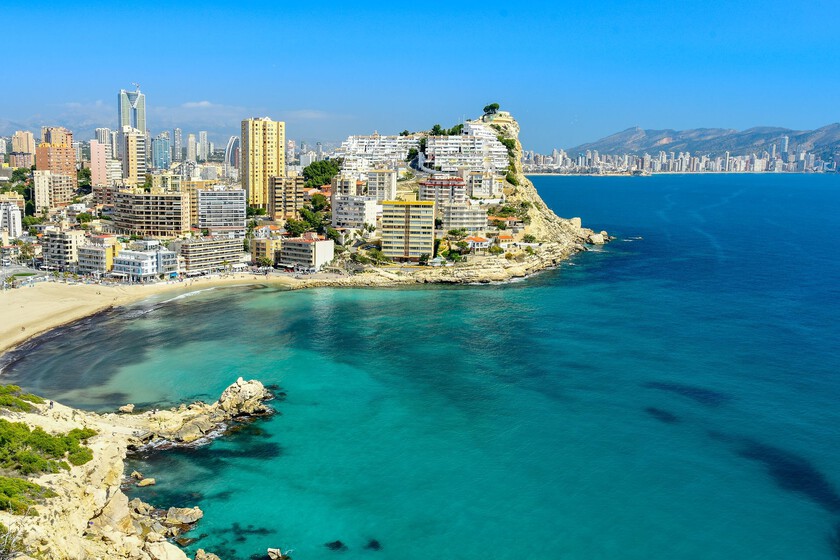
The waters of the Mediterranean have been undergoing drastic changes in temperature in recent years and the coast of Alicante has become “ground zero” for this phenomenon. Here a recent report indicates that the sea temperature on the coast of Benidorm has experienced a rise of 3 °C in the last five years, and although it may end up being scary, it has an explanation.
The temperature difference. The thermal jump detected in Benidorm is real and, if we look at the records of the Valencian coast, at the beginning of July 2024 the sea surface temperature was around 24 °C. But now in July 2026, the thermometers read between 26 and 28 °C. That is, an anomaly of up to 4 degrees in just a couple of years in specific areas.
However, in climatology a background trend is not the same as an extreme event, and we are clear that the rise of 3 °C in five years reflects a marine heat wave, an extreme peak of the situation.
As expected. Looking at the full movie, data from the Copernicus Marine Service confirms that the long-term warming rate of the Mediterranean is 0.4°C per decade. This means that the “base” temperature should have risen by about 0.12 °C in the last five years, and not 3 °C, so what is happening off the coast of Benidorm is a radical anomalous event fueled by the lack of winds, the anticyclone and high sunshine.
We continue to increase. The fact that it is a peak that can end up being recovered and not the base trend does not mean that we should breathe easy, since marine heat waves are like fever: a symptom that the patient is going through a difficult time, and the Mediterranean is the reality that is not going through its best moment.
The data SOCIB in their 2025 report pointed out that the year was the second warmest year since 1982, with an average sea surface temperature of 21.1 ºC, only surpassed by 2024. But the most revealing data comes from the CLIVAR-Spain program of the AEMET and the IEO-CSIC when they point out that The waters surrounding Spain are warming at a rate between 60% and 200% faster than the global average. The Mediterranean bears the brunt, warming up to three times faster than the average world ocean.

The transition. This summer of 2026 is being especially tough, since at the end of June, the AEMET recorded that the Mediterranean reached 26.63 °C on average, being 2.6 °C above normal. And if we go outside the average, in the western basin, the Copernicus satellites have managed to capture astonishing peaks of up to +8 °C above the historical averages (1991-2020) in very localized areas.
The importance for Benidorm. A sea at 28°C alters ecosystems, endangers Posidonia meadows, attracts invasive species and, from a meteorological point of view, acts like a can of gasoline. Such a hot sea does not cool the night atmosphere on the coast, aggravating the torrid nights, and accumulates an immense amount of energy that, when colliding with the first gusts of cold air in September, can trigger more violent damage and torrential rains.
Images | Emilio Sanchez Hernandez
In | Sea temperature continues to rise and experts are clear: “It is partly favored by the start of a new El Niño phenomenon”


