I didn’t notice it at first.
It wasn’t a demo video or a flashy product launch. It was a normal support call. I asked a question, paused instinctively — and the answer came back so fast that I actually stopped mid-breath.
No lag. No dead air. No “one moment while I check that for you.”
Just… response.
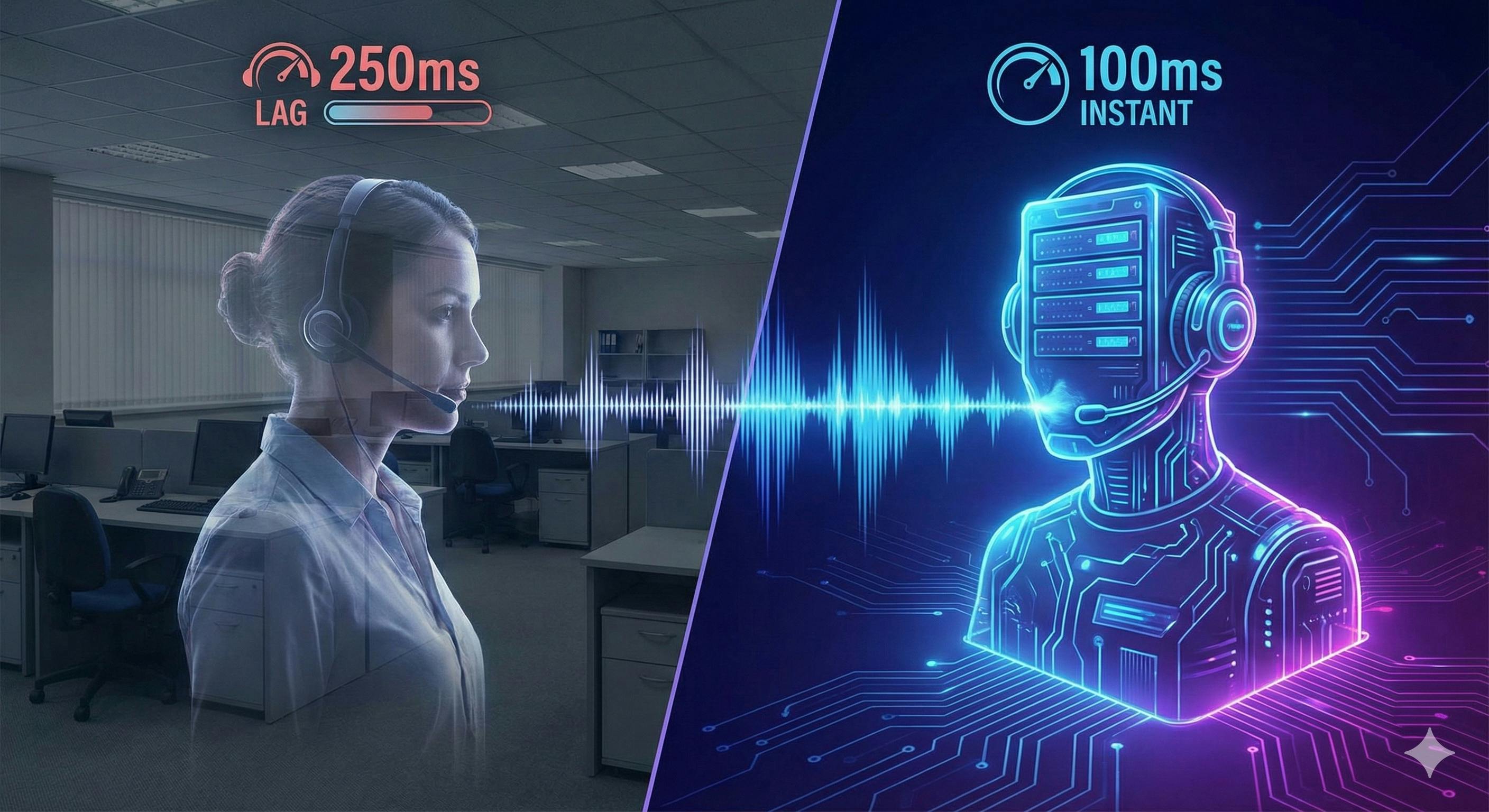
For years, that tiny pause was the tell. Even when voice bots sounded good, the delay gave them away. Your brain knew something artificial was happening. You relaxed differently. You spoke differently. You waited.
That pause is gone now. And once you notice it, it’s hard to ignore what it means.
We Used to Rely on Lag (Without Realizing It)
Think about the last decade of automated customer service. The voices improved. The scripts improved. The accents improved.
But the silence stayed.
You’d ask something, then sit in that empty space while “the system” thought. That gap wasn’t just technical — it was psychological. It was how we subconsciously classified the interaction as safe, mechanical, limited.
I’m not sure we appreciated how important that delay was until it disappeared.
Now responses are coming back in roughly 100 milliseconds. That’s faster than most people can consciously react to a stimulus. It feels less like waiting for an answer and more like being in a conversation where the other party is already halfway into their reply.
It doesn’t feel like talking to software anymore. It feels like interruption.
The Unsettling Part Isn’t Intelligence — It’s Timing
What surprised me wasn’t that the answers were correct. Accuracy has been improving steadily for years.
What surprised me was the messiness.
There was a tiny inhale before a longer response. A half-pause where I expected one. Once, when I cut the agent off mid-sentence, it stopped immediately — not awkwardly, not late. Instantly.
None of this was necessary to solve my problem. It was necessary to feel human.
Earlier systems aimed for perfection: no filler words, no hesitation, no overlap. Ironically, that’s exactly what made them feel fake. Humans are noisy. We breathe. We mistime things. We react before we fully think.
These newer systems don’t just tolerate that noise — they reproduce it.
At some point during the call, I caught myself adjusting my tone, the same way I do when I don’t want to sound rude to a person. That was the moment that stuck with me.
The Economics Are Brutal, Even If You Ignore the Hype
I’m wary of dramatic “jobs are over” claims. They usually age badly.
But the numbers here are hard to look away from.
A typical Tier-1 human support agent costs, very roughly, anywhere from $15 to $25 an hour in the US. Offshore teams bring that down, but not without layers of management, training, turnover, and quality control.
Voice agents running on modern stacks cost cents per minute. Not someday. Now.
Even if you assume they only handle 70–80% of calls well — not perfectly, just well enough — the math starts to feel uncomfortable. Not ethically uncomfortable. Financially inevitable.
This isn’t about replacing your best people. It’s about making the average case too cheap to justify human labor.
“Chatbot” Is the Wrong Word Now
I still hear people call these systems chatbots, and it doesn’t quite fit anymore.
Chatbots talk. These systems do things.
They’re connected directly to internal tools. They don’t hand off requests — they execute them. Refunds, changes, upgrades, cancellations. No escalation. No supervisor. Just action.
That shift matters more than the voice itself.
Once an agent can listen, decide, and act inside your systems, the boundary between “support” and “operations” starts to blur. At that point, the human isn’t managing the workflow — they’re supervising an exception.
And exceptions don’t scale the way routine work does.
I Don’t Think Humans Disappear — But I Do Think They Become Optional
This is the part I’m least certain about, and probably the part people will argue with most.
I don’t think human interaction vanishes. I think it gets reclassified.
The default experience becomes automated, fast, polite, and emotionally flat in a very convincing way. If you want a real person — someone slower, more fallible, maybe more empathetic — that becomes a premium path.
Not because humans are better at everything, but because they’re expensive.
We already accept this logic in other places. Faster shipping costs more. Personal advisors cost more. Handcrafted things cost more.
Why wouldn’t conversation follow the same pattern?
What Makes This Feel Different From Past Waves
I’ve heard “this changes everything” enough times to be skeptical by default.
But this time, the change isn’t raw intelligence or even cost. It’s interaction fidelity. The removal of silence collapses the mental distance we used to rely on.
Once that distance is gone, we stop negotiating with machines as machines. We negotiate with them as counterparts.
And when that happens at scale, entire categories of work quietly stop making sense.
I Don’t Have a Clean Ending for This
I wish I could wrap this up with a clear takeaway or a call to action. I don’t have one.
What I do have is a lingering discomfort that feels different from past tech shifts. Not panic — just the sense that a line was crossed without much announcement.
The silence used to protect us. n It told us where the machine ended and we began.
That silence is gone now. And I’m not sure we’ve decided what replaces it.