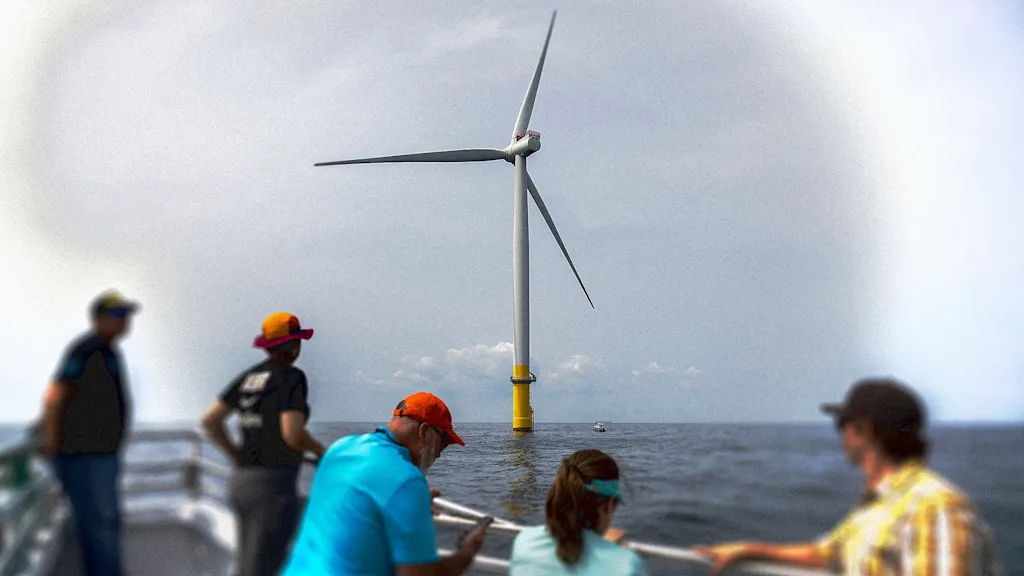
When the Department of the Interior announced on Monday that it was suspending the leases of five offshore wind farms that are currently under construction, it blamed national security concerns. Military experts say that’s an excuse.
“I think it is all made up,” says Dave Belote, a retired Air Force colonel who previously led the Department of Defense’s energy siting clearinghouse at the Pentagon and who currently consults with onshore wind companies about military issues. “I’ve got 15 years of experience that I will stack against the Secretary of Interior to say that is all made up to please a president that just irrationally hates ‘windmills.’”
Each of the five projects—two off the coast of New York, and others in Massachusetts, Virginia, and Rhode Island—went through a yearslong vetting process that closely involved the Department of Defense, now renamed the Department of War. ,Aafter the administration threatened some of the wind farms earlier in the year, New York Governor Kathy Hochul reportedly negotiated with the Trump administration and even agreed to approve a natural gas pipeline in exchange for saving one of the wind farms—but those efforts may now have been in vain.)
Any potential military issues were already fully considered, says Belote. When it announced the new cancellations, the Department of Interior cited radar issues. But that’s already well known—and the Department of Defense has known how to deal with it for more than a decade. Spinning wind turbines do interfere with radar, but wind project developers currently pay for a software patch that edits that interference out of NORAD’s radar scope. With a bigger investment, the radar itself could be upgraded to eliminate the issue without relying on the patch.
The military needs to know how to deal with wind turbines regardless of whether they’re in US waters. China, for example, has 129 offshore wind farms. “They are concentrated along the shorelines in the most militarily significant areas around Shanghai and around Taiwan Strait,” says Belote. “If any American is launching from a carrier or Guam or Japan or Korea and pointed west at the Chinese shoreline, that man or woman in the fighter cockpit or bomber cockpit is going to have to deal with a whole bunch of spinning wind turbines on their radar scopes or head of displays. So the whole idea that we can neither train nor detect threats in the presence of small numbers of offshore wind turbines is ludicrous.”
The administration has also cited unspecified “classified” issues, but Belote says—as someone who has considered all possible issues that could theoretically occur—that those issues don’t exist. “There’s no there,” he says. (The Department of Defense said it could not immediately respond to Fast Company‘s request for a comment on the issue.)
On the East Coast, Belote argues that the military could even make use of the infrastructure on offshore wind turbines because they already have power, fiber optics, and security that could improve communications in military exercises.