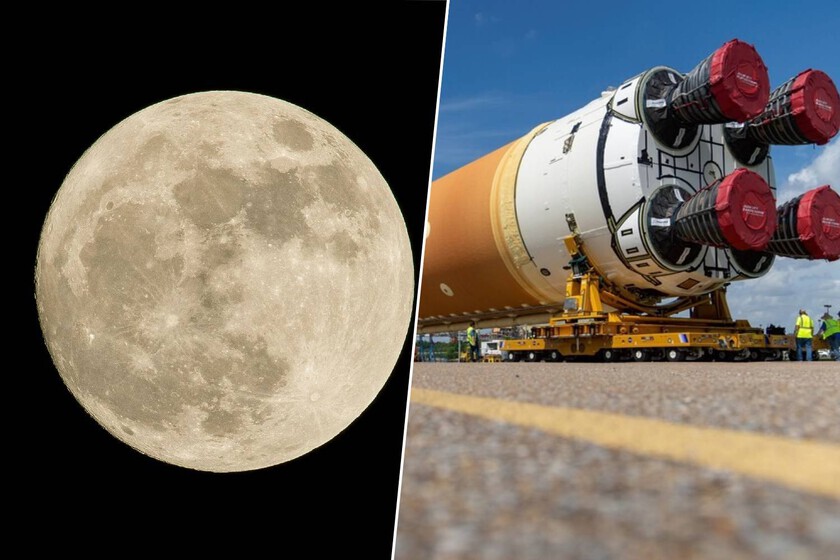
There is already an official date. After years of delays and speculation, NASA has confirmed what had been rumored in the halls of Washington: Artemis 2 has the green light for launch on February 6, 2026. And what is its destination? Neither more nor less than the Moon itself.
Tuning. With this announcement, NASA is already preparing to transfer the gigantic SLS (Space Launch System) rocket to platform 39B this January 17, starting the final countdown for humans to orbit the Moon again. Something that has not happened since 1972 with Apollo 17.
However, this is not a celebration without controversy. The mission, which will take astronauts Reid Wiseman, Victor Glover, Christina Koch and Jeremy Hansen on a 10-day trip around our satellite, has been brought forward under strong political pressure. And it does so with a worrying technical asterisk: the behavior of the Orion ship’s heat shield.
A battle of pressures. On the one hand, Donald Trump has historically shown his impatience with the deadlines that NASA was giving to be able to orbit the Moon. All of this with an eye on China, which threatened to be the ‘first’ and overtake the United States in this matter.
What has been the solution? Put Jared Isaacman as NASA administrator, a billionaire, pilot and private astronaut (known for his missions on Polaris Dawn and his ties to SpaceX) to prioritize speed and calculated risk-taking over the complete risk aversion that the “old NASA” had.
Because. February 6, 2026 has been set as set in stone for several strategic reasons that outweigh engineering doubts about the heat shield. The first of them is the race against China, since the Asian country has a very advanced lunar program and aims to put taikonauts on the Moon before 2030. If Artemis 2 was delayed to redesign the heat shield (which would have taken years), Artemis 3 would have gone until 2028-2029 or more, leaving the door open for China to arrive earlier or very close.
But they do not stop here, since for this administration the Moon is a springboard to reach Mars, this mission being a simple way to validate the systems they are using. That is why every delay on the Moon is a delay for the mission to Mars, which promises to be the historical legacy they seek.
The Avcoat dilemma. The main point of friction between engineers and the agency’s new management lies at the bottom of the Orion capsule. During the unmanned Artemis 1 mission in 2022, the heat shield (made from an ablative material called Avcoat) behaved unexpectedly. And instead of being consumed uniformly, it broke off in pieces, creating craters and cracks due to the gases trapped in the material during re-entry into the atmosphere.
The engineering logic faced with this problem would be to make a new design or change the material. But since it is something that would delay everything, NASA has opted for a change in angle during reentry to minimize thermal stress in the most affected areas to maintain the same shield.
The doubts. NASA assures that the risk is “acceptable”, but this decision has raised blisters in the aerospace security community. Added to this is that the life support system (ECLSS), provided in part by ESA, has never been fully tested in flight with humans, adding an extra layer of uncertainty to the mission.
Charles Camarda, veteran astronaut of the STS-114 mission, the return flight after the Columbia disaster, has been blunt in this regard. In statements, Camarda has compared the current situation to the “dysfunctional culture” that led to the Challenger and Columbia tragedies. But for the NASA administrator, Artemis 2 is a non-negotiable step to ensure American leadership and the future cislunar economy.
Operating tension. As if the pressure on Artemis were not enough, NASA also faces a parallel crisis in low orbit. The agency and SpaceX have scheduled January 14 undocking of the Crew-11 mission from the International Space Station (ISS) due to an urgent medical evacuation.
This is an unprecedented event in the history of the ISS: lowering an astronaut for an unspecified medical problem (although he has been confirmed to be stable). Although Isaacman has assured that this operational incident will not affect the Artemis 2 schedule, it adds considerable stress to the mission control teams in Houston, which must now manage a crisis in real time while preparing for the most important launch of the decade.

What can we expect? At the moment, the dates we know are January 17, where the SLS rolls towards its platform, and February 6, when the window for its launch will open. In total, a 10-day flight mission is expected, with a lunar flyby and high-speed return. Specifically, 40,000 km/h.
NASA has much more at stake than a mission in February. The validation of its security model is at stake in the new space era, where geopolitical competition and commercial rush collide head-on with the immutable laws of physics and thermodynamics.
Images | Pedro Lastra NASA
In WorldOfSoftware | We have been deceived by the distances of the Solar System: the closest neighbor to Neptune is Mercury