Modern archeology has just thrown us one of those pieces of the puzzle that forces us to rewrite, in part, what we knew about different ancient cultures of northern Mesoamerica. Something obligatory, since a team from the National Institute of Anthropology and History has identified in Tamaulipas a find as unusual as it is fascinating: a skull with an intentional deformation in the shape of a “cube.”
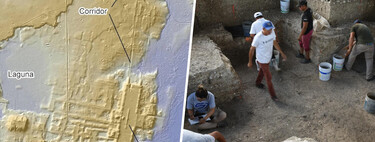
“Parallelepiped” deformation. The discovery took place in the archaeological zone of Balcón de Montezuma, in the Sierra Madre Oriental. As detailed in the official INAH bulletin, the remains belong to an adult man over forty years old who lived during the Classic period between 400 and 900 AD.
Although the most surprising thing may seem given the curious deformation of the skull, for anthropologists the real news was in a modification of the “erect tabular” type in its “parallelepiped” variant.
How did it come to this? To have a skull with this peculiar shape, it is suggested that the ancient settlers of that area had to use wooden compression devices such as splints. These would be applied to the back of the head (the occipital bone) and the forehead to restrict the natural growth of bones from childhood. Because it is precisely when they are malleable to adjust them to what you were looking for.
Who was it? This is where hypotheses begin to emerge. Anthropologists point out that this type of deformation is more typical of the Mesoamerican southeast. But these bones have been found in the northern area. So the question was clear: Was this man a foreigner who came to the north?
The answer, thanks to strontium isotope analysis, is a resounding no. The conclusion that has been reached is that the bones belonged to a local man who was born and raised in the Sierra Madre Occidental area. And this is something that changes the narrative completely: we are not facing a migrant, but rather evidence of cultural adoption.
Because. The fact that a local inhabitant decided (or his parents decided for him when they were very young) that the skull had to be modified with a technique that involved two splints makes sense. The hypotheses initially point to belonging to a local elite, and this modification could be a distinctive sign to indicate that they were in a higher stratum than the rest of the inhabitants.
But it is also something that can suggest a cultural connection, since there was a great flow of ideas and aesthetic fashions that was much more fluid than previously thought between different cities in the area. That is why it may be that having a skull like this was an indication of beauty or it was simply ‘viral’ at that time.
Its importance. Until now, archeology had recorded cranial deformations in the area, but they were generally more inclined backwards. The appearance of this more elongated upward shape is something that had not been recorded before in this area.
This is something that a priori will help discard the old idea that the northern areas were culturally isolated. On the contrary, this “cubic skull” is physical proof that the northern border of Mesoamerica was fully integrated into the ritual and aesthetic dynamics of the rest of the subcontinent.
Images | Chelms Varthoumlien
In WorldOfSoftware | If Spain believes it has a problem with droughts, it is because it does not know what led the Mayans to collapse: 150 extreme years