By using this site, you agree to the Privacy Policy and Terms of Use.
Accept
World of SoftwareWorld of SoftwareWorld of Software
  • News
  • Software
  • Mobile
  • Computing
  • Gaming
  • Videos
  • More
    • Gadget
    • Web Stories
    • Trending
    • Press Release
Search
  • Privacy
  • Terms
  • Advertise
  • Contact
Copyright © All Rights Reserved. World of Software.
Reading: Tracking and Controlling Data Flows at Scale in GenAI: Meta’s Privacy-Aware Infrastructure
Share
Sign In
Notification Show More
Font ResizerAa
World of SoftwareWorld of Software
Font ResizerAa
  • Software
  • Mobile
  • Computing
  • Gadget
  • Gaming
  • Videos
Search
  • News
  • Software
  • Mobile
  • Computing
  • Gaming
  • Videos
  • More
    • Gadget
    • Web Stories
    • Trending
    • Press Release
Have an existing account? Sign In
Follow US
  • Privacy
  • Terms
  • Advertise
  • Contact
Copyright © All Rights Reserved. World of Software.
World of Software > News > Tracking and Controlling Data Flows at Scale in GenAI: Meta’s Privacy-Aware Infrastructure
News

Tracking and Controlling Data Flows at Scale in GenAI: Meta’s Privacy-Aware Infrastructure

News Room
Last updated: 2026/01/20 at 1:06 PM
News Room Published 20 January 2026
Share
Tracking and Controlling Data Flows at Scale in GenAI: Meta’s Privacy-Aware Infrastructure
SHARE

Meta has published new details on how it is scaling its privacy infrastructure, outlining architectural changes designed to support generative AI product development while managing increasingly complex data flows and enforcing privacy compliance across its systems.

Meta engineers emphasized that generative AI workloads introduce new challenges for privacy enforcement, including increased data volumes, new data modalities, and faster iteration cycles. They explained that traditional review and approval processes were not designed to operate at this scale or pace, particularly in environments where data moves across thousands of interconnected services and pipelines.

To address these constraints, Privacy-Aware Infrastructure (PAI) was expanded to include a set of shared services and libraries that embed privacy controls directly into data storage, processing, and generative AI inference workflows. Engineers explained that this expansion provides a common foundation for enforcing privacy policies across heterogeneous systems, enabling controls to be applied consistently as data moves between services and products.

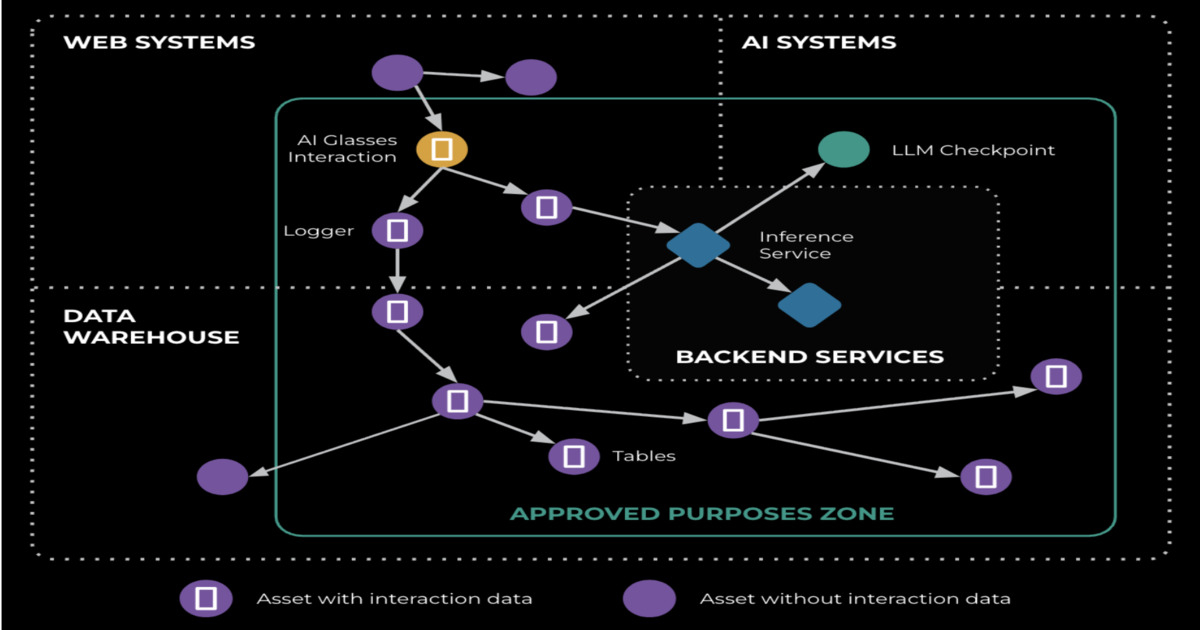
End-to-end lineage for AI-glasses interaction(Source : Meta Tech Blog)

A key component of this infrastructure is large-scale data lineage. Meta engineers explained that lineage tracking provides them visibility into where data originates, how it propagates across systems, and how downstream services, including AI training and inference pipelines, consume it. This visibility enables continuous evaluation of privacy policies as data flows through batch processing, real-time services, and generative AI workloads.

To support lineage at scale, a shared privacy library, PrivacyLib, is embedded across infrastructure layers. Engineers detailed how the library instruments data reads and writes, and emits metadata linked into a centralized lineage graph. Standardizing the capture of privacy metadata allows policy constraints to be evaluated consistently without requiring individual teams to implement custom logic.

Lineage observability via PrivacyLib (Source: Meta Tech Blog)

Policy-based controls have also been added to govern how data can be stored, accessed, and used for specific purposes. These controls evaluate data flows at runtime, detecting and responding to violations as they occur. Enforcement actions can include logging, blocking prohibited flows, or routing data through approved pathways, engineers outlined.

From lineage to proof via Policy Zones (Source: Meta Tech Blog)

Meta’s engineer describes this infrastructure as supporting GenAI-enabled products that generate continuous streams of interaction and sensor data, including wearable devices, and how privacy infrastructure allowed Meta products to evolve without introducing manual approval bottlenecks, while still enforcing constraints on data usage, retention, and downstream processing.

Privacy workflows are organized around four stages: understanding data, discovering data flows, enforcing policies, and demonstrating compliance. These stages are supported by automated tooling that produces audit artifacts and compliance evidence as part of normal system operation.

According to Meta engineers, scaling privacy for generative AI is an ongoing effort. As AI capabilities advance, enhanced lineage analysis and developer-facing tools are being integrated to manage increasingly complex data flows and support privacy enforcement across systems. PAI continues to evolve to meet these demands while enabling the development of AI-powered products without introducing manual bottlenecks.


Sign Up For Daily Newsletter

Be keep up! Get the latest breaking news delivered straight to your inbox.
By signing up, you agree to our Terms of Use and acknowledge the data practices in our Privacy Policy. You may unsubscribe at any time.
Share This Article
Facebook Twitter Email Print
Share
What do you think?
Love0
Sad0
Happy0
Sleepy0
Angry0
Dead0
Wink0
Previous Article UK study to examine effects of restricting social media for children UK study to examine effects of restricting social media for children
Next Article I Treated the Human Genome as a Legacy Codebase—Here’s What I Found | HackerNoon I Treated the Human Genome as a Legacy Codebase—Here’s What I Found | HackerNoon
Leave a comment

Leave a Reply Cancel reply

Your email address will not be published. Required fields are marked *

Stay Connected

248.1k Like
69.1k Follow
134k Pin
54.3k Follow

Latest News

How CyberArk Protects AI Agents with Instruction Detectors and History-Aware Validation
News
How to create a social media report [free template included]
Computing
Champions League Soccer: Livestream Real Madrid vs. Monaco Live From Anywhere
News
Why Pure AI Agents Fail in B2B (and How To Build Deterministic Workflows) | HackerNoon
Computing

You Might also Like

How CyberArk Protects AI Agents with Instruction Detectors and History-Aware Validation
News

How CyberArk Protects AI Agents with Instruction Detectors and History-Aware Validation

4 Min Read
Champions League Soccer: Livestream Real Madrid vs. Monaco Live From Anywhere
News

Champions League Soccer: Livestream Real Madrid vs. Monaco Live From Anywhere

9 Min Read
New £20m space hub opens in Buckinghamshire – UKTN
News

New £20m space hub opens in Buckinghamshire – UKTN

2 Min Read
Will the iPhone 18 have a Dynamic Island? Leakers contradict each other
News

Will the iPhone 18 have a Dynamic Island? Leakers contradict each other

3 Min Read
//

World of Software is your one-stop website for the latest tech news and updates, follow us now to get the news that matters to you.

Quick Link

  • Privacy Policy
  • Terms of use
  • Advertise
  • Contact

Topics

  • Computing
  • Software
  • Press Release
  • Trending

Sign Up for Our Newsletter

Subscribe to our newsletter to get our newest articles instantly!

World of SoftwareWorld of Software
Follow US
Copyright © All Rights Reserved. World of Software.
Welcome Back!

Sign in to your account

Lost your password?