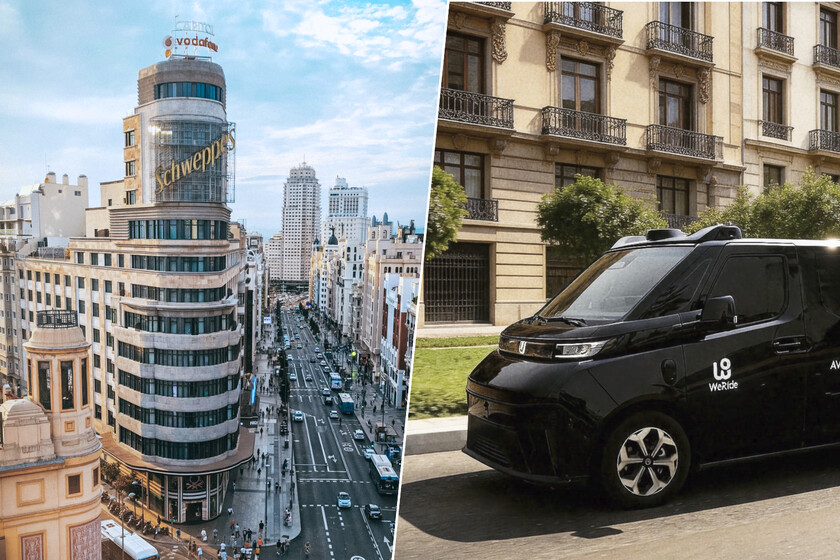
Robotaxis will arrive in Madrid before the end of the year. That is the headline you can read in the vast majority of media outlets. This has been made known by Uber, which has published the announcement on its own website.
There’s just one small problem: very few things are clear.
The advertisement. With a press release that you can read on its own website. This is how Uber has announced that its robotaxis, in collaboration with WeRide and Avomo, will arrive in Madrid. In their press release they talk about collaboration with the regional government and the intention to launch the service before the end of the year.
And little else.
The information provided by the company about the project is, basically, that. It is barely mentioned that this is a pilot project and that they are willing to add “hundreds of robotaxis” as “key performance milestones are met” to “expand the commercial driverless taxi service to all urban areas.”
many doubts. However, in the information that has been published there are many doubts that remain unresolved. In We have contacted Uber and WeRide but as of this writing we have not received answers to the following questions:
- How many cars will be available in the first phase?
- Will it be a service open to the entire city or will it be limited to specific neighborhoods in Madrid?
- Do Uber and WeRide already have permission to operate cars without a person on board?
- Will anyone be able to request a driverless vehicle to reach their destination?
What the DGT says. The one who has answered our questions is the DGT. The organization assures us that they have no evidence that Uber or any other company associated with this project has requested permission to carry out tests of autonomous driverless cars.
They also emphasize that, at this time, the companies in charge can only operate in “Test Mode” and, of course, “as long as they have been authorized to do so.” The latter, according to the DGT, has not occurred.

What are the deadlines approved by the DGT? In its statement, Uber only mentions driverless vehicles but the DGT refers us to the phases already approved to be able to carry out this type of tests. In these phases the most important points are the following:
- Controlled phase: no more than three autonomous cars and always with a safety operator behind the wheel.
- Extensive phase: no more than 10 vehicles and always with an operator behind the wheel.
- Pre-deployment phase: the limit of 10 vehicles is eliminated and the operator behind the wheel is optional but always has to supervise a remote operator.
Right now, the only company that is in the “pre-deployment” phase is Tesla, which is testing its FSD with 30 vehicles and they have freedom of movement throughout the national territory.

In collaboration with the Community of Madrid. In the text published by Uber it is mentioned that the arrival of the robotaxis to Madrid will be carried out “in collaboration with the Government of the Community of Madrid.” In We have tried to contact this party but have not received a response either.
And, let’s talk about roads of regional or municipal ownership, the DGT has to give the go-ahead to be able to carry out this type of tests on Spanish soil. At first, from Expansion It was pointed out that two other municipalities, in addition to Madrid, would join the arrival of the aforementioned robotaxis and that companies such as Cabify or Bolt have also shown interest. At the moment, there is no more news on this.

Europa. While in the United States and China the use of robotaxis is beginning to be normalized, Europe continues to be a forbidden field for them. Tesla has been pushing for approval for its FSD for some time, publishing videos collected in its tests in spaces as complicated to manage as Paris, Rome… or Madrid.
The other test that had attracted attention is the pilot project that is being carried out in Zagrev (Croatia). There, 10 Arcfox Alpha T5 cars from the Chinese manufacturer BAIC offer commercial driverless taxi services, powered by the Chinese artificial intelligence company Pony.AI.
Beyond. In China, as we say, the use of robotaxis is beginning to be widespread. Baidu’s Apollo Go, WeRide and Pony.AI have driverless vehicles that offer commercial services in cities such as Wuhan, Beijing, Shenzhen or Shanghai. However, the Chinese Government itself is slowing the arrival of automation in private cars, especially after accidents involving some cars that had driving assistance functions active.
In the United States, San Francisco and Texas or Los Angeles are the large places where autonomous taxis are tested. However, as the DGT suggests, the tests there began with humans at the wheel. And in some cases the service is limited in space and does not reach the entire city.
Some doubts. The robotaxis service is one of the sectors that has moved and leveraged the most money in recent years. Also the one who has frustrated the most promises and burned money. Billions of euros later and after a decade of intensive development, its availability remains exceptional.
Furthermore, robotaxis continue to generate doubts in the user. Transversal doubts from the moral dilemma to the purely practical debate. And in cities like San Francisco, the service is seen by many as an enemy not only because of its ability to eliminate human jobs, but also because of the problems it generates on a daily basis if faced with an unforeseen event or, simply, if a blackout occurs.
And in China they have also verified what happens when a system failure occurs and a hundred robotaxis freeze in the middle of traffic. Some, frozen in the middle of a road with traffic on both sides.
Photo | Jordi Moncasi and Uber
In | Waymo’s self-driving cars have started honking at each other. At 4 in the morning