More than a year since he returned to the White House vowing to end the Russia-Ukraine War within 24 hours, US President Donald Trump remains upbeat about the prospect of peace. “Very, very good talks today,” Trump stated on February 6 following the latest round of negotiations in Abu Dhabi. “Something could be happening.”
Few in Kyiv share this optimism. While Ukrainian officials are loathe to dismiss Trump’s peace efforts for fear incurring his displeasure, a majority of Ukrainians remain utterly unconvinced that Russian President Vladimir Putin has any interest whatsoever in ending hostilities. A poll conducted by Kyiv’s International Institute of Sociology in late January found that only 20 percent of Ukrainians think the war will end by July, while 43 percent expect fighting to continue into 2027 or beyond.
Such skepticism is easy to understand. Ukraine agreed to an unconditional ceasefire way back in March 2025, but Putin has so far refused to follow suit. Instead, he has spent much of the past year engaging in blatant stalling tactics while constantly moving the diplomatic goalposts in a transparent bid to prevent any progress toward a lasting settlement. This has resulted in what most Ukrainians and many others regard as a phony peace process.
As fruitless US-led negotiations rumble on, Putin has underlined his true intentions by dramatically increasing Russian attacks on the Ukrainian population, leading to a 31 percent surge in civilian casualties during 2025. The most recent escalation saw Russia attempt to freeze millions of Ukrainians in their own homes by systematically bombing critical heating and power infrastructure amid Arctic conditions. Some believe this ruthless winter bombing campaign qualifies as an act of genocide; it is most certainly not the act of a man seeking a compromise peace.
Trump has difficulty reading Putin because he fundamentally misunderstands the motivations behind the Russian invasion of Ukraine. To Trump, the current negotiations are a geopolitical real estate deal, with the Russians playing hardball to secure better terms. In reality, however, Putin is operating on a completely different wavelength altogether.
The Kremlin dictator is not looking to make deals, acquire additional land, or push the Russian border a few hundred kilometers to the west. Instead, he wants to secure his place in history. Putin genuinely believes he is on an historic mission to reverse the injustice of the Soviet collapse and revive the Russian Empire. In order to achieve this, he has convinced himself that he must erase Ukraine as a state and as a nation.
For more than two decades, Putin’s Ukraine obsession has shaped his reign and defined Russian foreign policy. His relationship with the West first became openly hostile in the aftermath of Ukraine’s 2004 Orange Revolution, which Putin bitterly denounced as a Western plot to destabilize Russia. Since that watershed moment, Ukraine has been at the heart of virtually every single new crisis in relations between Moscow and the democratic world, from the 2014 seizure of Crimea to the full-scale invasion of 2022. Throughout this period, Putin has repeatedly demonstrated his readiness to sacrifice all other Russian national interests in pursuit of his anti-Ukrainian crusade.
Meanwhile, he has used the full weight of the formidable Kremlin propaganda machine to poison Russian society against all things Ukrainian and prepare the ground for a war of national extermination. Putin has become notorious for insisting that Ukrainians are actually Russians (“one people”), and has dismissed independent Ukraine as an illegitimate state and an artificial “anti-Russia.” Anyone in Ukraine who dares to disagree has been dehumanized and branded a Nazi. This hate campaign has proved remarkably successful and has led to an almost complete absence of visible anti-war sentiment in today’s Russia, despite widespread public knowledge of the atrocities taking place in Ukraine.
Ukraine’s importance to Putin is twofold. As the largest non-Russian former Soviet republic by population and the closest to Russia in terms of shared heritage, Putin sees Ukraine as the key to undoing the verdict of 1991. If he can end what he regards as the aberration of Ukrainian statehood, this will redeem Russia and reestablish the country’s credentials as a great power.
Likewise, Ukraine’s perceived closeness means that the further consolidation of an independent and democratic Ukrainian state represents an existential threat to authoritarian Russia. As a KGB officer in East Germany during the late 1980s, Putin witnessed firsthand how grassroots movements could topple empires. If Ukraine’s transition from Kremlin vassal to European democracy continues, it could serve as a catalyst for the next stage in a Russian imperial retreat that begin in 1989 with the fall of the Berlin Wall.
This helps to explain why Putin has shown so little interest in the seemingly generous peace terms proposed by Trump. The US leader has indicated that Russia would be allowed to retain captured territories in Ukraine while facing no meaningful consequences for launching the largest European invasion since World War II. At first glance, these terms might appear to represent a major Russian victory, but Putin himself obviously does not think so.
Putin’s reluctance to accept Trump’s offer makes perfect sense when viewed from the perspective of the Russian ruler’s revisionist worldview and imperial ambitions. Crucially, Putin is doubtless well aware that any peace deal based on the current front lines of the war would leave 80 percent of Ukraine beyond Kremlin control and free to integrate into the democratic world. That is exactly what Putin is fighting to prevent.
In line with the present proposals, the Kremlin would confirm control over the rust belt towns of the Donbas, but would permanently cede iconic Odesa and sacred Kyiv, the mother city of all Russia, to a hostile neighbor. Most Russians would regard such an outcome as a defeat of historic proportions. Instead of being remembered as a new Peter the Great, Putin would be doomed to enter Russian history as the man who lost Ukraine.
Eurasia Center events

With a compromise peace out of the question, Putin has no real choice but to fight on. Doing so offers some obvious advantages. As long as the war continues, Putin can delay a reckoning over the huge Russian losses incurred in Ukraine in terms of soldiers, wealth, and prestige. But as the fourth anniversary of the invasion draws near, it is becoming increasingly difficult to disguise the fact that things are not going according to plan.
Putin’s problems are most immediately apparent on the battlefield. When he launched the full-scale invasion in February 2022, Putin vowed to “demilitarize” Ukraine. Four years on, Ukraine now boasts the largest army in Europe and has emerged as a world leader in drone warfare.
The radically upgraded Ukrainian military has already defeated Russia in multiple major engagements and is now seeking to gain the upper hand as the defender in a grueling high-tech war of attrition. Putin’s army suffered hundreds of thousands of casualties in 2025, while seizing less than one percent of Ukraine. At the current glacial pace, it would take the Russian military decades to conquer Ukraine.
In public, Putin continues to project confidence, but his boasts of battlefield dominance now ring hollow. With so few actual victories to cheer, he has resorted to inventing imaginary advances. Putin’s habit of exaggerating Russian gains came back to haunt him in late 2025 when he repeatedly claimed to have captured the Ukrainian city of Kupyansk, only for Ukrainian President Volodymyr Zelenskyy to personally visit the city and record a selfie video exposing the Russian ruler’s lies. This embarrassing episode underlined the growing credibility gap between Putin’s bold talk of inevitable Russian victory and the far less impressive battlefield reality of his faltering invasion.
Putin’s other stated war aim was the “denazification” of Ukraine. This is Kremlin code for the erasure of a separate Ukrainian national identity and the imposition of Russian imperial doctrine in every sphere of public life, from education and culture to politics and religion. If this was the intention, it has backfired disastrously. The war has fueled an unprecedented consolidation of Ukrainian patriotism alongside a wholesale rejection of all things Russian. As a result, the entire notion of a future pro-Kremlin government in Kyiv is now inconceivable unless propped up indefinitely by Russian bayonets, which would be ruinously expensive for the Kremlin.
This geopolitical divorce is also evident in the international arena. For centuries, Ukraine was widely seen by the outside world as indivisible from Russia itself. Putin still clings to this imperial mythology, but his propaganda slogans of “brotherly nations” now sound absurdly outdated. Instead, today’s Ukraine is widely recognized as an emerging European democracy with an absolutely indispensable role to play in the continent’s future security.
Russia’s sheer size means that it remains a formidable threat and will likely continue to grind forward in Ukraine. At the same time, after nearly four years of limited progress and staggering losses, it is now becoming increasingly difficult to imagine how Putin could achieve his maximalist goals in Ukraine via military means.
Many Russians had pinned their hopes on a new Trump presidency, but even the dramatic reduction in US military aid for Ukraine over the past year has failed to produce any significant Russian battlefield breakthroughs. Furthermore, US weapons continue to flow to Ukraine via the PURL initiative, with indications that the White House has also relaxed earlier restrictions on strikes inside Russia.
America’s withdrawal from transatlantic commitments also means European leaders are now more motivated than ever to maintain their support for Ukraine in the coming years. With Ukraine’s own revitalized defense industry meeting around half of the country’s military needs domestically, Kyiv looks well able to continue defending itself.
As the war enters a fifth year, Putin finds himself in an unenviable predicament. He has no obvious pathway to victory but cannot agree to a compromise settlement without acknowledging what would amount to an historic defeat. Faced with a bloody quagmire on the front lines, he will seek to break Ukrainian resistance by escalating attacks on the general population, while at the same time attempting to bribe the United States with wild proposals and bully Europe into inaction.
If President Trump is serious about ending the war, he needs to recognize that his Russian counterpart simply cannot risk a compromise peace. Putin knows that if Ukraine survives, he loses. A sustainable peace deal will therefore only be possible if he comes under significantly more pressure and is confronted with the prospect of a fate far worse than failure in Ukraine.
Putin will abandon his invasion when he begins to fear that continuing the war could threaten the future of his regime and the stability of Russia itself. The current occupant of the Kremlin still dreams of emulating Stalin and Katherine the Great, but he has no desire to become the next Tsar Nicholas II.
Peter Dickinson is editor of the ’s UkraineAlert service.
The views expressed in UkraineAlert are solely those of the authors and do not necessarily reflect the views of the , its staff, or its supporters.

The Eurasia Center’s mission is to enhance transatlantic cooperation in promoting stability, democratic values, and prosperity in Eurasia, from Eastern Europe and Turkey in the West to the Caucasus, Russia, and Central Asia in the East.
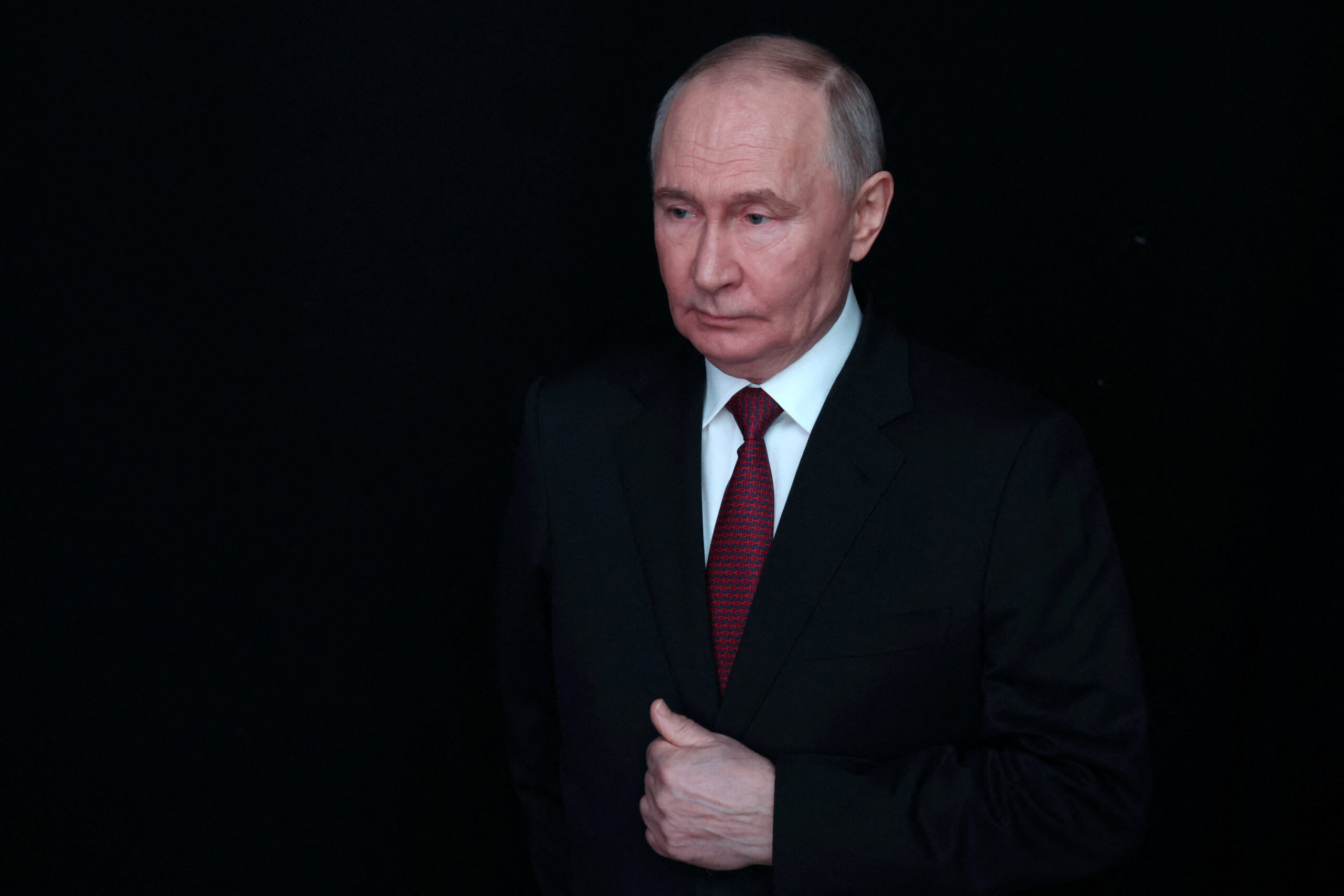
Image: Russian President Vladimir Putin arrives for a ceremony to launch the Year of the Unity of the Peoples of Russia in Moscow, Russia. February 5, 2026. )Sputnik/Vyacheslav Prokofyev/Pool via REUTERS)