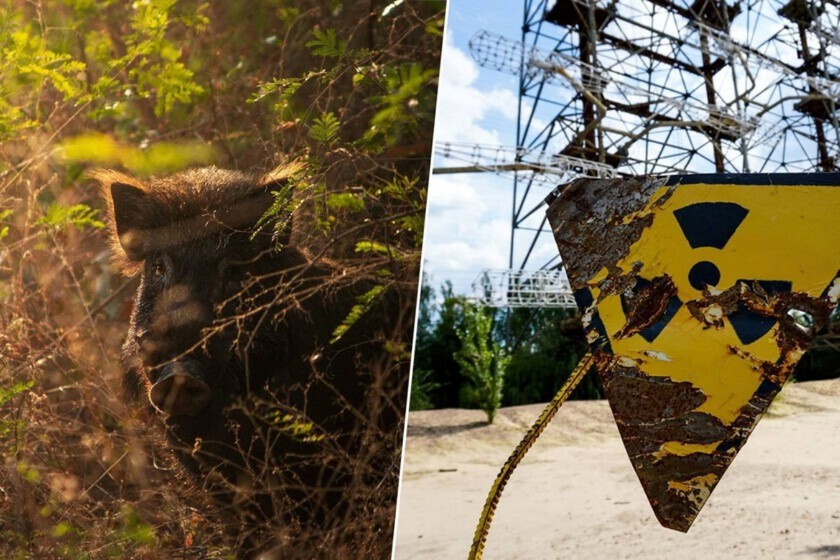
When we think about animals and radiation, our minds may imagine a three-eyed fish from The Simpsons or gigantic beasts from science fiction movies. But the reality is that those areas of the planet that have suffered a radioactive disaster present a much more complex and often more fascinating reality from an evolutionary point of view.
The data. Decades after the Chernobyl accidents in 1986, Fukushima in 2011 and the historic disasters in Mayak, science has begun to collect enough data to understand what happens when fauna retakes “exclusion zones” that have been abandoned by humans. The most recent studies tell us that there are no monsters, but there are accelerated genetic changes, forced adaptations and physiological scars.
The Chernobyl case. The Chernobyl Exclusion Zone has become an involuntary nature reserve, since, without humans, fauna has proliferated, but genetic studies tell a story of invisible stress. One of the most classic and revealing studies focuses on the barn swallow, since far from being immune, these birds have acted as bioindicators of the disaster.
Research has documented an unusually high frequency of partial albinism in its plumage, an outward sign of genetic instability. In this case, an increase in the germline mutation rate of between 2 and 10 times has been recorded compared to control areas in Italy or uncontaminated rural Ukraine. As a result, between 1991 and 2006, high frequencies of physical abnormalities were documented in adults, suggesting that radiation continues to exert constant selective pressure.
The case of the dogs. In Chernobyl, perhaps the most surprising discovery in recent years comes from the descendants of pets that were abandoned during the evacuation. A recent genomic analysis of feral dogs living near the nuclear power plant shows a genetic makeup distinct from dogs living in the city of Chernobyl, just a few kilometers away.
In this case, scientists have identified changes in candidate genes such as XRCC4, essential for DNA repair. This suggests a multigenerational selection where the dogs with the best mechanisms to repair cellular damage caused by radiation are those that have managed to survive and reproduce. In this case, a meta-analysis covering 45 studies and 30 species confirms that the effect on mutation rates is large and persistent, being curiously stronger in plants than in animals.
The case of Fukushima. If we go to Japan, it is where we find one of the most recent nuclear disasters and it is where we have been allowed to observe the immediate impact and the medium-term adaptation of nature. One of the most notable points is found in a new study published in January of this same year, which tells how thousands of domestic pigs escaped from their abandoned farms and began to mate with wild boars in the forest.
Here it is pointed out that this encounter not only produced hybrids between pigs and wild boars, but has accelerated the biology of these animals. And we are not facing “radioactive mutants” like the three-eyed fish from The Simpsons, but rather something biologically more interesting: an accelerated reproduction machine that has managed to dilute its domestic genes in record time.
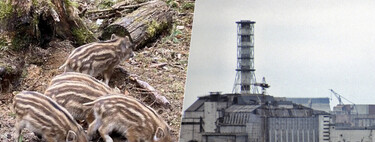
How it looked. The researchers analyzed the mitochondrial DNA, which is inherited only from the mother, and also the nuclear DNA of 191 wild boars and 10 pigs in the area between 2015 and 2018. The results suggested that, although the hybrids look like wild boars, many hide a secret in their maternal lineage.
The key to this is the biological difference between both species, since, although the wild boar has a strict annual breeding season, domestic pigs have a continuous reproductive cycle to breed all year round. From here, it has been seen that hybrids that descend from a mother pig inherit this rapid reproductive cycle, which has caused a dizzying generational rotation by detecting more than five generations of hybrids in just a few years after the disaster. In short, wild boars have seen their reproduction accelerate when a few years ago it was much slower.
A genetic paradox. Here comes the most curious part of the study, since if these animals reproduce so much, why don’t we see pigs everywhere in Fukushima? The answer lies in massive backcrossing in the genetic field. And the population of wild boars in the area is immensely higher than that of pigs escaped from farms, so hybrids almost always end up mating with pure wild boars.
In this way, if hybrid mothers have many offspring thanks to their domestic “engine” and those offspring are crossed again with wild boars, the result is that the pig’s nuclear DNA, which defines appearance and most traits, is quickly diluted.
An evolutionary improvement. With this dilution, the study indicates that, although the mitochondrial DNA reveals the domestic origin of these new wild boars, the nuclear genome and its appearance are almost indistinguishable from that of a wild boar. This is why they are, for all practical purposes, reproductively “improved” wild boars that have erased their visual domestic pig trace.
The case of the butterfly. If we continue in Fukushima, we find another interesting case in the butterfly pale grass blue which was monitored between 2011 and 2013. In this case, a reduction in the size of the butterfly’s wings and a delay in growth was observed, which was combined with the appearance of deformities in the eyes and wings.
After the initial spike of anomalies, the population appeared to stabilize, but this suggests a “purge” process: the most sensitive individuals died quickly, leaving a more resilient surviving population, an example of accelerated evolutionary adaptation.
The Mayak disaster. Although few people know it, before Chernobyl there was this disaster that received very little media attention and which had as its protagonist the Techa River in the Urals (Russia). Here, between 1949 and 1952, waste was dumped, creating a historical laboratory for chronic exposure.
Technical reports and dose modeling in aquatic organisms such as fish in the Obi-Techa river system remind us that radioactive contamination in water creates a different exposure cycle, much more difficult to contain than on land, affecting benthic fauna and fish for decades beyond the original incident.
The Spanish case. Although there has not been any nuclear war in our country, we have had contact with these devices. The incident in question occurred in 1966 when four thermonuclear bombs fell after a plane accident, but without exploding. And although it did not explode, there was a plutonium leak that led to decontamination.
In this context, a technical report from CIEMAT and the DOE in 2006 detected radiation levels above normal in snails and invertebrate fauna in the area, although at the moment no significant morphological alterations have been seen.
Semipalatinsk. For 40 years it was the USSR’s nuclear testing ground in Kazakhstan, and cytogenetic studies have found stable chromosomal aberrations not only in humans, but also evidence of elevated mutagenesis and morphological changes in the local fauna that has inhabited the explosion crater for generations.
Imagenes | Harshit Suryawanshi
In WorldOfSoftware | After analyzing more than 4,000 ancient genomes, what we knew about Neanderthals changes: there was a “hybrid zone” of 4,000 kilometers