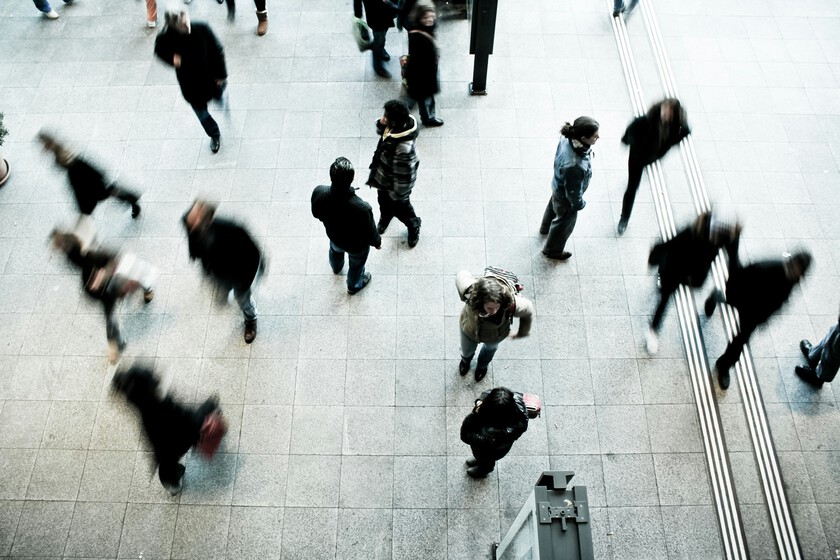
It’s a matter of a moment. You’re walking down the sidewalk, thinking about your things, maybe you look at your phone, and suddenly there’s something in front of you. It doesn’t matter if it’s a bollard, a person, a kiosk or a baby stroller. You have to avoid it, you have to do it now. Now. And, probably, you are going to the left.
And it seems that you decided it, but that decision was already made long before that walk down the street. A few days ago, a research team led by the University of Navarra has shown that, when wandering freely, pedestrians tend to turn counterclockwise and that this tendency is robust, cross-cultural and of individual origin (not a pattern that emerges from group interaction).
Turn left. The team showed that the tendency to turn left occurred in 32 of the 33 experiments they conducted. The only exception was in a study in Japan where the result was 50 to 50.
According to the authors, bias appears “almost immediately” in around 80% of people; when tested walking alone, 75% still deviate to the left. Furthermore, it is something individual: it does not matter whether the person walks alone or in the middle of a crowd. The bias appears exactly the same.
And this is what’s interesting because, basically, it turns upside down what we think we know about “pedestrian dynamics.”
And why is this happening? That’s the big question. Researchers rule out many things. It is not a product of manual laterality (being right or left-handed), foot laterality or ocular dominance. There are also no differences between sexes or between cultures. It doesn’t matter what the venue is like (whether it’s an open-air esplanade or a tiny patio full of walls), it doesn’t matter what avoidance maneuvers pedestrians use and, of course, it doesn’t matter what social norms they learn.
Furthermore, if we ask pedestrians where they think they should go, most of them say the opposite of what they end up doing.
What researchers do not do is propose a closed mechanism to explain it. In other words, we don’t know.
And what is it for? The most important implications for the design of spaces. As the authors explain, airports, stations, museums, shopping centers or squares could be designed in favor of the counterclockwise bias.
Obviously, not everyone always turns left. What the authors are saying is that, statistically, the probability of turning to the right is lower. The logic is simple: if we take that into account, the dynamics of public spaces can be more fluid.
We already know that in evacuations or highly scheduled environments, other mechanisms can override the counterclockwise bias. But the idea is not that, it is to use the bias in favor.
Imagen | Timon Studler
In | There’s a reason why working out for an hour a day at the gym doesn’t give you results. And that reason is evolution